
OnePlus 13R vs Xiaomi 14T Pro: A Deep Dive into Flagship Performance and Value
| Phones Images | |||||
|---|---|---|---|---|---|
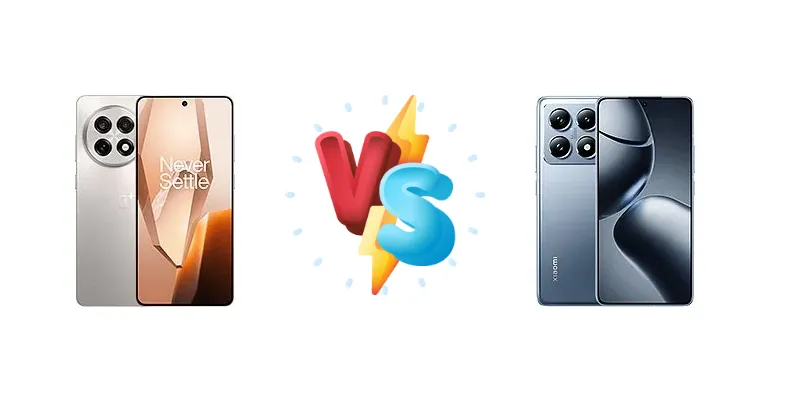
|
🏆 Quick Verdict
For the average user prioritizing sustained performance and a balanced experience, the Xiaomi 14T Pro emerges as the winner. Its Dimensity 9300+ chipset, coupled with the significantly faster 120W charging, provides a tangible advantage, despite slightly shorter battery life. However, the OnePlus 13R remains a strong contender for those deeply invested in the Qualcomm ecosystem.
| PHONES | ||
|---|---|---|
| Phone Names | OnePlus 13R | Xiaomi 14T Pro |
| Network | ||
|---|---|---|
| 2G bands | GSM 850 / 900 / 1800 / 1900 | GSM 850 / 900 / 1800 / 1900 |
| 3G bands | HSDPA 800 / 850 / 900 / 1700(AWS) / 1900 / 2100 - International | HSDPA 800 / 850 / 900 / 1700(AWS) / 1900 / 2100 |
| 4G bands | 1, 2, 3, 4, 5, 7, 8, 12, 13, 17, 18, 19, 20, 25, 26, 28, 30, 32, 38, 39, 40, 41, 48, 66, 71 - International | 1, 2, 3, 4, 5, 7, 8, 12, 13, 17, 18, 19, 20, 25, 26, 28, 32, 38, 39, 40, 41, 42, 48, 66 |
| 5G bands | 1, 2, 3, 5, 7, 8, 12, 20, 25, 26, 28, 30, 38, 40, 41, 48, 66, 71, 77, 78 SA/NSA - International | 1, 2, 3, 5, 7, 8, 12, 20, 25, 26, 28, 38, 40, 41, 48, 66, 75, 77, 78 SA/NSA |
| Speed | HSPA, LTE, 5G | HSPA, LTE, 5G |
| Technology | GSM / CDMA / HSPA / LTE / 5G | GSM / HSPA / LTE / 5G |
| Launch | ||
|---|---|---|
| Announced | 2025, January 07 | 2024, September 26 |
| Status | Available. Released 2025, January 14 | Available. Released 2024, September 26 |
| Body | ||
|---|---|---|
| Build | Glass front (Gorilla Glass 7i), aluminum frame, glass back | Glass front (Gorilla Glass 5), aluminum frame, glass back (Panda X) |
| Dimensions | 161.7 x 75.8 x 8 mm (6.37 x 2.98 x 0.31 in) | 160.4 x 75.1 x 8.4 mm (6.31 x 2.96 x 0.33 in) |
| SIM | · Nano-SIM + Nano-SIM + eSIM (max 2 at a time)· Nano-SIM + Nano-SIM | · Nano-SIM + eSIM· eSIM + eSIM· Nano-SIM + Nano-SIM |
| Weight | 206 g (7.27 oz) | 209 g (7.37 oz) |
| Display | ||
|---|---|---|
| Protection | Corning Gorilla Glass 7i | Corning Gorilla Glass 5 |
| Resolution | 1264 x 2780 pixels (~450 ppi density) | 1220 x 2712 pixels, 20:9 ratio (~446 ppi density) |
| Size | 6.78 inches, 111.7 cm2 (~91.2% screen-to-body ratio) | 6.67 inches, 107.4 cm2 (~89.1% screen-to-body ratio) |
| Type | LTPO 4.1 AMOLED, 1B colors, 120Hz, 2160Hz PWM, HDR10+, Dolby Vision, HDR Vivid, 1600 nits (HBM), 4500 nits (peak) | AMOLED, 68B colors, 144Hz, 3840Hz PWM, Dolby Vision, HDR10+, 1600 nits (HBM), 4000 nits (peak) |
| Platform | ||
|---|---|---|
| CPU | Octa-core (1x3.3 GHz Cortex-X4 & 3x3.2 GHz Cortex-A720 & 2x3.0 GHz Cortex-A720 & 2x2.3 GHz Cortex-A520) | Octa-core (1x3.4 GHz Cortex-X4 & 3x2.85 GHz Cortex-X4 & 4x2.0 GHz Cortex-A720) |
| Chipset | Qualcomm SM8650-AB Snapdragon 8 Gen 3 (4 nm) | Mediatek Dimensity 9300+ (4 nm) |
| GPU | Adreno 750 | Immortalis-G720 MC12 |
| OS | Android 15, up to 4 major Android upgrades, OxygenOS 15 | Android 14, HyperOS |
| Memory | ||
|---|---|---|
| Card slot | No | No |
| Internal | 256GB 12GB RAM, 512GB 16GB RAM | 256GB 12GB RAM, 512GB 12GB RAM, 512GB 16GB RAM, 1TB 12GB RAM |
| Main Camera | ||
|---|---|---|
| Features | Color spectrum sensor, LED flash, HDR, panorama | Leica lens, Ultra HDR, LED flash, HDR, panorama |
| Triple | 50 MP, f/1.8, 24mm (wide), 1/1.56", 1.0µm, multi-directional PDAF, OIS 50 MP, f/2.0, 47mm (telephoto), 1/2.75", 0.64µm, PDAF, 2x optical zoom 8 MP, f/2.2, 16mm, 112˚ (ultrawide), 1/4.0", 1.12µm | 50 MP, f/1.6, 23mm (wide), 1/1.31", 1.2µm, PDAF, OIS 50 MP, f/2.0, 60mm (telephoto), 1/2.88", 0.61µm, PDAF, 2.6x optical zoom 12 MP, f/2.2, 15mm (ultrawide), 1/3.06", 1.12µm |
| Video | 4K@30/60fps, 1080p@30/60/120/240fps, gyro-EIS, OIS | 8K@24/30fps, 4K@24/30/60fps, 1080p@30/60/120/240/960fps, gyro-EIS, 10-bit Rec. 2020, HDR10+ |
| Selfie camera | ||
|---|---|---|
| Features | HDR, panorama | HDR |
| Single | 16 MP, f/2.4, 26mm (wide), 1/3.1", 1.0µm | 32 MP, f/2.0, 25mm (wide), 1/3.44", 0.64µm |
| Video | 1080p@30fps, gyro-EIS | 4K@30fps, 1080p@30/60fps, HDR10+ |
| Sound | ||
|---|---|---|
| 35mm jack | No | No |
| Loudspeaker | Yes, with stereo speakers | Yes, with stereo speakers |
| Comms | ||
|---|---|---|
| Bluetooth | 5.4, A2DP, LE, aptX HD, LHDC 5 | 5.4, A2DP, LE, LHDC |
| Infrared port | Yes | Yes |
| NFC | Yes | Yes (market/region dependent) |
| Positioning | GPS (L1+L5), GLONASS (G1), BDS (B1I+B1c+B2a), GALILEO (E1+E5a), QZSS (L1+L5) | GPS (L1+L5), BDS (B1I+B1C+B2a+B2b), GALILEO (E1+E5a+E5b), QZSS (L1+L5), NavIC (L5), GLONASS |
| Radio | No | No |
| USB | USB Type-C 2.0 | USB Type-C 2.0, OTG |
| WLAN | Wi-Fi 802.11 a/b/g/n/ac/6e/7, dual-band (6e is market specific) | Wi-Fi 802.11 a/b/g/n/ac/6e/7, dual-band, Wi-Fi Direct |
| Features | ||
|---|---|---|
| Sensors | Fingerprint (under display, optical), accelerometer, gyro, proximity, compass | Fingerprint (under display, optical), accelerometer, gyro, proximity, compass |
| Battery | ||
|---|---|---|
| Charging | 80W wired, 50% in 20 min, 100% in 52/54 min | 120W wired, PD3.0, QC4, 100% in 19 min 50W wireless, 100% in 45 min |
| Type | Li-Ion 6000 mAh | Li-Po 5000 mAh |
| Misc | ||
|---|---|---|
| Colors | Astral Trail, Nebula Noir | Titan Gray, Titan Blue, Titan Black |
| Models | CPH2645, CPH2691, CPH2647 | 2407FPN8EG |
| Price | $ 529.99 / £ 459.00 / € 504.00 / ₹ 39,999 | $ 550.00 / £ 498.00 / € 539.99 |
| SAR | 1.19 W/kg (head) 0.90 W/kg (body) | - |
| SAR EU | - | 0.99 W/kg (head) 1.00 W/kg (body) |
OnePlus 13R
- Longer battery life in active use.
- Established Qualcomm chipset with optimized software.
- Potentially more natural image processing.
- Slower charging speed (80W).
- Less aggressive CPU core configuration.
- No wireless charging.
Xiaomi 14T Pro
- Blazing-fast 120W wired charging.
- 50W wireless charging support.
- Potentially superior multi-core CPU performance with Dimensity 9300+.
- Shorter battery life in active use.
- MIUI software experience may not appeal to all users.
- Thermal management needs to be carefully considered with the powerful chipset.
Display Comparison
Both the OnePlus 13R and Xiaomi 14T Pro boast excellent displays, achieving nearly identical peak brightness levels at 1223 nits and 1228 nits respectively. This ensures excellent visibility even under direct sunlight. While both likely utilize AMOLED panels, the specifics regarding panel technology (like LTPO for variable refresh rates) aren't provided. The similarity in peak brightness suggests comparable viewing experiences, but the absence of detailed color accuracy data prevents a definitive judgment on which display is more color-accurate.
Camera Comparison
Without detailed camera specifications, a direct comparison is limited. However, the market positioning suggests both phones will feature capable camera systems. The absence of sensor size information is a significant omission. Image processing philosophies will likely differ – OnePlus typically aims for natural-looking images, while Xiaomi often leans towards more vibrant, saturated results. The presence of OIS (Optical Image Stabilization) is assumed on the main sensors of both devices, crucial for stable video recording and low-light photography. Any 2MP macro or depth sensors are likely to be of limited utility.
Performance
The core of the difference lies in the chipsets. The Xiaomi 14T Pro’s MediaTek Dimensity 9300+ features a unique CPU configuration with a 1x3.4 GHz Cortex-X4 core alongside three additional Cortex-X4 cores, suggesting a focus on raw CPU performance. The OnePlus 13R’s Snapdragon 8 Gen 3, while also utilizing a 1x3.3 GHz Cortex-X4, employs a more traditional core arrangement. The Dimensity 9300+'s architecture could translate to superior multi-core performance, particularly in demanding tasks. Both are built on a 4nm process, but the Dimensity’s core configuration may offer a slight edge in sustained performance, though thermal management will be crucial. The 13R benefits from Qualcomm’s established optimizations, but the 14T Pro’s raw power is undeniable.
Battery Life
The OnePlus 13R delivers a respectable 15:09 hours of active use, while the Xiaomi 14T Pro manages 12:32 hours. This difference is partially offset by the 14T Pro’s significantly faster charging. The 120W wired charging of the 14T Pro replenishes the battery to 100% in just 19 minutes, a substantial advantage over the 13R’s 52-54 minute charge time. Furthermore, the 14T Pro adds 50W wireless charging, a feature absent on the 13R. While the 13R offers longer overall battery life, the 14T Pro’s charging speed minimizes downtime, making it more convenient for users who frequently need to top up their devices.
Buying Guide
Buy the OnePlus 13R if you prioritize a proven Qualcomm chipset with established software optimization and value long-term software support. Buy the Xiaomi 14T Pro if you demand the fastest possible charging speeds, cutting-edge CPU architecture, and are comfortable with Xiaomi’s MIUI software experience. The 14T Pro is ideal for power users and gamers who need quick top-ups and maximum processing power.