
OnePlus 13R vs. vivo X100 Ultra: A Deep Dive into Battery, Display, and Performance
| Phones Images | |||||
|---|---|---|---|---|---|
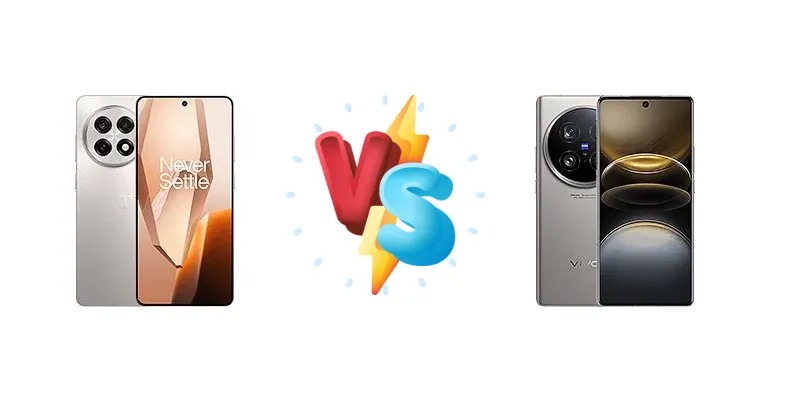
|
🏆 Quick Verdict
For the average user prioritizing all-day battery life, the OnePlus 13R emerges as the winner with its impressive 15:09-hour active use score. However, the vivo X100 Ultra’s significantly brighter display and broader charging options (including wireless) make it a compelling choice for media consumers and power users.
| PHONES | ||
|---|---|---|
| Phone Names | OnePlus 13R | vivo X100 Ultra |
| Network | ||
|---|---|---|
| 2G bands | GSM 850 / 900 / 1800 / 1900 | GSM 850 / 900 / 1800 / 1900 |
| 3G bands | HSDPA 800 / 850 / 900 / 1700(AWS) / 1900 / 2100 - International | HSDPA 800 / 850 / 900 / 1700(AWS) / 1900 / 2100 |
| 4G bands | 1, 2, 3, 4, 5, 7, 8, 12, 13, 17, 18, 19, 20, 25, 26, 28, 30, 32, 38, 39, 40, 41, 48, 66, 71 - International | 1, 2, 3, 4, 5, 7, 8, 12, 17, 18, 19, 20, 25, 26, 28, 34, 38, 39, 40, 41, 42, 66 |
| 5G bands | 1, 2, 3, 5, 7, 8, 12, 20, 25, 26, 28, 30, 38, 40, 41, 48, 66, 71, 77, 78 SA/NSA - International | 1, 2, 3, 5, 7, 8, 12, 20, 25, 26, 28, 38, 40, 41, 66, 77, 78, 79 SA/NSA |
| Speed | HSPA, LTE, 5G | HSPA, LTE, 5G |
| Technology | GSM / CDMA / HSPA / LTE / 5G | GSM / CDMA / HSPA / LTE / 5G |
| Launch | ||
|---|---|---|
| Announced | 2025, January 07 | 2024, May 13 |
| Status | Available. Released 2025, January 14 | Available. Released 2024, May 28 |
| Body | ||
|---|---|---|
| Build | Glass front (Gorilla Glass 7i), aluminum frame, glass back | Glass front, glass back, aluminum frame |
| Dimensions | 161.7 x 75.8 x 8 mm (6.37 x 2.98 x 0.31 in) | 164.1 x 75.6 x 9.2 mm (6.46 x 2.98 x 0.36 in) |
| SIM | · Nano-SIM + Nano-SIM + eSIM (max 2 at a time)· Nano-SIM + Nano-SIM | Nano-SIM + Nano-SIM |
| Weight | 206 g (7.27 oz) | 229 g (8.08 oz) |
| Display | ||
|---|---|---|
| Protection | Corning Gorilla Glass 7i | - |
| Resolution | 1264 x 2780 pixels (~450 ppi density) | 1440 x 3200 pixels, 20:9 ratio (~517 ppi density) |
| Size | 6.78 inches, 111.7 cm2 (~91.2% screen-to-body ratio) | 6.78 inches, 111.4 cm2 (~89.8% screen-to-body ratio) |
| Type | LTPO 4.1 AMOLED, 1B colors, 120Hz, 2160Hz PWM, HDR10+, Dolby Vision, HDR Vivid, 1600 nits (HBM), 4500 nits (peak) | LTPO AMOLED, 1B colors, 120Hz, Dolby Vision, HDR, 3000 nits (peak) |
| Platform | ||
|---|---|---|
| CPU | Octa-core (1x3.3 GHz Cortex-X4 & 3x3.2 GHz Cortex-A720 & 2x3.0 GHz Cortex-A720 & 2x2.3 GHz Cortex-A520) | Octa-core (1x3.3 GHz Cortex-X4 & 3x3.2 GHz Cortex-A720 & 2x3.0 GHz Cortex-A720 & 2x2.3 GHz Cortex-A520) |
| Chipset | Qualcomm SM8650-AB Snapdragon 8 Gen 3 (4 nm) | Qualcomm SM8650-AB Snapdragon 8 Gen 3 (4 nm) |
| GPU | Adreno 750 | Adreno 750 |
| OS | Android 15, up to 4 major Android upgrades, OxygenOS 15 | Android 14, upgradable to Android 15, OriginOS 5 |
| Memory | ||
|---|---|---|
| Card slot | No | No |
| Internal | 256GB 12GB RAM, 512GB 16GB RAM | 256GB 12GB RAM, 512GB 16GB RAM, 1TB 16GB RAM |
| Main Camera | ||
|---|---|---|
| Features | Color spectrum sensor, LED flash, HDR, panorama | Laser AF, color spectrum sensor, Zeiss optics, Zeiss T* lens coating, LED flash, panorama, HDR, 3D LUT import |
| Triple | 50 MP, f/1.8, 24mm (wide), 1/1.56", 1.0µm, multi-directional PDAF, OIS 50 MP, f/2.0, 47mm (telephoto), 1/2.75", 0.64µm, PDAF, 2x optical zoom 8 MP, f/2.2, 16mm, 112˚ (ultrawide), 1/4.0", 1.12µm | 50 MP, f/1.8, 23mm (wide), 1/0.98", 1.6µm, dual pixel PDAF, gimbal OIS 200 MP, f/2.7, 85mm (periscope telephoto), 1/1.4", 0.56µm, multi-directional PDAF, OIS, 3.7x optical zoom, macro 3.4:1 50 MP, f/2.2, 14mm, 116˚ (ultrawide), 1/2.0", 0.8µm, AF |
| Video | 4K@30/60fps, 1080p@30/60/120/240fps, gyro-EIS, OIS | 8K@30fps, 4K@30/60/120fps, 1080p@30/60/120/240fps, gyro-EIS, Dolby Vision HDR |
| Selfie camera | ||
|---|---|---|
| Features | HDR, panorama | HDR |
| Single | 16 MP, f/2.4, 26mm (wide), 1/3.1", 1.0µm | 50 MP, f/2.5, 24mm (wide), 1/2.76", 0.64µm, AF |
| Video | 1080p@30fps, gyro-EIS | 4K@30/60fps, 1080p@30/60fps |
| Sound | ||
|---|---|---|
| 35mm jack | No | No |
| Loudspeaker | Yes, with stereo speakers | Yes, with stereo speakers |
| Comms | ||
|---|---|---|
| Bluetooth | 5.4, A2DP, LE, aptX HD, LHDC 5 | 5.4, A2DP, LE, aptX HD, aptX Adaptive, aptX Lossless, LHDC |
| Infrared port | Yes | Yes |
| NFC | Yes | Yes |
| Positioning | GPS (L1+L5), GLONASS (G1), BDS (B1I+B1c+B2a), GALILEO (E1+E5a), QZSS (L1+L5) | GPS (L1+L5), BDS (B1I+B1c+B2a), GALILEO (E1+E5a), QZSS (L1+L5), GLONASS |
| Radio | No | No |
| USB | USB Type-C 2.0 | USB Type-C 3.2, OTG, DisplayPort |
| WLAN | Wi-Fi 802.11 a/b/g/n/ac/6e/7, dual-band (6e is market specific) | Wi-Fi 802.11 a/b/g/n/ac/6/7, dual-band |
| Features | ||
|---|---|---|
| Sensors | Fingerprint (under display, optical), accelerometer, gyro, proximity, compass | Fingerprint (under display, ultrasonic), accelerometer, gyro, proximity, compass |
| Battery | ||
|---|---|---|
| Charging | 80W wired, 50% in 20 min, 100% in 52/54 min | 80W wired, PD, PPS, QC, UFCS 30W wireless Reverse wired Reverse wireless |
| Type | Li-Ion 6000 mAh | Si/C Li-Ion 5500 mAh |
| Misc | ||
|---|---|---|
| Colors | Astral Trail, Nebula Noir | Titanium, White, Grey |
| Models | CPH2645, CPH2691, CPH2647 | V2366GA, V2366HA |
| Price | $ 529.99 / £ 459.00 / € 504.00 / ₹ 39,999 | About 980 EUR |
| SAR | 1.19 W/kg (head) 0.90 W/kg (body) | - |
OnePlus 13R
- Exceptional battery life (15:09h active use)
- Competitive price point
- Powerful Snapdragon 8 Gen 3 performance
- Lower peak display brightness
- Lacks wireless charging
vivo X100 Ultra
- Significantly brighter display (1801 nits)
- Versatile charging options (80W wired, 30W wireless, reverse charging)
- Potentially superior camera system (based on brand history)
- Shorter battery life (12:55h active use)
- Likely higher price
Display Comparison
The vivo X100 Ultra boasts a significantly brighter display, reaching a measured 1801 nits compared to the OnePlus 13R’s 1223 nits. This translates to superior visibility in direct sunlight, a crucial advantage for outdoor users. While both utilize high-refresh-rate panels (assumed, based on market positioning), the X100 Ultra’s higher peak brightness is the defining difference. We expect both to employ AMOLED technology, but the X100 Ultra’s brightness suggests a potentially more advanced panel generation or calibration. The impact of PWM dimming rates, not provided, would be important for users sensitive to flicker.
Camera Comparison
Context data lacks camera specifications, making a direct comparison impossible. However, given vivo’s history with camera innovation, particularly in sensor technology, the X100 Ultra is likely to feature a more advanced camera system. We anticipate a larger main sensor and potentially more sophisticated image processing algorithms. The OnePlus 13R will likely offer a competent camera experience, but may prioritize overall value over camera-centric features. Without sensor size or aperture information, it’s difficult to assess low-light performance or dynamic range.
Performance
Both the OnePlus 13R and vivo X100 Ultra are powered by the Qualcomm SM8650-AB Snapdragon 8 Gen 3 (4nm), featuring the same octa-core CPU configuration (1x3.3 GHz Cortex-X4, 3x3.2 GHz Cortex-A720, 2x3.0 GHz Cortex-A720, 2x2.3 GHz Cortex-A520). This means raw processing power will be nearly identical. Performance differences will likely stem from thermal management and RAM configuration (LPDDR5x is expected on both). The 4nm process node ensures relatively efficient power consumption, but sustained performance under heavy load will depend on each manufacturer’s cooling solution. Given the X100 Ultra’s focus on premium features, it may incorporate a more robust cooling system.
Battery Life
The OnePlus 13R delivers a substantial advantage in battery life, achieving 15:09 hours of active use compared to the vivo X100 Ultra’s 12:55 hours. This nearly 2.5-hour difference is significant for users who heavily utilize their smartphones throughout the day. Both devices support 80W wired charging, reaching 50% charge in approximately 20 minutes, and full charge in around 52-54 minutes for the 13R. However, the X100 Ultra adds 30W wireless charging, PD, PPS, QC, and UFCS, alongside reverse wired and wireless charging, offering greater versatility. The X100 Ultra’s charging flexibility comes at the cost of slightly reduced battery endurance.
Buying Guide
Buy the OnePlus 13R if you need exceptional battery life for demanding daily use, value a smooth and responsive experience without excessive cost, and prioritize longevity over cutting-edge display features. Buy the vivo X100 Ultra if you prefer a stunningly bright display for outdoor visibility and content consumption, desire the convenience of wireless charging and reverse wireless charging, and are willing to trade some battery endurance for these premium features.