
OnePlus 13R vs Realme GT 6: A Deep Dive into Performance, Battery, and Charging
| Phones Images | |||||
|---|---|---|---|---|---|
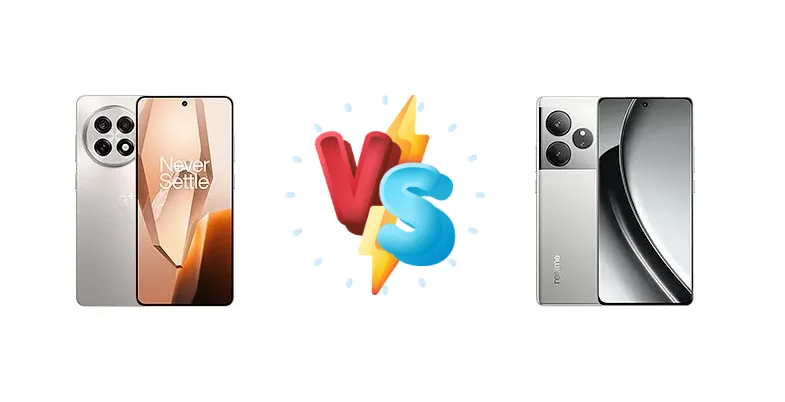
|
🏆 Quick Verdict
For the average user prioritizing sustained performance and longer battery life, the OnePlus 13R emerges as the winner. Its Snapdragon 8 Gen 3 chipset and 15:09 active use score provide a noticeable advantage, despite the Realme GT 6’s significantly faster 120W charging.
| PHONES | ||
|---|---|---|
| Phone Names | OnePlus 13R | Realme GT 6 |
| Network | ||
|---|---|---|
| 2G bands | GSM 850 / 900 / 1800 / 1900 | GSM 850 / 900 / 1800 / 1900 |
| 3G bands | HSDPA 800 / 850 / 900 / 1700(AWS) / 1900 / 2100 - International | HSDPA 800 / 850 / 900 / 1700(AWS) / 1900 / 2100 |
| 4G bands | 1, 2, 3, 4, 5, 7, 8, 12, 13, 17, 18, 19, 20, 25, 26, 28, 30, 32, 38, 39, 40, 41, 48, 66, 71 - International | 1, 2, 3, 4, 5, 7, 8, 12, 13, 17, 18, 19, 20, 26, 28, 38, 39, 40, 41, 66 |
| 5G bands | 1, 2, 3, 5, 7, 8, 12, 20, 25, 26, 28, 30, 38, 40, 41, 48, 66, 71, 77, 78 SA/NSA - International | 1, 3, 5, 7, 8, 20, 28, 38, 40, 41, 66, 77, 78 SA/NSA |
| Speed | HSPA, LTE, 5G | HSPA, LTE, 5G |
| Technology | GSM / CDMA / HSPA / LTE / 5G | GSM / HSPA / LTE / 5G |
| Launch | ||
|---|---|---|
| Announced | 2025, January 07 | 2024, June 20 |
| Status | Available. Released 2025, January 14 | Available. Released 2024, June 25 |
| Body | ||
|---|---|---|
| Build | Glass front (Gorilla Glass 7i), aluminum frame, glass back | Glass front (Gorilla Glass Victus 2), plastic frame, glass back |
| Dimensions | 161.7 x 75.8 x 8 mm (6.37 x 2.98 x 0.31 in) | 162 x 75.1 x 8.6 mm (6.38 x 2.96 x 0.34 in) |
| SIM | · Nano-SIM + Nano-SIM + eSIM (max 2 at a time)· Nano-SIM + Nano-SIM | Nano-SIM + Nano-SIM |
| Weight | 206 g (7.27 oz) | 199 g (7.02 oz) |
| Display | ||
|---|---|---|
| Protection | Corning Gorilla Glass 7i | Corning Gorilla Glass Victus 2 |
| Resolution | 1264 x 2780 pixels (~450 ppi density) | 1264 x 2780 pixels (~450 ppi density) |
| Size | 6.78 inches, 111.7 cm2 (~91.2% screen-to-body ratio) | 6.78 inches, 111.7 cm2 (~91.8% screen-to-body ratio) |
| Type | LTPO 4.1 AMOLED, 1B colors, 120Hz, 2160Hz PWM, HDR10+, Dolby Vision, HDR Vivid, 1600 nits (HBM), 4500 nits (peak) | LTPO AMOLED, 1B colors, 120Hz, HDR 10+, Dolby Vision, 1600 nits (HBM), 6000 nits (peak) |
| Platform | ||
|---|---|---|
| CPU | Octa-core (1x3.3 GHz Cortex-X4 & 3x3.2 GHz Cortex-A720 & 2x3.0 GHz Cortex-A720 & 2x2.3 GHz Cortex-A520) | Octa-core (1x3.0 GHz Cortex-X4 & 4x2.8 GHz Cortex-A720 & 3x2.0 GHz Cortex-A520) |
| Chipset | Qualcomm SM8650-AB Snapdragon 8 Gen 3 (4 nm) | Qualcomm SM8635 Snapdragon 8s Gen 3 (4 nm) |
| GPU | Adreno 750 | Adreno 735 |
| OS | Android 15, up to 4 major Android upgrades, OxygenOS 15 | Android 14, up to 3 major Android upgrades, Realme UI 5.0 |
| Memory | ||
|---|---|---|
| Card slot | No | No |
| Internal | 256GB 12GB RAM, 512GB 16GB RAM | 256GB 8GB RAM, 256GB 12GB RAM, 512GB 16GB RAM |
| Main Camera | ||
|---|---|---|
| Features | Color spectrum sensor, LED flash, HDR, panorama | Color spectrum sensor, Dual-LED flash, HDR, panorama |
| Triple | 50 MP, f/1.8, 24mm (wide), 1/1.56", 1.0µm, multi-directional PDAF, OIS 50 MP, f/2.0, 47mm (telephoto), 1/2.75", 0.64µm, PDAF, 2x optical zoom 8 MP, f/2.2, 16mm, 112˚ (ultrawide), 1/4.0", 1.12µm | 50 MP, f/1.7, (wide), 1/1.4", PDAF, OIS 50 MP, f/2.0, 47mm (telephoto), 1/2.8", PDAF 8 MP, f/2.2, 16mm, 112˚ (ultrawide), 1/4.0", 1.12µm |
| Video | 4K@30/60fps, 1080p@30/60/120/240fps, gyro-EIS, OIS | 4K@30/60fps, 1080p@30/60/120/240fps, gyro-EIS |
| Selfie camera | ||
|---|---|---|
| Features | HDR, panorama | Panorama |
| Single | 16 MP, f/2.4, 26mm (wide), 1/3.1", 1.0µm | 32 MP, f/2.5, 22mm (wide), 1/2.74" |
| Video | 1080p@30fps, gyro-EIS | 4K@30fps, 1080p@30fps |
| Sound | ||
|---|---|---|
| 35mm jack | No | No |
| Loudspeaker | Yes, with stereo speakers | Yes, with stereo speakers |
| Comms | ||
|---|---|---|
| Bluetooth | 5.4, A2DP, LE, aptX HD, LHDC 5 | 5.4, A2DP, LE, aptX HD, LHDC |
| Infrared port | Yes | Yes |
| NFC | Yes | Yes, 360˚ |
| Positioning | GPS (L1+L5), GLONASS (G1), BDS (B1I+B1c+B2a), GALILEO (E1+E5a), QZSS (L1+L5) | GPS (L1+L5), GLONASS, BDS, GALILEO, QZSS |
| Radio | No | No |
| USB | USB Type-C 2.0 | USB Type-C 2.0 |
| WLAN | Wi-Fi 802.11 a/b/g/n/ac/6e/7, dual-band (6e is market specific) | Wi-Fi 802.11 a/b/g/n/ac/6, dual-band |
| Features | ||
|---|---|---|
| Sensors | Fingerprint (under display, optical), accelerometer, gyro, proximity, compass | Fingerprint (under display, optical), accelerometer, gyro, proximity, compass |
| Battery | ||
|---|---|---|
| Charging | 80W wired, 50% in 20 min, 100% in 52/54 min | 120W wired, 50% in 10 min, 100% in 28 min |
| Type | Li-Ion 6000 mAh | 5500 mAh |
| Misc | ||
|---|---|---|
| Colors | Astral Trail, Nebula Noir | Fluid Sliver, Razor Green |
| Models | CPH2645, CPH2691, CPH2647 | RMX3851 |
| Price | $ 529.99 / £ 459.00 / € 504.00 / ₹ 39,999 | € 479.99 / $ 230.40 / £ 428.48 |
| SAR | 1.19 W/kg (head) 0.90 W/kg (body) | - |
OnePlus 13R
- Superior CPU performance with Snapdragon 8 Gen 3
- Longer battery life (15:09h active use)
- Higher peak display brightness (1223 nits)
- Slower charging speed (80W)
- Potentially higher price point
Realme GT 6
- Ultra-fast 120W charging (100% in 28 minutes)
- Competitive performance with Snapdragon 8s Gen 3
- Potentially more aggressive pricing
- Shorter battery life (14:32h active use)
- Slightly less powerful CPU compared to the 13R
Display Comparison
The OnePlus 13R boasts a display capable of reaching 1223 nits of peak brightness, ensuring excellent visibility even in direct sunlight. While the Realme GT 6 doesn’t provide a measured brightness figure, it advertises an 'Infinite' contrast ratio, suggesting a strong OLED panel. The lack of detailed display specs for the GT 6 makes a direct comparison difficult, but the 13R’s measured brightness gives it a clear advantage for outdoor use. Both are likely to utilize high refresh rate panels, common in this segment, but the 13R’s brightness is a quantifiable benefit.
Camera Comparison
Without detailed camera specifications, a direct comparison is limited. However, both phones likely feature multi-camera systems geared towards versatility. The focus should be on the main sensor size and aperture, as these significantly impact low-light performance. Given the price points, both are likely to employ image processing algorithms to enhance detail and dynamic range. The absence of information on OIS (Optical Image Stabilization) makes it difficult to assess video recording capabilities. We can assume both will include standard wide, ultrawide, and potentially macro lenses, but the quality will depend heavily on the sensor and processing.
Performance
The core difference lies in the chipsets. The OnePlus 13R’s Snapdragon 8 Gen 3 (SM8650-AB) features a 1x3.3 GHz Cortex-X4 prime core, supported by 3x3.2 GHz Cortex-A720 cores and 2x2.3 GHz Cortex-A520 cores. The Realme GT 6 utilizes the Snapdragon 8s Gen 3 (SM8635) with a 1x3.0 GHz Cortex-X4, 4x2.8 GHz Cortex-A720, and 3x2.0 GHz Cortex-A520 cores. The Gen 3’s higher clock speeds, particularly on the prime core, translate to faster single-core performance. While both are built on a 4nm process, the Gen 3 generally offers superior thermal management, reducing the likelihood of performance throttling during prolonged intensive tasks. The GT 6’s chipset is still very capable, but the 13R has a clear edge in raw processing power.
Battery Life
The OnePlus 13R achieves an impressive 15:09 hours of active use, demonstrating excellent battery endurance. The Realme GT 6, with 14:32 hours, is still respectable, but falls slightly behind. However, the GT 6 compensates with its blazing-fast 120W wired charging, reaching 50% charge in just 10 minutes and a full charge in 28 minutes. The 13R’s 80W charging, while still quick (50% in 20 minutes, 100% in 52-54 minutes), is significantly slower. This difference is crucial for users who frequently need to top up their battery quickly.
Buying Guide
Buy the OnePlus 13R if you need a phone that can handle demanding tasks like video editing or extended gaming sessions without significant throttling, and if maximizing battery life is a priority. Buy the Realme GT 6 if you absolutely prioritize the fastest possible charging speeds and are willing to trade a small amount of sustained performance and battery endurance for that convenience.