
OnePlus 13R vs Nothing Phone (2): A Deep Dive Comparison
| Phones Images | |||||
|---|---|---|---|---|---|
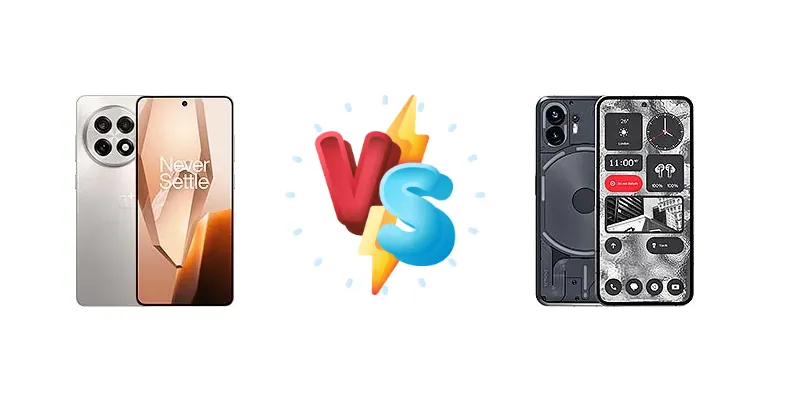
|
🏆 Quick Verdict
For most users prioritizing raw performance and fast charging, the OnePlus 13R emerges as the winner. Its Snapdragon 8 Gen 3 chipset and 80W charging significantly outperform the Nothing Phone (2)'s Snapdragon 8+ Gen 1 and 45W charging. However, the Nothing Phone (2)'s distinctive design and software experience may appeal to those seeking something different.
| PHONES | ||
|---|---|---|
| Phone Names | OnePlus 13R | Nothing Phone (2) |
| Network | ||
|---|---|---|
| 2G bands | GSM 850 / 900 / 1800 / 1900 | GSM 850 / 900 / 1800 / 1900 |
| 3G bands | HSDPA 800 / 850 / 900 / 1700(AWS) / 1900 / 2100 - International | HSDPA 800 / 850 / 900 / 1700(AWS) / 1900 / 2100 |
| 4G bands | 1, 2, 3, 4, 5, 7, 8, 12, 13, 17, 18, 19, 20, 25, 26, 28, 30, 32, 38, 39, 40, 41, 48, 66, 71 - International | 1, 2, 3, 4, 5, 7, 8, 12, 17, 18, 19, 20, 25, 26, 28, 30, 32, 34, 38, 39, 40, 41, 42, 48, 66, 71 |
| 5G bands | 1, 2, 3, 5, 7, 8, 12, 20, 25, 26, 28, 30, 38, 40, 41, 48, 66, 71, 77, 78 SA/NSA - International | 1, 2, 3, 5, 7, 8, 12, 20, 25, 28, 30, 38, 40, 41, 66, 71, 75, 77, 78 SA/NSA |
| Speed | HSPA, LTE, 5G | HSPA, LTE, 5G |
| Technology | GSM / CDMA / HSPA / LTE / 5G | GSM / HSPA / LTE / 5G |
| Launch | ||
|---|---|---|
| Announced | 2025, January 07 | 2023, July 11 |
| Status | Available. Released 2025, January 14 | Available. Released 2023, July 17 |
| Body | ||
|---|---|---|
| Build | Glass front (Gorilla Glass 7i), aluminum frame, glass back | Glass front (Gorilla Glass 5), glass back (Gorilla Glass 5), aluminum frame |
| Dimensions | 161.7 x 75.8 x 8 mm (6.37 x 2.98 x 0.31 in) | 162.1 x 76.4 x 8.6 mm (6.38 x 3.01 x 0.34 in) |
| SIM | · Nano-SIM + Nano-SIM + eSIM (max 2 at a time)· Nano-SIM + Nano-SIM | Nano-SIM + Nano-SIM |
| Weight | 206 g (7.27 oz) | 201.2 g (7.09 oz) |
| Display | ||
|---|---|---|
| Protection | Corning Gorilla Glass 7i | Corning Gorilla Glass 5 |
| Resolution | 1264 x 2780 pixels (~450 ppi density) | 1080 x 2412 pixels, 20:9 ratio (~394 ppi density) |
| Size | 6.78 inches, 111.7 cm2 (~91.2% screen-to-body ratio) | 6.7 inches, 108.0 cm2 (~87.2% screen-to-body ratio) |
| Type | LTPO 4.1 AMOLED, 1B colors, 120Hz, 2160Hz PWM, HDR10+, Dolby Vision, HDR Vivid, 1600 nits (HBM), 4500 nits (peak) | LTPO OLED, 1B colors, 120Hz, 1920Hz PWM, HDR10+, 1600 nits (HBM), 1600 nits (peak) |
| Platform | ||
|---|---|---|
| CPU | Octa-core (1x3.3 GHz Cortex-X4 & 3x3.2 GHz Cortex-A720 & 2x3.0 GHz Cortex-A720 & 2x2.3 GHz Cortex-A520) | Octa-core (1x3.0 GHz Cortex-X2 & 3x2.5 GHz Cortex-A710 & 4x1.80 GHz Cortex-A510) |
| Chipset | Qualcomm SM8650-AB Snapdragon 8 Gen 3 (4 nm) | Qualcomm SM8475 Snapdragon 8+ Gen 1 (4 nm) |
| GPU | Adreno 750 | Adreno 730 |
| OS | Android 15, up to 4 major Android upgrades, OxygenOS 15 | Android 13, upgradable to Android 15, up to 3 major Android upgrades, Nothing OS 3.0 |
| Memory | ||
|---|---|---|
| Card slot | No | No |
| Internal | 256GB 12GB RAM, 512GB 16GB RAM | 128GB 8GB RAM, 256GB 12GB RAM, 512GB 12GB RAM |
| Main Camera | ||
|---|---|---|
| Dual | - | 50 MP, f/1.9, 24mm (wide), 1/1.56", 1.0µm, PDAF, OIS 50 MP, f/2.2, 114˚ (ultrawide), 1/2.76", 0.64µm, AF |
| Features | Color spectrum sensor, LED flash, HDR, panorama | LED flash, panorama, HDR |
| Triple | 50 MP, f/1.8, 24mm (wide), 1/1.56", 1.0µm, multi-directional PDAF, OIS 50 MP, f/2.0, 47mm (telephoto), 1/2.75", 0.64µm, PDAF, 2x optical zoom 8 MP, f/2.2, 16mm, 112˚ (ultrawide), 1/4.0", 1.12µm | - |
| Video | 4K@30/60fps, 1080p@30/60/120/240fps, gyro-EIS, OIS | 4K@30/60fps, 1080p@30/60fps, gyro-EIS, live HDR, OIS |
| Selfie camera | ||
|---|---|---|
| Features | HDR, panorama | HDR |
| Single | 16 MP, f/2.4, 26mm (wide), 1/3.1", 1.0µm | 32 MP, f/2.5, (wide), 1/2.74", 0.8µm |
| Video | 1080p@30fps, gyro-EIS | 1080p@30fps |
| Sound | ||
|---|---|---|
| 35mm jack | No | No |
| Loudspeaker | Yes, with stereo speakers | Yes, with stereo speakers |
| Comms | ||
|---|---|---|
| Bluetooth | 5.4, A2DP, LE, aptX HD, LHDC 5 | 5.3, A2DP, LE, aptX HD, aptX Adaptive |
| Infrared port | Yes | - |
| NFC | Yes | Yes |
| Positioning | GPS (L1+L5), GLONASS (G1), BDS (B1I+B1c+B2a), GALILEO (E1+E5a), QZSS (L1+L5) | GPS (L1+L5), GLONASS (L1), BDS (B1I+B1c), GALILEO (E1), QZSS (L1), NavIC |
| Radio | No | No |
| USB | USB Type-C 2.0 | USB Type-C 2.0, OTG |
| WLAN | Wi-Fi 802.11 a/b/g/n/ac/6e/7, dual-band (6e is market specific) | Wi-Fi 802.11 a/b/g/n/ac/6, dual-band, Wi-Fi Direct |
| Features | ||
|---|---|---|
| Sensors | Fingerprint (under display, optical), accelerometer, gyro, proximity, compass | Fingerprint (under display, optical), accelerometer, proximity, gyro, compass |
| Battery | ||
|---|---|---|
| Charging | 80W wired, 50% in 20 min, 100% in 52/54 min | 45W wired, PD3.0, PPS, QC4, 100% in 55 min 15W wireless, 100% in 130 min 5W reverse wireless |
| Type | Li-Ion 6000 mAh | Li-Ion 4700 mAh |
| Misc | ||
|---|---|---|
| Colors | Astral Trail, Nebula Noir | White, Dark Gray |
| Models | CPH2645, CPH2691, CPH2647 | A065 |
| Price | $ 529.99 / £ 459.00 / € 504.00 / ₹ 39,999 | $ 379.99 / £ 370.00 |
| SAR | 1.19 W/kg (head) 0.90 W/kg (body) | - |
OnePlus 13R
- Significantly faster processor (Snapdragon 8 Gen 3)
- Much faster wired charging (80W)
- Brighter display for outdoor visibility
- Lacks wireless charging
- Camera details are currently unknown
Nothing Phone (2)
- Unique design with Glyph Interface
- Wireless and reverse wireless charging
- Clean software experience
- Older processor (Snapdragon 8+ Gen 1)
- Slower wired charging (45W)
Display Comparison
The OnePlus 13R boasts a brighter display, reaching a measured peak brightness of 1223 nits, compared to the Nothing Phone (2)'s 998 nits. This translates to better visibility under direct sunlight. While both utilize 4nm chipsets, the display brightness difference is a tangible benefit for outdoor users. We lack panel technology details (LTPO, refresh rate) but the brightness advantage clearly favors the 13R. Bezels appear comparable based on available imagery, and color accuracy will require dedicated testing, but the 13R’s higher peak brightness is a clear win.
Camera Comparison
The provided data lacks detailed camera specifications for both devices. However, the Nothing Phone (2) explicitly mentions 'Photo / Video' capabilities, suggesting a greater emphasis on camera features. Without sensor size, aperture, or OIS details, a direct comparison is difficult. We can assume the Nothing Phone (2) will likely offer more software-driven camera enhancements and potentially a more versatile camera system, given Nothing’s marketing focus. The 2MP macro cameras often found in this price range are generally of limited utility on both devices.
Performance
The OnePlus 13R’s Snapdragon 8 Gen 3 represents a significant leap in performance over the Nothing Phone (2)’s Snapdragon 8+ Gen 1. The 8 Gen 3’s octa-core configuration (1x3.3 GHz Cortex-X4, 3x3.2 GHz Cortex-A720, 2x3.0 GHz Cortex-A720, 2x2.3 GHz Cortex-A520) offers a more modern architecture and higher clock speeds than the 8+ Gen 1’s (1x3.0 GHz Cortex-X2, 3x2.5 GHz Cortex-A710, 4x1.80 GHz Cortex-A510). This translates to faster app loading times, smoother multitasking, and superior gaming performance. While the 8+ Gen 1 remains capable, the 8 Gen 3 provides a future-proofed experience. Thermal management will be crucial; the 4nm process of both chips should help, but the 8 Gen 3’s increased power demands may necessitate a more robust cooling solution.
Battery Life
The OnePlus 13R achieves an active use battery score of 15:09h, exceeding the Nothing Phone (2)'s 14:21h. While the Nothing Phone (2) has an older 'Endurance rating' of 103h, this metric is less reliable than real-world active use testing. Crucially, the 13R supports 80W wired charging, reaching 50% in 20 minutes and 100% in 52-54 minutes, significantly faster than the Nothing Phone (2)'s 45W charging (100% in 55 minutes). The Nothing Phone (2) adds 15W wireless and 5W reverse wireless charging, features absent on the 13R, offering convenience for compatible users.
Buying Guide
Buy the OnePlus 13R if you need uncompromising performance for demanding tasks like gaming or video editing, and value the fastest possible charging speeds. Buy the Nothing Phone (2) if you prioritize a unique aesthetic, a clean software experience with the Glyph Interface, and are willing to trade some raw power for a distinctive user experience and wireless charging capabilities.