
OnePlus 13R vs Motorola Edge 50 Pro: A Deep Dive into Performance and Value
| Phones Images | |||||
|---|---|---|---|---|---|
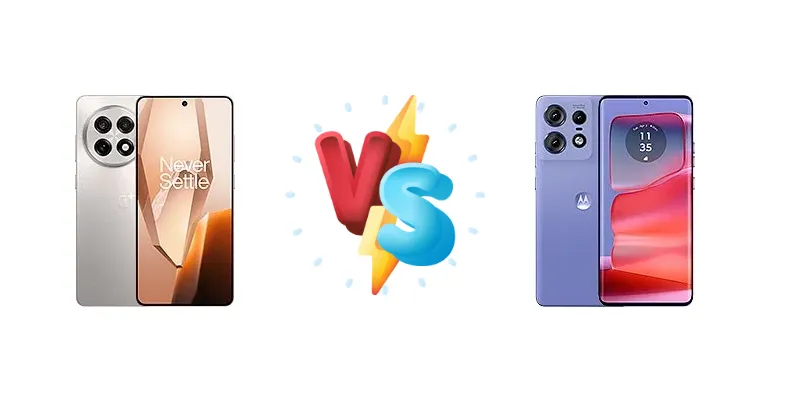
|
🏆 Quick Verdict
For users prioritizing raw performance and sustained gaming, the OnePlus 13R is the clear winner, thanks to its Snapdragon 8 Gen 3 chipset and impressive 15:09h battery life. However, the Motorola Edge 50 Pro’s 125W charging, filling the battery in just 18 minutes, is a game-changer for those who value speed and convenience.
| PHONES | ||
|---|---|---|
| Phone Names | OnePlus 13R | Motorola Edge 50 Pro |
| Network | ||
|---|---|---|
| 2G bands | GSM 850 / 900 / 1800 / 1900 | GSM 850 / 900 / 1800 / 1900 |
| 3G bands | HSDPA 800 / 850 / 900 / 1700(AWS) / 1900 / 2100 - International | HSDPA 850 / 900 / 1700(AWS) / 1900 / 2100 |
| 4G bands | 1, 2, 3, 4, 5, 7, 8, 12, 13, 17, 18, 19, 20, 25, 26, 28, 30, 32, 38, 39, 40, 41, 48, 66, 71 - International | 1, 2, 3, 4, 5, 7, 8, 12, 13, 17, 18, 19, 20, 26, 28, 32, 38, 39, 40, 41, 43, 48, 66 |
| 5G bands | 1, 2, 3, 5, 7, 8, 12, 20, 25, 26, 28, 30, 38, 40, 41, 48, 66, 71, 77, 78 SA/NSA - International | 1, 2, 3, 5, 7, 8, 20, 26, 28, 38, 40, 41, 66, 77, 78 SA/NSA/Sub6 |
| Speed | HSPA, LTE, 5G | HSPA, LTE, 5G |
| Technology | GSM / CDMA / HSPA / LTE / 5G | GSM / HSPA / LTE / 5G |
| Launch | ||
|---|---|---|
| Announced | 2025, January 07 | 2024, April 03 |
| Status | Available. Released 2025, January 14 | Available. Released 2024, April 08 |
| Body | ||
|---|---|---|
| Build | Glass front (Gorilla Glass 7i), aluminum frame, glass back | Glass front, plastic back or silicone polymer back (eco leather), aluminum frame |
| Dimensions | 161.7 x 75.8 x 8 mm (6.37 x 2.98 x 0.31 in) | 161.2 x 72.4 x 8.2 mm (6.35 x 2.85 x 0.32 in) |
| SIM | · Nano-SIM + Nano-SIM + eSIM (max 2 at a time)· Nano-SIM + Nano-SIM | · Nano-SIM + eSIM· Nano-SIM + Nano-SIM |
| Weight | 206 g (7.27 oz) | 186 g (6.56 oz) |
| Display | ||
|---|---|---|
| Protection | Corning Gorilla Glass 7i | Corning Gorilla Glass (unspecified version) |
| Resolution | 1264 x 2780 pixels (~450 ppi density) | 1220 x 2712 pixels, 20:9 ratio (~446 ppi density) |
| Size | 6.78 inches, 111.7 cm2 (~91.2% screen-to-body ratio) | 6.7 inches, 107.4 cm2 (~92.0% screen-to-body ratio) |
| Type | LTPO 4.1 AMOLED, 1B colors, 120Hz, 2160Hz PWM, HDR10+, Dolby Vision, HDR Vivid, 1600 nits (HBM), 4500 nits (peak) | P-OLED, 1B colors, 144Hz, HDR10+, 2000 nits (peak) |
| Platform | ||
|---|---|---|
| CPU | Octa-core (1x3.3 GHz Cortex-X4 & 3x3.2 GHz Cortex-A720 & 2x3.0 GHz Cortex-A720 & 2x2.3 GHz Cortex-A520) | Octa-core (1x2.63 GHz Cortex-A715 & 4x2.4 GHz Cortex-A715 & 3x1.8 GHz Cortex-A510) |
| Chipset | Qualcomm SM8650-AB Snapdragon 8 Gen 3 (4 nm) | Qualcomm SM7550-AB Snapdragon 7 Gen 3 (4 nm) |
| GPU | Adreno 750 | Adreno 720 |
| OS | Android 15, up to 4 major Android upgrades, OxygenOS 15 | Android 14, up to 3 major Android upgrades |
| Memory | ||
|---|---|---|
| Card slot | No | No |
| Internal | 256GB 12GB RAM, 512GB 16GB RAM | 128GB 8GB RAM, 256GB 8GB RAM, 256GB 12GB RAM, 512GB 12GB RAM |
| Main Camera | ||
|---|---|---|
| Features | Color spectrum sensor, LED flash, HDR, panorama | Laser AF, LED flash, panorama, HDR |
| Triple | 50 MP, f/1.8, 24mm (wide), 1/1.56", 1.0µm, multi-directional PDAF, OIS 50 MP, f/2.0, 47mm (telephoto), 1/2.75", 0.64µm, PDAF, 2x optical zoom 8 MP, f/2.2, 16mm, 112˚ (ultrawide), 1/4.0", 1.12µm | 50 MP, f/1.4, 25mm (wide), 1/1.55", 1.0µm, multi-directional PDAF, OIS 10 MP, f/2.0, 67mm (telephoto), 1/3.94", 1.0µm, PDAF, OIS, 3x optical zoom 13 MP, f/2.2, 16mm, 120˚ (ultrawide), 1/3.0", 1.12µm, PDAF |
| Video | 4K@30/60fps, 1080p@30/60/120/240fps, gyro-EIS, OIS | 4K@30fps, 1080p@30/60/120/240fps, 10-bit HDR10+, gyro-EIS |
| Selfie camera | ||
|---|---|---|
| Features | HDR, panorama | HDR |
| Single | 16 MP, f/2.4, 26mm (wide), 1/3.1", 1.0µm | 50 MP, f/1.9, 21mm (wide), 0.64µm, AF |
| Video | 1080p@30fps, gyro-EIS | 4K@30fps, 1080p@30/60fps |
| Sound | ||
|---|---|---|
| 35mm jack | No | No |
| Loudspeaker | Yes, with stereo speakers | Yes, with stereo speakers |
| Comms | ||
|---|---|---|
| Bluetooth | 5.4, A2DP, LE, aptX HD, LHDC 5 | 5.4, A2DP, LE |
| Infrared port | Yes | - |
| NFC | Yes | Yes |
| Positioning | GPS (L1+L5), GLONASS (G1), BDS (B1I+B1c+B2a), GALILEO (E1+E5a), QZSS (L1+L5) | GPS, GLONASS, GALILEO, BDS, QZSS, NavIC |
| Radio | No | No |
| USB | USB Type-C 2.0 | USB Type-C 3.1, OTG, DisplayPort 1.4 |
| WLAN | Wi-Fi 802.11 a/b/g/n/ac/6e/7, dual-band (6e is market specific) | Wi-Fi 802.11 a/b/g/n/ac/6e, tri-band, Wi-Fi Direct |
| Features | ||
|---|---|---|
| Sensors | Fingerprint (under display, optical), accelerometer, gyro, proximity, compass | Fingerprint (under display, optical), accelerometer, gyro, proximity, compass |
| Battery | ||
|---|---|---|
| Charging | 80W wired, 50% in 20 min, 100% in 52/54 min | 125W wired, 100% in 18 min 50W wireless 10W reverse wireless |
| Type | Li-Ion 6000 mAh | Li-Po 4500 mAh |
| Misc | ||
|---|---|---|
| Colors | Astral Trail, Nebula Noir | Luxe Lavender, Black Beauty, Moonlight Pearl, Vanilla Cream |
| Models | CPH2645, CPH2691, CPH2647 | XT2403-2 |
| Price | $ 529.99 / £ 459.00 / € 504.00 / ₹ 39,999 | € 410.57 / $ 399.00 / £ 369.99 / ₹ 22,995 |
| SAR | 1.19 W/kg (head) 0.90 W/kg (body) | 1.08 W/kg (head) 1.08 W/kg (body) |
OnePlus 13R
- Significantly faster processor (Snapdragon 8 Gen 3)
- Longer battery life (15:09h active use)
- Superior image processing capabilities
- Slower charging speed (80W vs 125W)
- Slightly dimmer display
Motorola Edge 50 Pro
- Incredibly fast 125W wired charging (18 minutes to full)
- Brighter display (1295 nits)
- Wireless and reverse wireless charging
- Less powerful processor (Snapdragon 7 Gen 3)
- Shorter battery life (11:59h active use)
Display Comparison
Both phones feature 4nm chipsets and boast high-quality displays, but differ in peak brightness. The Motorola Edge 50 Pro edges out the OnePlus 13R with a measured peak brightness of 1295 nits compared to the 13R’s 1223 nits, potentially offering better visibility in direct sunlight. While both likely utilize OLED panels, the absence of refresh rate data prevents a full comparison of smoothness. The brighter display of the Edge 50 Pro will benefit users who consume a lot of outdoor content.
Camera Comparison
Without detailed camera specifications, a direct comparison is limited. However, the chipset difference suggests the 8 Gen 3 in the OnePlus 13R will offer superior image signal processing (ISP) capabilities, potentially leading to better dynamic range and low-light performance. The Edge 50 Pro’s ISP, while capable, will be constrained by the limitations of the Snapdragon 7 Gen 3. The absence of sensor size data makes it difficult to assess image quality further, but the 8 Gen 3’s processing power gives the 13R an advantage.
Performance
The core difference lies in the chipsets. The OnePlus 13R’s Snapdragon 8 Gen 3 (1x3.3 GHz Cortex-X4) is a significant leap ahead of the Motorola Edge 50 Pro’s Snapdragon 7 Gen 3 (1x2.63 GHz Cortex-A715). The 8 Gen 3’s Cortex-X4 prime core and more powerful Adreno GPU translate to substantially faster processing and graphics performance. The 13R’s CPU configuration (1+3+2+2) also indicates a more robust multi-core performance profile. While the 7 Gen 3 is efficient, it’s designed for a different segment, prioritizing efficiency over outright speed. This difference will be most noticeable in demanding games and applications.
Battery Life
The OnePlus 13R delivers a longer active use battery score of 15:09h, compared to the Motorola Edge 50 Pro’s 11:59h. This suggests better power efficiency, despite the 13R’s more powerful processor. However, the Edge 50 Pro compensates with its blazing-fast 125W wired charging, achieving a full charge in just 18 minutes. The 13R’s 80W charging, while still fast (52-54 minutes to full), can’t match that speed. The Edge 50 Pro also adds 50W wireless and 10W reverse wireless charging, features absent on the 13R.
Buying Guide
Buy the OnePlus 13R if you need uncompromising performance for demanding tasks like gaming, video editing, or heavy multitasking, and value long battery life. Buy the Motorola Edge 50 Pro if you prioritize incredibly fast charging, a slightly brighter display, and a more balanced feature set at a potentially lower price point. The Edge 50 Pro is ideal for users who frequently find themselves needing a quick power boost.