
OnePlus 13R vs. Google Pixel 8a: A Deep Dive into Performance and Battery Life
| Phones Images | |||||
|---|---|---|---|---|---|
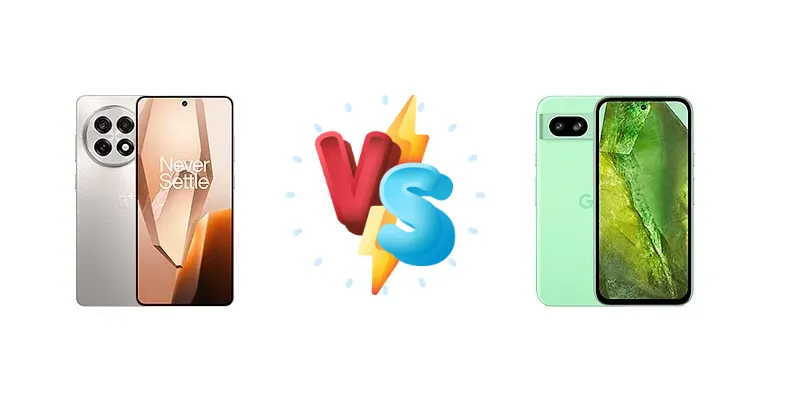
|
🏆 Quick Verdict
For users prioritizing gaming and demanding tasks, the OnePlus 13R is the clear winner, offering significantly faster processing power. However, the Google Pixel 8a excels in battery life and offers a more refined software experience, making it ideal for everyday users who value longevity and Google’s AI features.
| PHONES | ||
|---|---|---|
| Phone Names | OnePlus 13R | Google Pixel 8a |
| Network | ||
|---|---|---|
| 2G bands | GSM 850 / 900 / 1800 / 1900 | GSM 850 / 900 / 1800 / 1900 |
| 3G bands | HSDPA 800 / 850 / 900 / 1700(AWS) / 1900 / 2100 - International | HSDPA 800 / 850 / 900 / 1700(AWS) / 1900 / 2100 |
| 4G bands | 1, 2, 3, 4, 5, 7, 8, 12, 13, 17, 18, 19, 20, 25, 26, 28, 30, 32, 38, 39, 40, 41, 48, 66, 71 - International | 1, 2, 3, 4, 5, 7, 8, 12, 17, 18, 19, 20, 26, 28, 32, 38, 40, 41, 42, 66 - G6GPR (International) |
| 5G bands | 1, 2, 3, 5, 7, 8, 12, 20, 25, 26, 28, 30, 38, 40, 41, 48, 66, 71, 77, 78 SA/NSA - International | 1, 2, 3, 5, 7, 8, 12, 20, 26, 28, 38, 40, 41, 66, 75, 76, 77, 78 SA/NSA/Sub6 - G6GPR (International) |
| Speed | HSPA, LTE, 5G | HSPA, LTE, 5G |
| Technology | GSM / CDMA / HSPA / LTE / 5G | GSM / HSPA / LTE / 5G |
| Launch | ||
|---|---|---|
| Announced | 2025, January 07 | 2024, May 07 |
| Status | Available. Released 2025, January 14 | Available. Released 2024, May 14 |
| Body | ||
|---|---|---|
| Build | Glass front (Gorilla Glass 7i), aluminum frame, glass back | Glass front (Gorilla Glass 3), aluminum frame, plastic back |
| Dimensions | 161.7 x 75.8 x 8 mm (6.37 x 2.98 x 0.31 in) | 152.1 x 72.7 x 8.9 mm (5.99 x 2.86 x 0.35 in) |
| SIM | · Nano-SIM + Nano-SIM + eSIM (max 2 at a time)· Nano-SIM + Nano-SIM | Nano-SIM + eSIM |
| Weight | 206 g (7.27 oz) | 188 g (6.63 oz) |
| Display | ||
|---|---|---|
| Protection | Corning Gorilla Glass 7i | Corning Gorilla Glass 3, Mohs level 5 |
| Resolution | 1264 x 2780 pixels (~450 ppi density) | 1080 x 2400 pixels, 20:9 ratio (~430 ppi density) |
| Size | 6.78 inches, 111.7 cm2 (~91.2% screen-to-body ratio) | 6.1 inches, 90.3 cm2 (~81.6% screen-to-body ratio) |
| Type | LTPO 4.1 AMOLED, 1B colors, 120Hz, 2160Hz PWM, HDR10+, Dolby Vision, HDR Vivid, 1600 nits (HBM), 4500 nits (peak) | OLED, HDR, 120Hz, 2000 nits (peak) |
| Platform | ||
|---|---|---|
| CPU | Octa-core (1x3.3 GHz Cortex-X4 & 3x3.2 GHz Cortex-A720 & 2x3.0 GHz Cortex-A720 & 2x2.3 GHz Cortex-A520) | Nona-core (1x3.0 GHz Cortex-X3 & 4x2.45 GHz Cortex-A715 & 4x2.15 GHz Cortex-A510) |
| Chipset | Qualcomm SM8650-AB Snapdragon 8 Gen 3 (4 nm) | Google Tensor G3 (4 nm) |
| GPU | Adreno 750 | Immortalis-G715s MC10 |
| OS | Android 15, up to 4 major Android upgrades, OxygenOS 15 | Android 14, upgradable to Android 16, up to 7 major Android upgrades |
| Memory | ||
|---|---|---|
| Card slot | No | No |
| Internal | 256GB 12GB RAM, 512GB 16GB RAM | 128GB 8GB RAM, 256GB 8GB RAM |
| Main Camera | ||
|---|---|---|
| Dual | - | 64 MP (16 MP eff.), f/1.9, 26mm (wide), 1/1.73", 0.8µm, dual pixel PDAF, OIS 13 MP, f/2.2, 120˚ (ultrawide), 1.12µm |
| Features | Color spectrum sensor, LED flash, HDR, panorama | Dual-LED flash, Pixel Shift, Ultra HDR, panorama, Best Take |
| Triple | 50 MP, f/1.8, 24mm (wide), 1/1.56", 1.0µm, multi-directional PDAF, OIS 50 MP, f/2.0, 47mm (telephoto), 1/2.75", 0.64µm, PDAF, 2x optical zoom 8 MP, f/2.2, 16mm, 112˚ (ultrawide), 1/4.0", 1.12µm | - |
| Video | 4K@30/60fps, 1080p@30/60/120/240fps, gyro-EIS, OIS | 4K@30/60fps, 1080p@30/60/120/240fps, OIS |
| Selfie camera | ||
|---|---|---|
| Features | HDR, panorama | HDR, panorama |
| Single | 16 MP, f/2.4, 26mm (wide), 1/3.1", 1.0µm | 13 MP, f/2.2, 20mm (ultrawide), 1.12µm |
| Video | 1080p@30fps, gyro-EIS | 4K@30fps, 1080p@30/60fps |
| Sound | ||
|---|---|---|
| 35mm jack | No | No |
| Loudspeaker | Yes, with stereo speakers | Yes, with stereo speakers |
| Comms | ||
|---|---|---|
| Bluetooth | 5.4, A2DP, LE, aptX HD, LHDC 5 | 5.3, A2DP, LE |
| Infrared port | Yes | - |
| NFC | Yes | Yes |
| Positioning | GPS (L1+L5), GLONASS (G1), BDS (B1I+B1c+B2a), GALILEO (E1+E5a), QZSS (L1+L5) | GPS, GLONASS, GALILEO, BDS, QZSS, NavIC |
| Radio | No | No |
| USB | USB Type-C 2.0 | USB Type-C 3.2 |
| WLAN | Wi-Fi 802.11 a/b/g/n/ac/6e/7, dual-band (6e is market specific) | Wi-Fi 802.11 a/b/g/n/ac/6e, dual/tri-band (market/region dependent) |
| Features | ||
|---|---|---|
| Sensors | Fingerprint (under display, optical), accelerometer, gyro, proximity, compass | Fingerprint (under display, optical), accelerometer, gyro, proximity, compass, barometer |
| Battery | ||
|---|---|---|
| Charging | 80W wired, 50% in 20 min, 100% in 52/54 min | 18W wired, PD3.0 7.5W wireless Bypass charging |
| Type | Li-Ion 6000 mAh | Li-Po 4492 mAh |
| Misc | ||
|---|---|---|
| Colors | Astral Trail, Nebula Noir | Obsidian, Porcelain, Bay, Aloe |
| Models | CPH2645, CPH2691, CPH2647 | GKV4X, G6GPR, G8HHN, G576D |
| Price | $ 529.99 / £ 459.00 / € 504.00 / ₹ 39,999 | $ 229.98 / C$ 417.99 / £ 279.00 / € 299.99 / ₹ 33,300 |
| SAR | 1.19 W/kg (head) 0.90 W/kg (body) | - |
| EU LABEL | ||
|---|---|---|
| Battery | - | 40:06h endurance, 1000 cycles |
| Energy | - | Class B |
| Free fall | - | Class A (270 falls) |
| Repairability | - | Class B |
OnePlus 13R
- Significantly faster processor for demanding tasks
- 80W fast charging for quick top-ups
- Potentially better gaming performance
- Shorter battery life compared to the Pixel 8a
- Software experience may not be as refined as Pixel
Google Pixel 8a
- Exceptional battery life and longevity
- Google’s AI-powered features and software optimization
- Excellent camera performance through computational photography
- Slower processor compared to the Snapdragon 8 Gen 3
- Slower 18W charging
Display Comparison
Both devices feature 4nm chipsets, but their displays differ significantly. The Pixel 8a boasts a higher peak brightness of 1508 nits compared to the OnePlus 13R’s 1223 nits, offering superior visibility in direct sunlight. While both are excellent, the Pixel 8a’s brightness advantage is measurable. Details regarding panel technology (LTPO vs. standard OLED) and refresh rates are missing, but the Pixel 8a’s brightness suggests a more advanced panel. Bezels appear comparable based on available imagery, and color accuracy is likely excellent on both, given the brands’ reputations.
Camera Comparison
Camera details are limited, but the focus should be on image processing. The Pixel 8a benefits from Google’s renowned computational photography, likely delivering excellent dynamic range and detail in various lighting conditions. While sensor sizes and apertures are unknown, the Pixel’s software algorithms often compensate for hardware limitations. The OnePlus 13R’s camera performance will depend heavily on its sensor and image processing pipeline, but it’s unlikely to match the Pixel’s consistently high image quality without significant software optimization. Ignoring the likely present, but unimportant, 2MP macro lenses on both devices, the main sensor and processing are key.
Performance
The OnePlus 13R’s Snapdragon 8 Gen 3 (Octa-core, up to 3.3 GHz) is a substantial leap ahead of the Pixel 8a’s Google Tensor G3 (Nona-core, up to 3.0 GHz). The Snapdragon’s Cortex-X4 prime core and more powerful A720 cores deliver superior CPU performance. The 13R’s chipset is built on a 4nm process, offering efficiency, but the Tensor G3 also utilizes a 4nm process. The real-world impact is noticeable: the 13R will handle demanding games and applications with greater ease. RAM specifications are not provided, but the 13R’s superior chipset will likely mitigate any RAM differences. Thermal management will be crucial for the 13R to sustain peak performance.
Battery Life
Battery life is where the Pixel 8a truly shines. Its impressive 40:06h endurance rating and 1000 cycle lifespan significantly outperform the OnePlus 13R’s 15:09h active use score. While the 13R charges much faster at 80W (50% in 20 minutes, 100% in 52-54 minutes) compared to the Pixel 8a’s 18W wired charging, the Pixel’s longevity offsets the slower charging speed. The Pixel 8a also offers 7.5W wireless charging and bypass charging, features absent on the 13R. The Pixel 8a’s older endurance rating of 83h suggests consistent battery performance over time.
Buying Guide
Buy the OnePlus 13R if you need uncompromising performance for gaming, video editing, or other resource-intensive applications, and fast charging is a priority. Buy the Google Pixel 8a if you prefer a longer-lasting battery, a cleaner software experience with guaranteed updates, and a strong emphasis on computational photography and AI-powered features.