
OnePlus 13R vs Asus Zenfone 11 Ultra: A Deep Dive into Performance and Battery
| Phones Images | |||||
|---|---|---|---|---|---|
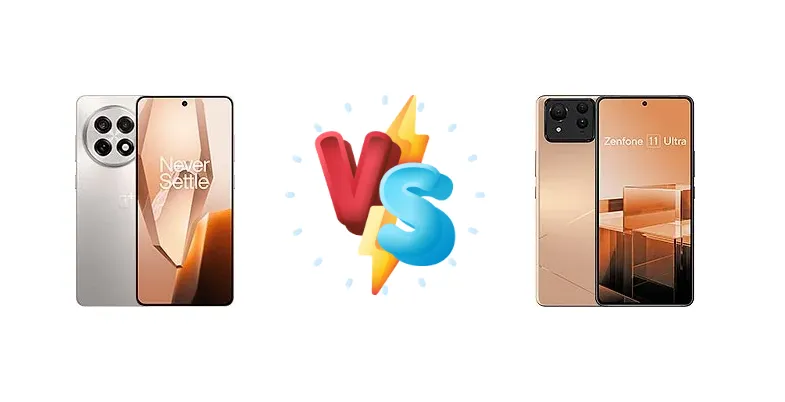
|
🏆 Quick Verdict
For the average user prioritizing all-around performance and a slightly longer battery life, the Asus Zenfone 11 Ultra is the superior choice. Its significantly brighter display and faster charging – reaching 100% in just 39 minutes – outweigh the OnePlus 13R’s more affordable price point.
| PHONES | ||
|---|---|---|
| Phone Names | OnePlus 13R | Asus Zenfone 11 Ultra |
| Network | ||
|---|---|---|
| 2G bands | GSM 850 / 900 / 1800 / 1900 | GSM 850 / 900 / 1800 / 1900 |
| 3G bands | HSDPA 800 / 850 / 900 / 1700(AWS) / 1900 / 2100 - International | HSDPA 800 / 850 / 900 / 1700(AWS) / 1900 / 2100 |
| 4G bands | 1, 2, 3, 4, 5, 7, 8, 12, 13, 17, 18, 19, 20, 25, 26, 28, 30, 32, 38, 39, 40, 41, 48, 66, 71 - International | 1, 2, 3, 4, 5, 7, 8, 12, 17, 18, 19, 20, 25, 26, 28, 32, 34, 38, 39, 40, 41, 42, 43, 48, 66 - International |
| 5G bands | 1, 2, 3, 5, 7, 8, 12, 20, 25, 26, 28, 30, 38, 40, 41, 48, 66, 71, 77, 78 SA/NSA - International | 1, 2, 3, 5, 7, 8, 12, 18, 20, 25, 26, 28, 38, 40, 41, 48, 66, 77, 78, 79 SA/NSA/Sub6 - International |
| Speed | HSPA, LTE, 5G | HSPA, LTE, 5G |
| Technology | GSM / CDMA / HSPA / LTE / 5G | GSM / HSPA / LTE / 5G |
| Launch | ||
|---|---|---|
| Announced | 2025, January 07 | 2024, March 14 |
| Status | Available. Released 2025, January 14 | Available. Released 2024, April 14 |
| Body | ||
|---|---|---|
| Build | Glass front (Gorilla Glass 7i), aluminum frame, glass back | Glass front (Gorilla Glass Victus 2), aluminum frame, glass back |
| Dimensions | 161.7 x 75.8 x 8 mm (6.37 x 2.98 x 0.31 in) | 163.8 x 76.8 x 8.9 mm (6.45 x 3.02 x 0.35 in) |
| SIM | · Nano-SIM + Nano-SIM + eSIM (max 2 at a time)· Nano-SIM + Nano-SIM | Nano-SIM + Nano-SIM |
| Weight | 206 g (7.27 oz) | 224 g (7.90 oz) |
| Display | ||
|---|---|---|
| Protection | Corning Gorilla Glass 7i | Corning Gorilla Glass Victus 2 |
| Resolution | 1264 x 2780 pixels (~450 ppi density) | 1080 x 2400 pixels, 20:9 ratio (~388 ppi density) |
| Size | 6.78 inches, 111.7 cm2 (~91.2% screen-to-body ratio) | 6.78 inches, 111.0 cm2 (~88.2% screen-to-body ratio) |
| Type | LTPO 4.1 AMOLED, 1B colors, 120Hz, 2160Hz PWM, HDR10+, Dolby Vision, HDR Vivid, 1600 nits (HBM), 4500 nits (peak) | LTPO AMOLED, 144Hz, HDR10, 1600 nits (HBM), 2500 nits (peak) |
| Platform | ||
|---|---|---|
| CPU | Octa-core (1x3.3 GHz Cortex-X4 & 3x3.2 GHz Cortex-A720 & 2x3.0 GHz Cortex-A720 & 2x2.3 GHz Cortex-A520) | Octa-core (1x3.3 GHz Cortex-X4 & 3x3.2 GHz Cortex-A720 & 2x3.0 GHz Cortex-A720 & 2x2.3 GHz Cortex-A520) |
| Chipset | Qualcomm SM8650-AB Snapdragon 8 Gen 3 (4 nm) | Qualcomm SM8650-AB Snapdragon 8 Gen 3 (4 nm) |
| GPU | Adreno 750 | Adreno 750 |
| OS | Android 15, up to 4 major Android upgrades, OxygenOS 15 | Android 14, up to 2 major Android upgrades |
| Memory | ||
|---|---|---|
| Card slot | No | No |
| Internal | 256GB 12GB RAM, 512GB 16GB RAM | 256GB 12GB RAM, 512GB 16GB RAM |
| Main Camera | ||
|---|---|---|
| Features | Color spectrum sensor, LED flash, HDR, panorama | LED flash, HDR, panorama |
| Triple | 50 MP, f/1.8, 24mm (wide), 1/1.56", 1.0µm, multi-directional PDAF, OIS 50 MP, f/2.0, 47mm (telephoto), 1/2.75", 0.64µm, PDAF, 2x optical zoom 8 MP, f/2.2, 16mm, 112˚ (ultrawide), 1/4.0", 1.12µm | 50 MP, f/1.9, 24mm (wide), 1/1.56", 1.0µm, PDAF, gimbal OIS 32 MP, f/2.4, 65mm (telephoto), 1/3.2", 0.7µm, PDAF, OIS, 3x optical zoom 13 MP, f/2.2, 13mm, 120˚ (ultrawide), 1/3.0", 1.12µm |
| Video | 4K@30/60fps, 1080p@30/60/120/240fps, gyro-EIS, OIS | 8K@24fps, 4K@30/60fps, 1080p@30/60/120/240fps, 720p@480fps; gyro-EIS, HDR10+ |
| Selfie camera | ||
|---|---|---|
| Features | HDR, panorama | Panorama, HDR |
| Single | 16 MP, f/2.4, 26mm (wide), 1/3.1", 1.0µm | 32 MP, f/2.5, 22mm (wide), 1/3.2", 0.7µm |
| Video | 1080p@30fps, gyro-EIS | 1080p@30fps |
| Sound | ||
|---|---|---|
| 35mm jack | No | Yes |
| Loudspeaker | Yes, with stereo speakers | Yes, with stereo speakers |
| Comms | ||
|---|---|---|
| Bluetooth | 5.4, A2DP, LE, aptX HD, LHDC 5 | 5.4, A2DP, LE, aptX HD, aptX Adaptive, aptX Lossless |
| Infrared port | Yes | - |
| NFC | Yes | Yes |
| Positioning | GPS (L1+L5), GLONASS (G1), BDS (B1I+B1c+B2a), GALILEO (E1+E5a), QZSS (L1+L5) | GPS (L1+L5), BDS (B1I+B1c+B2a), GALILEO (E1+E5a), QZSS (L1+L5), NavIC, GLONASS |
| Radio | No | No |
| USB | USB Type-C 2.0 | USB Type-C |
| WLAN | Wi-Fi 802.11 a/b/g/n/ac/6e/7, dual-band (6e is market specific) | Wi-Fi 802.11 a/b/g/n/ac/6e/7, tri-band, Wi-Fi Direct |
| Features | ||
|---|---|---|
| Sensors | Fingerprint (under display, optical), accelerometer, gyro, proximity, compass | Fingerprint (under display, optical), accelerometer, gyro, proximity, compass |
| Battery | ||
|---|---|---|
| Charging | 80W wired, 50% in 20 min, 100% in 52/54 min | 65W wired, PD3.0, PPS, QC5, 100% in 39 min 15W wireless (Qi) 10W reverse wired |
| Type | Li-Ion 6000 mAh | 5500 mAh |
| Misc | ||
|---|---|---|
| Colors | Astral Trail, Nebula Noir | Eternal Black, Skyline Blue, Misty Gray, Desert Sand |
| Models | CPH2645, CPH2691, CPH2647 | AI2401, ASUS_AI2401_H |
| Price | $ 529.99 / £ 459.00 / € 504.00 / ₹ 39,999 | About 1820 EUR |
| SAR | 1.19 W/kg (head) 0.90 W/kg (body) | - |
OnePlus 13R
- Excellent battery life for its class
- Powerful Snapdragon 8 Gen 3 performance
- More affordable price point
- Slower charging speed compared to the Zenfone
- Less bright display
Asus Zenfone 11 Ultra
- Significantly brighter display for outdoor visibility
- Much faster wired and wireless charging
- Potential for a more advanced camera system
- Higher price tag
- Potentially more thermal throttling due to compact design
Display Comparison
The Asus Zenfone 11 Ultra boasts a considerably brighter display, peaking at 1773 nits compared to the OnePlus 13R’s 1223 nits. This translates to superior visibility under direct sunlight, a crucial benefit for outdoor users. While both utilize high-refresh-rate panels, the Zenfone’s higher peak brightness provides a more dynamic and immersive viewing experience. We expect both to use AMOLED technology, but the Zenfone’s brightness advantage is a clear differentiator.
Camera Comparison
Context data doesn't provide camera details, but given the Zenfone 11 Ultra’s positioning as a flagship, we anticipate a more sophisticated camera system with larger sensors and advanced image processing capabilities. Asus typically focuses on computational photography, aiming for realistic and detailed images. The OnePlus 13R will likely offer a capable camera, but may prioritize speed and convenience over ultimate image quality. Without sensor size or aperture information, a definitive comparison is impossible, but the Zenfone is expected to have the edge.
Performance
Both devices are powered by the Qualcomm SM8650-AB Snapdragon 8 Gen 3 (4 nm) chipset, featuring the same CPU core configuration: 1x3.3 GHz Cortex-X4, 3x3.2 GHz Cortex-A720, 2x3.0 GHz Cortex-A720, and 2x2.3 GHz Cortex-A520. This means raw processing power will be nearly identical. However, the Zenfone 11 Ultra’s more compact form factor may necessitate a more aggressive thermal management strategy, potentially leading to slightly more throttling under sustained load. Both likely utilize LPDDR5x RAM, but specific speeds weren't provided.
Battery Life
The Asus Zenfone 11 Ultra delivers a longer active use battery score of 16:28h compared to the OnePlus 13R’s 15:09h. While the difference isn’t massive, it’s noticeable. Crucially, the Zenfone 11 Ultra’s 65W wired charging is significantly faster, achieving a full charge in just 39 minutes, versus the 13R’s 52-54 minutes. The Zenfone also adds 15W wireless charging and 10W reverse wired charging, features absent on the 13R. This charging speed advantage is a major win for the Zenfone, especially for users who frequently need to top up their battery.
Buying Guide
Buy the OnePlus 13R if you need a powerful phone with excellent battery life at a more accessible price. It’s ideal for users who prioritize sustained performance during long workdays or media consumption. Buy the Asus Zenfone 11 Ultra if you prefer a brighter, more vibrant display, and value the convenience of significantly faster wired and wireless charging, even if it comes at a higher cost.