
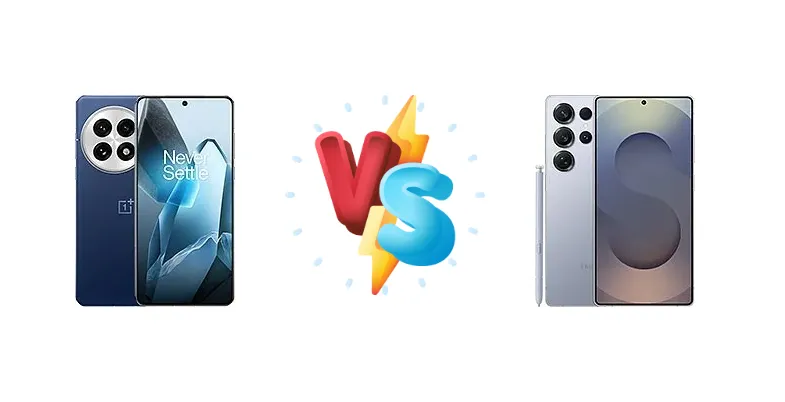
OnePlus 13 vs Samsung Galaxy S25 Ultra: A Deep Dive into Battery, Performance, and Display
| Phones Images | |||||
|---|---|---|---|---|---|
|
🏆 Quick Verdict
For the average user prioritizing all-day battery life and incredibly fast charging, the OnePlus 13 emerges as the winner. Its 61:36h endurance and 100W charging significantly outperform the S25 Ultra, despite Samsung's superior battery cycle count. However, the S25 Ultra’s brighter display and longer-term battery health are compelling advantages for power users.
| PHONES | ||
|---|---|---|
| Phone Names | OnePlus 13 | Samsung Galaxy S25 Ultra |
| Network | ||
|---|---|---|
| 2G bands | GSM 850 / 900 / 1800 / 1900 | GSM 850 / 900 / 1800 / 1900 |
| 3G bands | HSDPA 800 / 850 / 900 / 1700(AWS) / 1900 / 2100 - International | HSDPA 850 / 900 / 1700(AWS) / 1900 / 2100 |
| 4G bands | 1, 2, 3, 4, 5, 7, 8, 12, 13, 17, 18, 19, 20, 25, 26, 28, 30, 32, 38, 39, 40, 41, 48, 66, 71 - International | 1, 2, 3, 4, 5, 7, 8, 12, 13, 17, 18, 19, 20, 25, 26, 28, 32, 38, 39, 40, 41, 66 - International |
| 5G bands | 1, 2, 3, 5, 7, 8, 12, 20, 25, 28, 30, 38, 40, 41, 48, 66, 71, 75, 77, 78 SA/NSA/Sub6 - International | 1, 2, 3, 5, 7, 8, 12, 20, 25, 26, 28, 38, 40, 41, 66, 75, 77, 78 SA/NSA/Sub6 - International |
| Speed | HSPA, LTE, 5G | HSPA, LTE (up to 7CA), 5G |
| Technology | GSM / HSPA / LTE / 5G | GSM / CDMA / HSPA / EVDO / LTE / 5G |
| Launch | ||
|---|---|---|
| Announced | 2024, October 31 | 2025, January 22 |
| Status | Available. Released 2024, November 01 | Available. Released 2025, February 03 |
| Body | ||
|---|---|---|
| Build | Glass front (Ceramic Guard), glass back or silicone polymer back (eco leather), aluminum frame | Glass front (Corning Gorilla Armor 2), glass back (Gorilla Glass Victus 2), titanium frame (grade 5) |
| Dimensions | 162.9 x 76.5 x 8.5 mm or 8.9 mm | 162.8 x 77.6 x 8.2 mm (6.41 x 3.06 x 0.32 in) |
| SIM | · Nano-SIM + Nano-SIM + eSIM (max 2 at a time)· Nano-SIM + Nano-SIM | · Nano-SIM + Nano-SIM + eSIM + eSIM (max 2 at a time) - INT· Nano-SIM + eSIM + eSIM (max 2 at a time) - USA· Nano-SIM + Nano-SIM - CN |
| Weight | 210 g or 213 g (7.41 oz) | 218 g (7.69 oz) |
| Display | ||
|---|---|---|
| Protection | Ceramic Guard glass, Mohs level 4 | Corning Gorilla Armor 2, Mohs level 6 |
| Resolution | 1440 x 3168 pixels (~510 ppi density) | 1440 x 3120 pixels, 19.5:9 ratio (~498 ppi density) |
| Size | 6.82 inches, 113.0 cm2 (~90.7% screen-to-body ratio) | 6.9 inches, 116.9 cm2 (~92.5% screen-to-body ratio) |
| Type | LTPO 4.1 AMOLED, 1B colors, 120Hz, 2160Hz PWM, Dolby Vision, HDR10+, HDR Vivid, 800 nits (typ), 1600 nits (HBM), 4500 nits (peak) | Dynamic LTPO AMOLED 2X, 120Hz, HDR10+, 2600 nits (peak) |
| Platform | ||
|---|---|---|
| CPU | Octa-core (2x4.32 GHz Oryon V2 Phoenix L + 6x3.53 GHz Oryon V2 Phoenix M) | Octa-core (2x4.47 GHz Oryon V2 Phoenix L + 6x3.53 GHz Oryon V2 Phoenix M) |
| Chipset | Qualcomm SM8750-AB Snapdragon 8 Elite (3 nm) | Qualcomm SM8750-AC Snapdragon 8 Elite (3 nm) |
| GPU | Adreno 830 | Adreno 830 (1200 MHz) |
| OS | Android 15, up to 4 major Android upgrades, OxygenOS 15 (International), ColorOS 15 (China) | Android 15, up to 7 major Android upgrades, One UI 7 |
| Memory | ||
|---|---|---|
| Card slot | No | No |
| Internal | 256GB 12GB RAM, 512GB 12GB RAM, 512GB 16GB RAM, 1TB 24GB RAM | 256GB 12GB RAM, 512GB 12GB RAM, 1TB 12GB RAM, 1TB 16GB RAM |
| Main Camera | ||
|---|---|---|
| Features | Laser focus, Hasselblad Color Calibration, color spectrum sensor, Dual-LED flash, HDR, panorama | Laser AF, Best Face, LED flash, auto-HDR, panorama |
| Quad | - | 200 MP, f/1.7, 24mm (wide), 1/1.3", 0.6µm, multi-directional PDAF, OIS 10 MP, f/2.4, 67mm (telephoto), 1/3.52", 1.12µm, PDAF, OIS, 3x optical zoom 50 MP, f/3.4, 111mm (periscope telephoto), 1/2.52", 0.7µm, PDAF, OIS, 5x optical zoom 50 MP, f/1.9, 120˚ (ultrawide), 1/2.5", 0.7µm, dual pixel PDAF, Super Steady video |
| Triple | 50 MP, f/1.6, 23mm (wide), 1/1.43", 1.12µm, multi-directional PDAF, OIS 50 MP, f/2.6, 73mm (periscope telephoto), 1/1.95", 0.8µm, 3x optical zoom, PDAF, OIS 50 MP, f/2.0, 15mm, 120˚ (ultrawide), 1/2.75", 0.64µm, PDAF | - |
| Video | 8K@30fps, 4K@30/60fps, 1080p@30/60/240/480fps, Auto HDR, gyro-EIS, Dolby Vision | 8K@24/30fps, 4K@30/60/120fps, 1080p@30/60/120/240fps, 10-bit HDR, HDR10+, stereo sound rec., gyro-EIS |
| Selfie camera | ||
|---|---|---|
| Features | HDR, panorama | HDR, HDR10+ |
| Single | 32 MP, f/2.4, 21mm (wide), 1/2.74", 0.8µm | 12 MP, f/2.2, 26mm (wide), 1/3.2", 1.12µm, dual pixel PDAF |
| Video | 4K@30/60fps, 1080p@30/60fps, gyro-EIS | 4K@30/60fps, 1080p@30fps |
| Sound | ||
|---|---|---|
| 35mm jack | No | No |
| Loudspeaker | Yes, with stereo speakers | Yes, with stereo speakers |
| Comms | ||
|---|---|---|
| Bluetooth | 5.4, A2DP, LE, aptX HD, LHDC 5 | 5.4, A2DP, LE |
| Infrared port | Yes | - |
| NFC | Yes | Yes |
| Positioning | GPS (L1+L5), GLONASS (G1), BDS (B1I+B1c+B2a), GALILEO (E1+E5a), QZSS (L1+L5), NavIC | GPS, GLONASS, BDS, GALILEO, QZSS |
| Radio | No | No |
| USB | USB Type-C 3.2, OTG | USB Type-C 3.2, DisplayPort 1.2, OTG |
| WLAN | Wi-Fi 802.11 a/b/g/n/ac/6/7, dual or tri-band, Wi-Fi Direct | Wi-Fi 802.11 a/b/g/n/ac/6e/7, tri-band, Wi-Fi Direct |
| Features | ||
|---|---|---|
| Sensors | Fingerprint (under display, ultrasonic), accelerometer, gyro, proximity, compass, barometer | Fingerprint (under display, ultrasonic), accelerometer, gyro, proximity, compass, barometer |
| Battery | ||
|---|---|---|
| Charging | 100W wired, PD, QC, 50% in 13 min, 100% in 36 min 50W wireless 10W reverse wireless 5W reverse wired | 45W wired, PD3.0, 65% in 30 min 15W wireless (Qi2 Ready) 4.5W reverse wireless |
| Type | Si/C Li-Ion 6000 mAh | Li-Ion 5000 mAh |
| Misc | ||
|---|---|---|
| Colors | Black Eclipse, Arctic Dawn, Midnight Ocean | Titanium Silver Blue, Titanium Black, Titanium White Silver, Titanium Gray, Titanium Jade Green, Titanium Jet Black, Titanium Pink Gold |
| Models | CPH2655, CPH2653, PJZ110, CPH2649 | SM-S938B, SM-S938B/DS, SM-S938U, SM-S938U1, SM-S938W, SM-S938N, SM-S9380, SM-S938E, SM-S938E/DS |
| Price | € 779.00 / $ 669.99 / £ 669.99 / ₹ 65,999 | € 895.00 / $ 859.98 / £ 799.99 / ₹ 110,498 |
| SAR | 1.13 W/kg (head) 1.15 W/kg (body) | 1.26 W/kg (head) 0.64 W/kg (body) |
| SAR EU | - | 1.25 W/kg (head) 1.42 W/kg (body) |
| EU LABEL | ||
|---|---|---|
| Battery | 61:36h endurance, 1000 cycles | 44:54h endurance, 2000 cycles |
| Energy | Class A | Class B |
| Free fall | Class D (45 falls) | Class A (270 falls) |
| Repairability | Class B | Class C |
OnePlus 13
- Incredibly fast 100W charging
- Superior battery endurance (61:36h)
- Competitive Snapdragon 8 Elite performance
- Lower battery cycle count (1000)
- Slightly dimmer display compared to S25 Ultra
Samsung Galaxy S25 Ultra
- Brighter display (1417 nits)
- Exceptional battery cycle life (2000)
- Potentially better thermal management
- Slower charging speed (45W)
- Lower battery endurance (44:54h)
Display Comparison
The Samsung Galaxy S25 Ultra boasts a significantly brighter display, reaching 1417 nits compared to the OnePlus 13’s 1204 nits. This difference is immediately noticeable in direct sunlight. Both utilize advanced panel technology, likely LTPO AMOLED for adaptive refresh rates, but Samsung’s higher peak brightness provides a more vivid outdoor viewing experience. While both will likely offer excellent color accuracy, the S25 Ultra’s brightness advantage is a clear win for outdoor visibility.
Camera Comparison
While detailed camera specs are missing, the focus should be on image processing and sensor size. Given Samsung’s history, the S25 Ultra will likely prioritize vibrant, saturated colors, while OnePlus tends towards a more natural look. The larger sensor on the S25 Ultra (assuming it follows Samsung’s trend) will excel in low-light conditions, capturing more detail and reducing noise. Ignoring the likely inclusion of low-resolution macro lenses on both devices, the primary sensor and its associated OIS system will be the defining factor in image quality.
Performance
Both devices are powered by the Qualcomm SM8750-AB/AC Snapdragon 8 Elite (3nm), featuring the same Octa-core CPU configuration with 2x Oryon V2 Phoenix L cores at slightly different clock speeds (4.32 GHz vs 4.47 GHz). The S25 Ultra’s marginally higher CPU clock speed may translate to a small performance edge in synthetic benchmarks, but real-world differences will likely be negligible. The key differentiator will be thermal management; Samsung’s larger chassis may allow for more effective heat dissipation, potentially preventing throttling during sustained workloads. Both utilize LPDDR5x RAM, ensuring fast memory access.
Battery Life
The OnePlus 13 delivers a remarkable 61:36h endurance score, significantly exceeding the S25 Ultra’s 44:54h. This is coupled with an impressive 100W wired charging, capable of reaching 50% charge in just 13 minutes and a full charge in 36 minutes. The S25 Ultra, while offering 2000 battery cycles compared to the OnePlus 13’s 1000, charges much slower at 45W, taking 30 minutes to reach 65% charge. The OnePlus 13’s faster charging is a game-changer for users who need a quick power boost, while the S25 Ultra prioritizes long-term battery health and longevity.
Buying Guide
Buy the OnePlus 13 if you need a phone that can easily last a full day with heavy use and recharge from 0-100% in under an hour. It’s ideal for users who frequently travel or dislike battery anxiety. Buy the Samsung Galaxy S25 Ultra if you prioritize a brighter, more vibrant display, and value long-term battery health with its 2000 charge cycles, even if it means slower charging speeds and slightly less overall endurance.