
OnePlus 12 vs Xiaomi 14 Pro: A Head-to-Head Flagship Battle
| Phones Images | |||||
|---|---|---|---|---|---|
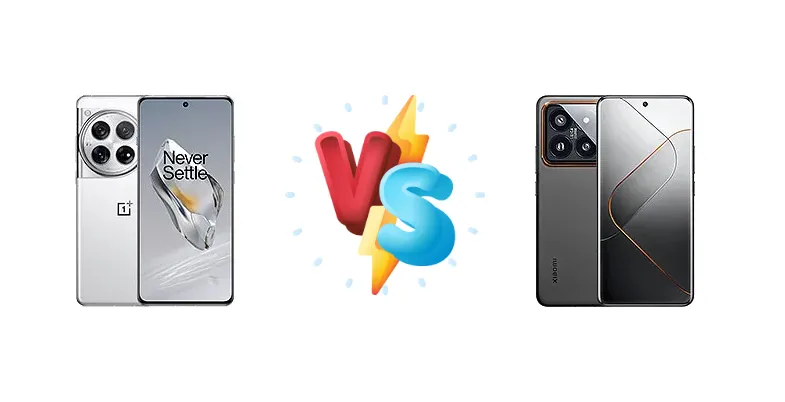
|
🏆 Quick Verdict
For the average user prioritizing rapid charging and a slightly brighter display, the Xiaomi 14 Pro emerges as the winner. Its 120W wired charging significantly reduces downtime, completing a full charge in just 18 minutes. However, the OnePlus 12 offers competitive battery life and a more globally consistent charging experience.
| PHONES | ||
|---|---|---|
| Phone Names | OnePlus 12 | Xiaomi 14 Pro |
| Network | ||
|---|---|---|
| 2G bands | GSM 850 / 900 / 1800 / 1900 | GSM 850 / 900 / 1800 / 1900 |
| 3G bands | HSDPA 850 / 900 / 1700(AWS) / 1900 / 2100 - International | HSDPA 800 / 850 / 900 / 1700(AWS) / 1900 / 2100 |
| 4G bands | 1, 2, 3, 4, 5, 7, 8, 12, 13, 17, 18, 19, 20, 25, 26, 28, 30, 32, 38, 39, 40, 41, 48, 66, 71 - International | 1, 3, 4, 5, 7, 8, 18, 19, 26, 28, 34, 38, 39, 40, 41, 42, 48, 66 |
| 5G bands | 1, 2, 3, 5, 7, 8, 12, 20, 25, 28, 30, 38, 40, 41, 66, 71, 77, 78 SA/NSA - International | 1, 3, 5, 7, 8, 28, 38, 40, 41, 48, 66, 77, 78, 79 SA/NSA |
| Speed | HSPA, LTE, 5G | HSPA, LTE, 5G |
| Technology | GSM / CDMA / HSPA / CDMA2000 / LTE / 5G | GSM / CDMA / HSPA / CDMA2000 / LTE / 5G |
| Launch | ||
|---|---|---|
| Announced | 2023, December 05 | 2023, October 26 |
| Status | Available. Released 2023, December 11 | Available. Released 2023, November 01 |
| Body | ||
|---|---|---|
| Build | Glass front (Gorilla Glass Victus 2), glass back (Gorilla Glass), aluminum frame | Glass front, aluminum frame or titanium frame, glass back |
| Dimensions | 164.3 x 75.8 x 9.2 mm (6.47 x 2.98 x 0.36 in) | 161.4 x 75.3 x 8.5 mm |
| SIM | · Nano-SIM· Nano-SIM + Nano-SIM + eSIM (max 2 at a time)· Nano-SIM + Nano-SIM | Nano-SIM + Nano-SIM |
| Weight | 220 g (7.76 oz) | 223 g or 230 g (7.87 oz) |
| Display | ||
|---|---|---|
| Protection | Corning Gorilla Glass Victus 2 | Shatterproof glass |
| Resolution | 1440 x 3168 pixels (~510 ppi density) | 1440 x 3200 pixels, 20:9 ratio (~522 ppi density) |
| Size | 6.82 inches, 113.0 cm2 (~90.8% screen-to-body ratio) | 6.73 inches, 108.9 cm2 (~89.6% screen-to-body ratio) |
| Type | LTPO AMOLED, 1B colors, 120Hz, 2160Hz PWM, Dolby Vision, HDR10+, 600 nits (typ), 1600 nits (HBM), 4500 nits (peak) | LTPO AMOLED, 68B colors, 120Hz, Dolby Vision, HDR10+, 3000 nits (peak) |
| Platform | ||
|---|---|---|
| CPU | Octa-core (1x3.3 GHz Cortex-X4 & 3x3.2 GHz Cortex-A720 & 2x3.0 GHz Cortex-A720 & 2x2.3 GHz Cortex-A520) | Octa-core (1x3.3 GHz Cortex-X4 & 3x3.2 GHz Cortex-A720 & 2x3.0 GHz Cortex-A720 & 2x2.3 GHz Cortex-A520) |
| Chipset | Qualcomm SM8650-AB Snapdragon 8 Gen 3 (4 nm) | Qualcomm SM8650-AB Snapdragon 8 Gen 3 (4 nm) |
| GPU | Adreno 750 | Adreno 750 |
| OS | Android 14, up to 4 major Android upgrades, OxygenOS 16 (International), ColorOS (China) | Android 14, HyperOS |
| Memory | ||
|---|---|---|
| Card slot | No | No |
| Internal | 256GB 12GB RAM, 256GB 16GB RAM, 512GB 16GB RAM, 1TB 16GB RAM, 1TB 24GB RAM | 256GB 12GB RAM, 512GB 16GB RAM, 1TB 16GB RAM |
| Main Camera | ||
|---|---|---|
| Features | Hasselblad Color Calibration, color spectrum sensor, Dual-LED flash, HDR, panorama | Laser AF, color spectrum sensor, Leica lens, Dual-LED dual-tone flash, HDR, panorama |
| Triple | 50 MP, f/1.6, 23mm (wide), 1/1.43", 1.12µm, multi-directional PDAF, OIS 64 MP, f/2.6, 70mm (periscope telephoto), 1/2.0", 0.7µm, PDAF, OIS, 3x optical zoom 48 MP, f/2.2, 14mm, 114˚ (ultrawide), 1/2.0", 0.8µm, PDAF | 50 MP, f/1.4-f/4.0, 23mm (wide), 1/1.31", 1.2µm, dual pixel PDAF, OIS 50 MP, f/2.0, 75mm (telephoto), PDAF (10cm - ∞), OIS, 3.2x optical zoom 50 MP, f/2.2, 14mm, 115˚ (ultrawide), AF |
| Video | 8K@24fps, 4K@30/60fps, 1080p@30/60/240/480fps, Auto HDR, gyro-EIS, Dolby Vision | 8K@24fps (HDR), 4K@24/30/60fps (HDR10+, 10-bit Dolby Vision HDR, 10-bit LOG), 1080p@30/60/120/240/960fps, 720p@1920fps, gyro-EIS |
| Selfie camera | ||
|---|---|---|
| Features | HDR, panorama | HDR, panorama |
| Single | 32 MP, f/2.4, 21mm (wide), 1/2.74", 0.8µm | 32 MP, f/2.0, 22mm (wide), 0.7µm |
| Video | 4K@30fps, 1080p@30fps, gyro-EIS | 4K@30/60fps, 1080p@30/60fps, gyro-EIS |
| Sound | ||
|---|---|---|
| 35mm jack | No | No |
| Loudspeaker | Yes, with stereo speakers | Yes, with stereo speakers |
| Comms | ||
|---|---|---|
| Bluetooth | 5.4, A2DP, LE, aptX HD, LHDC | 5.4, A2DP, LE, aptX HD, aptX Adaptive |
| Infrared port | Yes | Yes |
| NFC | Yes | Yes |
| Positioning | GPS (L1+L5), GLONASS (G1), BDS (B1I+B1c+B2a), GALILEO (E1+E5a), QZSS (L1+L5), NavIC | GPS (L1+L5), GLONASS (G1), BDS (B1I+B1c+B2a), GALILEO (E1+E5a), QZSS (L1+L5), NavIC (L5) |
| Radio | No | No |
| USB | USB Type-C 3.2, OTG | USB Type-C 3.2 Gen 2, OTG |
| WLAN | Wi-Fi 802.11 a/b/g/n/ac/6e/7, tri-band, Wi-Fi Direct | Wi-Fi 802.11 a/b/g/n/ac/6e/7, dual-band, Wi-Fi Direct |
| Features | ||
|---|---|---|
| Sensors | Fingerprint (under display, optical), accelerometer, gyro, proximity, compass | Fingerprint (under display, optical), accelerometer, proximity, gyro, compass, barometer |
| Battery | ||
|---|---|---|
| Charging | 100W wired, PD, QC, 100% in 26 min (International) 80W wired, PD, QC, 100% in 30 min (USA) 50W wireless, 100% in 55 min 10W reverse wireless | 120W wired, PD3.0, QC4, 100% in 18 min 50W wireless, 100% in 40 min 10W reverse wireless |
| Type | Li-Po 5400 mAh | Li-Po 4880 mAh |
| Misc | ||
|---|---|---|
| Colors | Flowy Emerald, Silky Black, Silver (Glacial White) | Black, Silver, Titanium, Green |
| Models | PJD110, CPH2573, CPH2581, CPH2583 | 23116PN5BC |
| Price | $ 639.99 / C$ 1,099.99 / £ 549.00 / € 527.00 | About 650 EUR |
| SAR | 1.18 W/kg (head) 0.68 W/kg (body) | - |
OnePlus 12
- Longer battery life during active use (14:11h)
- Globally consistent 100W charging (except USA)
- Reputable software support from OnePlus
- Slower charging speed compared to Xiaomi 14 Pro
- Charging speed varies by region (USA gets 80W)
Xiaomi 14 Pro
- Ultra-fast 120W wired charging (18 minutes)
- Potentially brighter display (specifications needed)
- MIUI offers extensive customization options
- Battery life is unknown, potentially lower than OnePlus 12
- MIUI can be resource-intensive and prone to bloatware
Display Comparison
The OnePlus 12 boasts a display capable of reaching 1155 nits of peak brightness, providing excellent visibility in direct sunlight. While both phones likely utilize LTPO technology for adaptive refresh rates (though not explicitly stated), the OnePlus 12’s measured brightness gives it a slight edge for outdoor use. The absence of detailed display specs for the Xiaomi 14 Pro makes a precise comparison difficult, but it’s reasonable to expect similar quality given its flagship status. Bezels are likely comparable, and color accuracy will depend on software calibration.
Camera Comparison
Detailed camera specifications are missing for both devices, making a comprehensive comparison challenging. However, the focus should be on the main sensor and image processing. While Xiaomi often emphasizes high megapixel counts, the OnePlus 12’s image processing is known for its natural color reproduction. The absence of information regarding sensor size and OIS capabilities prevents a definitive judgment. We can assume both phones will offer excellent image quality in good lighting conditions, but low-light performance will be a key differentiator.
Performance
Both the OnePlus 12 and Xiaomi 14 Pro are equipped with the Qualcomm SM8650-AB Snapdragon 8 Gen 3 (4 nm) chipset, featuring an identical CPU configuration: 1x3.3 GHz Cortex-X4, 3x3.2 GHz Cortex-A720, 2x3.0 GHz Cortex-A720, and 2x2.3 GHz Cortex-A520. This means raw processing power will be nearly indistinguishable. Performance differences will likely stem from thermal management and RAM optimization. The 4nm process node contributes to improved thermal efficiency, but sustained workloads will still generate heat. The lack of RAM specifications prevents a full assessment, but both will likely utilize LPDDR5x for fast memory access.
Battery Life
The OnePlus 12 delivers an impressive 14:11 hours of active use, showcasing strong battery optimization. The Xiaomi 14 Pro’s battery capacity is not specified, but its 120W wired charging (PD3.0, QC4) is a significant advantage, achieving a full charge in just 18 minutes. The OnePlus 12 offers 100W wired charging (26 min International, 30 min USA), and 50W wireless charging (55 min), while the Xiaomi 14 Pro matches the 50W wireless charging (40 min). The regional difference in OnePlus 12 charging speed is a notable drawback for US customers. Both phones offer 10W reverse wireless charging.
Buying Guide
Buy the OnePlus 12 if you value long-lasting battery life during active use (14:11h) and prefer a brand with a strong track record of software support. Buy the Xiaomi 14 Pro if you prioritize the absolute fastest charging speeds and are comfortable with Xiaomi’s MIUI software experience, and are not in the USA where charging is slower.