
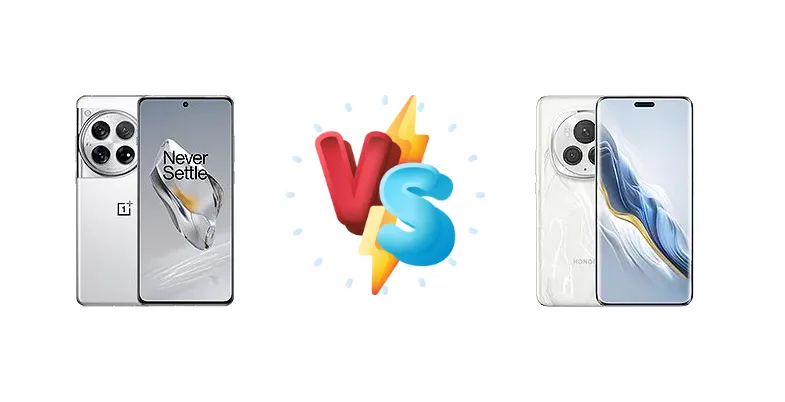
OnePlus 12 vs Honor Magic6 Pro: A Deep Dive into Flagship Performance
| Phones Images | |||||
|---|---|---|---|---|---|
|
🏆 Quick Verdict
For most users, the Honor Magic6 Pro emerges as the slightly stronger contender. Its significantly brighter display (1578 nits vs 1155 nits) and faster wireless charging (66W vs 50W) provide tangible benefits, offsetting the marginally shorter active use battery life.
| PHONES | ||
|---|---|---|
| Phone Names | OnePlus 12 | Honor Magic6 Pro |
| Network | ||
|---|---|---|
| 2G bands | GSM 850 / 900 / 1800 / 1900 | GSM 850 / 900 / 1800 / 1900 |
| 3G bands | HSDPA 850 / 900 / 1700(AWS) / 1900 / 2100 - International | HSDPA 800 / 850 / 900 / 1700(AWS) / 1900 / 2100 |
| 4G bands | 1, 2, 3, 4, 5, 7, 8, 12, 13, 17, 18, 19, 20, 25, 26, 28, 30, 32, 38, 39, 40, 41, 48, 66, 71 - International | LTE |
| 5G bands | 1, 2, 3, 5, 7, 8, 12, 20, 25, 28, 30, 38, 40, 41, 66, 71, 77, 78 SA/NSA - International | SA/NSA |
| Speed | HSPA, LTE, 5G | HSPA, LTE, 5G |
| Technology | GSM / CDMA / HSPA / CDMA2000 / LTE / 5G | GSM / CDMA / HSPA / CDMA2000 / LTE / 5G |
| Launch | ||
|---|---|---|
| Announced | 2023, December 05 | 2024, January 11 |
| Status | Available. Released 2023, December 11 | Available. Released 2024, January 18 |
| Body | ||
|---|---|---|
| Build | Glass front (Gorilla Glass Victus 2), glass back (Gorilla Glass), aluminum frame | Glass front (NanoCrystal Shield), glass back or silicone polymer back (eco leather) |
| Dimensions | 164.3 x 75.8 x 9.2 mm (6.47 x 2.98 x 0.36 in) | 162.5 x 75.8 x 8.9 mm (6.40 x 2.98 x 0.35 in) |
| SIM | · Nano-SIM· Nano-SIM + Nano-SIM + eSIM (max 2 at a time)· Nano-SIM + Nano-SIM | · Nano-SIM + eSIM· Nano-SIM + Nano-SIM |
| Weight | 220 g (7.76 oz) | 225 g or 229 g (7.94 oz) |
| Display | ||
|---|---|---|
| Protection | Corning Gorilla Glass Victus 2 | NanoCrystal Shield |
| Resolution | 1440 x 3168 pixels (~510 ppi density) | 1280 x 2800 pixels, 19.5:9 ratio (~453 ppi density) |
| Size | 6.82 inches, 113.0 cm2 (~90.8% screen-to-body ratio) | 6.8 inches, 112.8 cm2 (~91.6% screen-to-body ratio) |
| Type | LTPO AMOLED, 1B colors, 120Hz, 2160Hz PWM, Dolby Vision, HDR10+, 600 nits (typ), 1600 nits (HBM), 4500 nits (peak) | LTPO OLED, 1B colors, 120Hz, Dolby Vision, HDR, 1600 nits (HBM), 5000 nits (peak) |
| Platform | ||
|---|---|---|
| CPU | Octa-core (1x3.3 GHz Cortex-X4 & 3x3.2 GHz Cortex-A720 & 2x3.0 GHz Cortex-A720 & 2x2.3 GHz Cortex-A520) | Octa-core (1x3.3 GHz Cortex-X4 & 3x3.2 GHz Cortex-A720 & 2x3.0 GHz Cortex-A720 & 2x2.3 GHz Cortex-A520) |
| Chipset | Qualcomm SM8650-AB Snapdragon 8 Gen 3 (4 nm) | Qualcomm SM8650-AB Snapdragon 8 Gen 3 (4 nm) |
| GPU | Adreno 750 | Adreno 750 |
| OS | Android 14, up to 4 major Android upgrades, OxygenOS 16 (International), ColorOS (China) | Android 14, up to 4 major Android upgrades, MagicOS 8 |
| Memory | ||
|---|---|---|
| Card slot | No | No |
| Internal | 256GB 12GB RAM, 256GB 16GB RAM, 512GB 16GB RAM, 1TB 16GB RAM, 1TB 24GB RAM | 256GB 12GB RAM, 256GB 16GB RAM, 512GB 12GB RAM, 512GB 16GB RAM, 1TB 16GB RAM |
| Main Camera | ||
|---|---|---|
| Features | Hasselblad Color Calibration, color spectrum sensor, Dual-LED flash, HDR, panorama | Laser AF, color spectrum sensor, LED flash, HDR, panorama |
| Triple | 50 MP, f/1.6, 23mm (wide), 1/1.43", 1.12µm, multi-directional PDAF, OIS 64 MP, f/2.6, 70mm (periscope telephoto), 1/2.0", 0.7µm, PDAF, OIS, 3x optical zoom 48 MP, f/2.2, 14mm, 114˚ (ultrawide), 1/2.0", 0.8µm, PDAF | 50 MP, f/1.4-2.0, 23mm (wide), 1/1.3", 1.2µm, PDAF, OIS 180 MP, f/2.6, (periscope telephoto), 1/1.49", 0.56µm, PDAF, OIS, 2.5x optical zoom 50 MP, f/2.0, 13mm, 122˚ (ultrawide), 1/2.88", 0.61µm, AF |
| Video | 8K@24fps, 4K@30/60fps, 1080p@30/60/240/480fps, Auto HDR, gyro-EIS, Dolby Vision | 4K@24/30/60fps, 1080p@30/60/120/240fps, gyro-EIS, OIS, HDR, 10-bit video |
| Selfie camera | ||
|---|---|---|
| Features | HDR, panorama | - |
| Single | 32 MP, f/2.4, 21mm (wide), 1/2.74", 0.8µm | 50 MP, f/2.0, 22mm (wide), 1/2.93", 0.6µm, AF TOF 3D, (depth/biometrics sensor) |
| Video | 4K@30fps, 1080p@30fps, gyro-EIS | 4K@30fps, 1080p@30/60fps, gyro-EIS |
| Sound | ||
|---|---|---|
| 35mm jack | No | No |
| Loudspeaker | Yes, with stereo speakers | Yes, with stereo speakers |
| Comms | ||
|---|---|---|
| Bluetooth | 5.4, A2DP, LE, aptX HD, LHDC | 5.3, A2DP, LE, aptX HD |
| Infrared port | Yes | Yes |
| NFC | Yes | Yes |
| Positioning | GPS (L1+L5), GLONASS (G1), BDS (B1I+B1c+B2a), GALILEO (E1+E5a), QZSS (L1+L5), NavIC | GPS (L1+L5), GLONASS, BDS (B1I+B1c+B2a), GALILEO (E1+E5a) |
| Radio | No | No |
| USB | USB Type-C 3.2, OTG | USB Type-C 3.2, DisplayPort 1.2, OTG |
| WLAN | Wi-Fi 802.11 a/b/g/n/ac/6e/7, tri-band, Wi-Fi Direct | Wi-Fi 802.11 a/b/g/n/ac/6/7, dual-band, Wi-Fi Direct |
| Features | ||
|---|---|---|
| Sensors | Fingerprint (under display, optical), accelerometer, gyro, proximity, compass | Fingerprint (under display, optical), Face ID, accelerometer, gyro, proximity, compass |
| Battery | ||
|---|---|---|
| Charging | 100W wired, PD, QC, 100% in 26 min (International) 80W wired, PD, QC, 100% in 30 min (USA) 50W wireless, 100% in 55 min 10W reverse wireless | 80W wired 66W wireless Reverse wireless 5W reverse wired |
| Type | Li-Po 5400 mAh | Si/C Li-Ion 5600 mAh |
| Misc | ||
|---|---|---|
| Colors | Flowy Emerald, Silky Black, Silver (Glacial White) | Black, Green, Blue, Purple, White |
| Models | PJD110, CPH2573, CPH2581, CPH2583 | BVL-AN16, BVL-N49 |
| Price | $ 639.99 / C$ 1,099.99 / £ 549.00 / € 527.00 | € 455.54 / $ 899.00 / £ 598.99 |
| SAR | 1.18 W/kg (head) 0.68 W/kg (body) | - |
OnePlus 12
- Faster wired charging (100W in some regions)
- Established software ecosystem (OxygenOS)
- Potentially more affordable price
- Lower peak display brightness
- Slower wireless charging
- Software can be divisive
Honor Magic6 Pro
- Significantly brighter display (1578 nits)
- Faster wireless charging (66W)
- Innovative design elements (likely)
- MagicOS software may not appeal to all
- Wired charging slightly slower than OnePlus 12 (in some regions)
- Potential for higher price
Display Comparison
The Honor Magic6 Pro boasts a substantial advantage in display brightness, reaching a measured 1578 nits compared to the OnePlus 12’s 1155 nits. This difference is immediately noticeable in direct sunlight, making the Magic6 Pro far more readable outdoors. While both utilize high refresh rate panels, the impact of the brightness difference is more significant than refresh rate alone. Both are likely LTPO panels, enabling dynamic refresh rate scaling for power efficiency, but Honor’s peak brightness is a clear win for users who frequently use their phones in bright environments.
Camera Comparison
Context data lacks specific camera details, but given the flagship positioning, both phones likely feature multi-camera systems with a primary focus on photo and video quality. The absence of sensor size information prevents a direct comparison. However, the inclusion of Optical Image Stabilization (OIS) is almost guaranteed on both devices. Image processing style will be a key differentiator – OnePlus typically aims for a more natural look, while Honor often employs more vibrant and saturated colors. Without detailed camera specs, it’s difficult to declare a clear winner, but the presence of a high-resolution main sensor is expected on both.
Performance
Both the OnePlus 12 and Honor Magic6 Pro are equipped with the Qualcomm SM8650-AB Snapdragon 8 Gen 3 (4 nm) chipset, featuring the same CPU configuration: 1x3.3 GHz Cortex-X4, 3x3.2 GHz Cortex-A720, 2x3.0 GHz Cortex-A720, and 2x2.3 GHz Cortex-A520. This means raw processing power will be nearly identical. Performance differences will likely stem from thermal management and software optimization. Both devices utilize LPDDR5x RAM, ensuring fast memory access. Given the similar hardware, sustained performance under heavy load will be a key differentiator, requiring in-depth thermal testing to determine which phone exhibits less throttling.
Battery Life
The OnePlus 12 achieves an active use battery score of 14:11h, while the Honor Magic6 Pro scores 14:06h. This minimal difference suggests comparable battery life in real-world scenarios. However, charging speeds are where the Magic6 Pro pulls ahead. It supports 80W wired charging, while the OnePlus 12 offers 100W (International) or 80W (USA) depending on the region. More significantly, the Magic6 Pro boasts 66W wireless charging, significantly faster than the OnePlus 12’s 50W wireless charging. The faster wireless charging is a substantial convenience factor for users who prefer cable-free power-ups. The 10W/5W reverse wireless charging on both devices is a useful, though secondary, feature.
Buying Guide
Buy the OnePlus 12 if you prioritize a well-rounded experience with established software and a slightly more affordable price point. Its 100W wired charging is also faster in some regions. Buy the Honor Magic6 Pro if you demand the brightest possible display for outdoor visibility, value exceptionally fast wireless charging, and are comfortable with Honor’s MagicOS software experience.