
OnePlus 12 vs Google Pixel 8 Pro: A Deep Dive into Android Flagships
| Phones Images | |||||
|---|---|---|---|---|---|
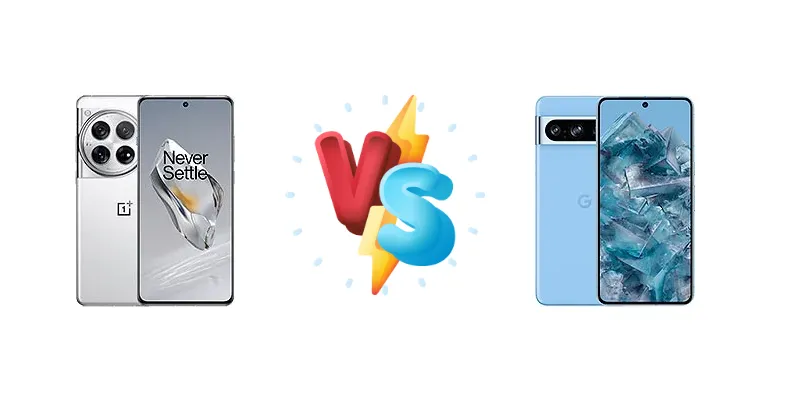
|
🏆 Quick Verdict
For users prioritizing speed and battery longevity, the OnePlus 12 emerges as the winner. Its Snapdragon 8 Gen 3 chipset and significantly faster charging (100W vs 30W) provide a tangible advantage. However, the Pixel 8 Pro’s superior display and camera processing remain compelling for content creators and photography enthusiasts.
| PHONES | ||
|---|---|---|
| Phone Names | OnePlus 12 | Google Pixel 8 Pro |
| Network | ||
|---|---|---|
| 2G bands | GSM 850 / 900 / 1800 / 1900 | GSM 850 / 900 / 1800 / 1900 |
| 3G bands | HSDPA 850 / 900 / 1700(AWS) / 1900 / 2100 - International | HSDPA 800 / 850 / 900 / 1700(AWS) / 1900 / 2100 |
| 4G bands | 1, 2, 3, 4, 5, 7, 8, 12, 13, 17, 18, 19, 20, 25, 26, 28, 30, 32, 38, 39, 40, 41, 48, 66, 71 - International | 1, 2, 3, 4, 5, 7, 8, 12, 13, 14, 17, 18, 19, 20, 25, 26, 28, 29, 30, 38, 39, 40, 41, 46, 48, 66, 71 - G1MNW |
| 5G bands | 1, 2, 3, 5, 7, 8, 12, 20, 25, 28, 30, 38, 40, 41, 66, 71, 77, 78 SA/NSA - International | 1, 2, 3, 5, 7, 8, 12, 20, 25, 26, 28, 29, 30, 38, 40, 41, 48, 66, 70, 71, 77, 78, 257, 258, 260, 261 SA/NSA/Sub6/mmWave - G1MNW |
| Speed | HSPA, LTE, 5G | HSPA, LTE, 5G |
| Technology | GSM / CDMA / HSPA / CDMA2000 / LTE / 5G | GSM / HSPA / LTE / 5G |
| Launch | ||
|---|---|---|
| Announced | 2023, December 05 | 2023, October 04 |
| Status | Available. Released 2023, December 11 | Available. Released 2023, October 12 |
| Body | ||
|---|---|---|
| Build | Glass front (Gorilla Glass Victus 2), glass back (Gorilla Glass), aluminum frame | Glass front (Gorilla Glass Victus 2), glass back (Gorilla Glass Victus 2), aluminum frame |
| Dimensions | 164.3 x 75.8 x 9.2 mm (6.47 x 2.98 x 0.36 in) | 162.6 x 76.5 x 8.8 mm (6.40 x 3.01 x 0.35 in) |
| SIM | · Nano-SIM· Nano-SIM + Nano-SIM + eSIM (max 2 at a time)· Nano-SIM + Nano-SIM | Nano-SIM + eSIM |
| Weight | 220 g (7.76 oz) | 213 g (7.51 oz) |
| Display | ||
|---|---|---|
| Protection | Corning Gorilla Glass Victus 2 | Corning Gorilla Glass Victus 2 |
| Resolution | 1440 x 3168 pixels (~510 ppi density) | 1344 x 2992 pixels, 20:9 ratio (~489 ppi density) |
| Size | 6.82 inches, 113.0 cm2 (~90.8% screen-to-body ratio) | 6.7 inches, 108.7 cm2 (~87.4% screen-to-body ratio) |
| Type | LTPO AMOLED, 1B colors, 120Hz, 2160Hz PWM, Dolby Vision, HDR10+, 600 nits (typ), 1600 nits (HBM), 4500 nits (peak) | LTPO OLED, 120Hz, HDR10+, 1600 nits (HBM), 2400 nits (peak) |
| Platform | ||
|---|---|---|
| CPU | Octa-core (1x3.3 GHz Cortex-X4 & 3x3.2 GHz Cortex-A720 & 2x3.0 GHz Cortex-A720 & 2x2.3 GHz Cortex-A520) | Nona-core (1x3.0 GHz Cortex-X3 & 4x2.45 GHz Cortex-A715 & 4x2.15 GHz Cortex-A510) |
| Chipset | Qualcomm SM8650-AB Snapdragon 8 Gen 3 (4 nm) | Google Tensor G3 (4 nm) |
| GPU | Adreno 750 | Immortalis-G715s MC10 |
| OS | Android 14, up to 4 major Android upgrades, OxygenOS 16 (International), ColorOS (China) | Android 14, upgradable to Android 16, up to 7 major Android upgrades |
| Memory | ||
|---|---|---|
| Card slot | No | No |
| Internal | 256GB 12GB RAM, 256GB 16GB RAM, 512GB 16GB RAM, 1TB 16GB RAM, 1TB 24GB RAM | 128GB 12GB RAM, 256GB 12GB RAM, 512GB 12GB RAM, 1TB 12GB RAM |
| Main Camera | ||
|---|---|---|
| Features | Hasselblad Color Calibration, color spectrum sensor, Dual-LED flash, HDR, panorama | Multi-zone Laser AF, Dual-LED flash, Pixel Shift, Ultra-HDR, panorama, Best Take, Zoom Enhance |
| Triple | 50 MP, f/1.6, 23mm (wide), 1/1.43", 1.12µm, multi-directional PDAF, OIS 64 MP, f/2.6, 70mm (periscope telephoto), 1/2.0", 0.7µm, PDAF, OIS, 3x optical zoom 48 MP, f/2.2, 14mm, 114˚ (ultrawide), 1/2.0", 0.8µm, PDAF | 50 MP, f/1.7, 25mm (wide), 1/1.31", 1.2µm, dual pixel PDAF, OIS 48 MP, f/2.8, 113mm (periscope telephoto), 1/2.55", 0.7µm, dual pixel PDAF, OIS, 5x optical zoom 48 MP, f/2.0, 126˚ (ultrawide), 1/2.0", 0.8µm, dual pixel PDAF |
| Video | 8K@24fps, 4K@30/60fps, 1080p@30/60/240/480fps, Auto HDR, gyro-EIS, Dolby Vision | 4K@30/60fps, 1080p@24/30/60/120/240fps; gyro-EIS, OIS, 10-bit HDR |
| Selfie camera | ||
|---|---|---|
| Features | HDR, panorama | HDR, panorama |
| Single | 32 MP, f/2.4, 21mm (wide), 1/2.74", 0.8µm | 10.5 MP, f/2.2, 20mm (ultrawide), 1/3.1", 1.22µm, PDAF |
| Video | 4K@30fps, 1080p@30fps, gyro-EIS | 4K@24/30/60fps, 1080p@30/60fps |
| Sound | ||
|---|---|---|
| 35mm jack | No | No |
| Loudspeaker | Yes, with stereo speakers | Yes, with stereo speakers |
| Comms | ||
|---|---|---|
| Bluetooth | 5.4, A2DP, LE, aptX HD, LHDC | 5.3, A2DP, LE, aptX HD |
| Infrared port | Yes | - |
| NFC | Yes | Yes |
| Positioning | GPS (L1+L5), GLONASS (G1), BDS (B1I+B1c+B2a), GALILEO (E1+E5a), QZSS (L1+L5), NavIC | GPS (L1+L5), GLONASS (G1), GALILEO (E1+E5a), QZSS (L1+L5) |
| Radio | No | No |
| USB | USB Type-C 3.2, OTG | USB Type-C 3.2 |
| WLAN | Wi-Fi 802.11 a/b/g/n/ac/6e/7, tri-band, Wi-Fi Direct | Wi-Fi 802.11 a/b/g/n/ac/6e/7, tri-band, Wi-Fi Direct |
| Features | ||
|---|---|---|
| Sensors | Fingerprint (under display, optical), accelerometer, gyro, proximity, compass | Fingerprint (under display, optical), accelerometer, gyro, proximity, compass, barometer, thermometer (skin temperature) |
| Battery | ||
|---|---|---|
| Charging | 100W wired, PD, QC, 100% in 26 min (International) 80W wired, PD, QC, 100% in 30 min (USA) 50W wireless, 100% in 55 min 10W reverse wireless | 30W wired, PD3.0, PPS, 50% in 30 min 23W wireless Reverse wireless Bypass charging |
| Type | Li-Po 5400 mAh | Li-Ion 5050 mAh |
| Misc | ||
|---|---|---|
| Colors | Flowy Emerald, Silky Black, Silver (Glacial White) | Obsidian, Porcelain, Bay, Mint |
| Models | PJD110, CPH2573, CPH2581, CPH2583 | GC3VE, G1MNW |
| Price | $ 639.99 / C$ 1,099.99 / £ 549.00 / € 527.00 | € 362.00 / $ 289.97 / £ 329.95 / ₹ 54,999 |
| SAR | 1.18 W/kg (head) 0.68 W/kg (body) | - |
OnePlus 12
- Significantly faster charging (100W)
- Longer battery life (14:11h active use)
- More powerful processor (Snapdragon 8 Gen 3)
- Display not as bright as Pixel 8 Pro
- Camera processing may not appeal to all users
Google Pixel 8 Pro
- Brighter display (1600 nits)
- Superior camera image processing
- Clean and AI-powered software experience
- Slower charging (30W)
- Shorter battery life (11:14h active use)
- Less powerful processor (Tensor G3)
Display Comparison
The Pixel 8 Pro boasts a significantly brighter display, reaching 1600 nits compared to the OnePlus 12’s 1155 nits. This translates to superior visibility in direct sunlight. While both utilize advanced panel technology, the Pixel 8 Pro’s higher peak brightness is a clear advantage for outdoor use. The OnePlus 12 doesn’t specify PWM frequency, while the Pixel 8 Pro’s advanced display tech likely incorporates a higher frequency, potentially benefiting users sensitive to screen flicker. Both displays are likely LTPO, enabling variable refresh rates for power efficiency.
Camera Comparison
Both phones feature capable camera systems, but approach image processing differently. While both are capable of excellent photo and video, the Pixel 8 Pro leverages Google’s computational photography expertise for superior dynamic range and detail in challenging lighting conditions. The OnePlus 12 likely focuses on more natural color reproduction. Sensor sizes are not specified, but the Pixel 8 Pro’s image processing pipeline is a key differentiator. The absence of detailed camera specs for the OnePlus 12 necessitates a reliance on real-world testing to fully assess its capabilities. Both phones will likely offer excellent video recording, but the Pixel 8 Pro’s software features, like Cinematic Blur, provide additional creative options.
Performance
The OnePlus 12’s Qualcomm Snapdragon 8 Gen 3 (4nm) chipset is architecturally superior to the Google Tensor G3 (4nm) in the Pixel 8 Pro. The Snapdragon 8 Gen 3’s Cortex-X4 prime core, clocked at 3.3 GHz, offers a performance edge over the Tensor G3’s Cortex-X3 at 3.0 GHz. The Snapdragon’s more balanced core configuration (1+3+2+2) also suggests better sustained performance under load. While the Tensor G3 excels in AI tasks, the Snapdragon 8 Gen 3 provides a more robust overall performance profile, particularly for gaming and demanding applications. The OnePlus 12’s LPDDR5x RAM further contributes to its speed advantage.
Battery Life
The OnePlus 12 delivers a longer active use battery life of 14:11h, compared to the Pixel 8 Pro’s 11:14h. This difference, coupled with the OnePlus 12’s dramatically faster charging speeds (100W wired, 50W wireless), makes it the clear winner in battery performance. The Pixel 8 Pro’s 30W wired charging feels comparatively slow. The OnePlus 12 can reach 100% charge in as little as 26 minutes (International) or 30 minutes (USA), while the Pixel 8 Pro takes significantly longer. The Pixel 8 Pro’s ‘Bypass charging’ feature, which minimizes battery degradation during overnight charging, is a useful addition, but doesn’t offset the charging speed disparity.
Buying Guide
Buy the OnePlus 12 if you need a phone that can handle demanding tasks, like gaming or video editing, all day long and recharge incredibly quickly. It’s ideal for power users who value performance above all else. Buy the Google Pixel 8 Pro if you prefer a phone with a best-in-class camera system, a stunningly bright display, and a clean, AI-powered software experience, even if it means sacrificing some battery life and charging speed.