
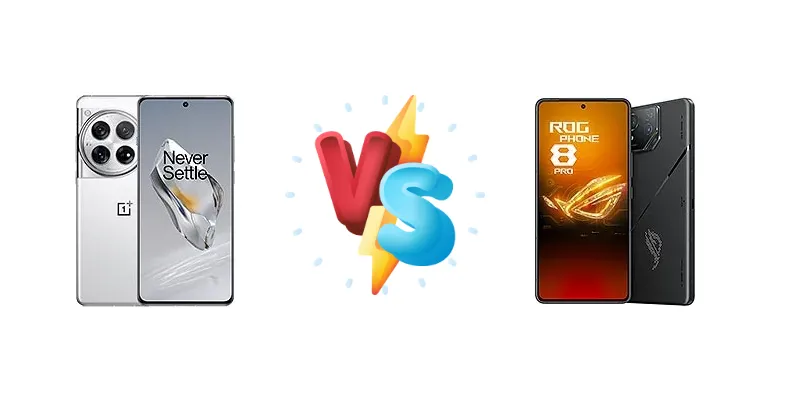
OnePlus 12 vs. Asus ROG Phone 8 Pro: A Deep Dive into Flagship Performance
| Phones Images | |||||
|---|---|---|---|---|---|
|
🏆 Quick Verdict
For the average user prioritizing a balanced experience with excellent camera capabilities and fast charging, the OnePlus 12 emerges as the winner. However, gamers who demand the brightest display, dedicated gaming features, and slightly longer battery life will find the Asus ROG Phone 8 Pro the superior choice.
| PHONES | ||
|---|---|---|
| Phone Names | OnePlus 12 | Asus ROG Phone 8 Pro |
| Network | ||
|---|---|---|
| 2G bands | GSM 850 / 900 / 1800 / 1900 | GSM 850 / 900 / 1800 / 1900 |
| 3G bands | HSDPA 850 / 900 / 1700(AWS) / 1900 / 2100 - International | HSDPA 850 / 900 / 1700(AWS) / 1800 / 1900 / 2100 - International |
| 4G bands | 1, 2, 3, 4, 5, 7, 8, 12, 13, 17, 18, 19, 20, 25, 26, 28, 30, 32, 38, 39, 40, 41, 48, 66, 71 - International | 1, 2, 3, 4, 5, 7, 8, 12, 17, 18, 19, 20, 25, 26, 28, 32, 34, 38, 39, 40, 41, 42, 43, 48, 66 - International |
| 5G bands | 1, 2, 3, 5, 7, 8, 12, 20, 25, 28, 30, 38, 40, 41, 66, 71, 77, 78 SA/NSA - International | 1, 2, 3, 5, 7, 8, 12, 18, 20, 25, 26, 28, 38, 40, 41, 48, 66, 77, 78, 79 SA/NSA/Sub6 - International |
| Speed | HSPA, LTE, 5G | HSPA, LTE (Up to 7CA), 5G |
| Technology | GSM / CDMA / HSPA / CDMA2000 / LTE / 5G | GSM / CDMA / HSPA / LTE / 5G |
| Launch | ||
|---|---|---|
| Announced | 2023, December 05 | 2024, January 08 |
| Status | Available. Released 2023, December 11 | Available. Released 2024, January 18 |
| Body | ||
|---|---|---|
| Build | Glass front (Gorilla Glass Victus 2), glass back (Gorilla Glass), aluminum frame | Glass front (Gorilla Glass Victus 2), glass back (Gorilla Glass), aluminum frame |
| Dimensions | 164.3 x 75.8 x 9.2 mm (6.47 x 2.98 x 0.36 in) | 163.8 x 76.8 x 8.9 mm (6.45 x 3.02 x 0.35 in) |
| SIM | · Nano-SIM· Nano-SIM + Nano-SIM + eSIM (max 2 at a time)· Nano-SIM + Nano-SIM | Nano-SIM + Nano-SIM |
| Weight | 220 g (7.76 oz) | 225 g (7.94 oz) |
| Display | ||
|---|---|---|
| Protection | Corning Gorilla Glass Victus 2 | Corning Gorilla Glass Victus 2 |
| Resolution | 1440 x 3168 pixels (~510 ppi density) | 1080 x 2400 pixels, 20:9 ratio (~388 ppi density) |
| Size | 6.82 inches, 113.0 cm2 (~90.8% screen-to-body ratio) | 6.78 inches, 111.0 cm2 (~88.2% screen-to-body ratio) |
| Type | LTPO AMOLED, 1B colors, 120Hz, 2160Hz PWM, Dolby Vision, HDR10+, 600 nits (typ), 1600 nits (HBM), 4500 nits (peak) | LTPO AMOLED, 1B colors, 165Hz, HDR10, 1600 nits (HBM), 2500 nits (peak) |
| Platform | ||
|---|---|---|
| CPU | Octa-core (1x3.3 GHz Cortex-X4 & 3x3.2 GHz Cortex-A720 & 2x3.0 GHz Cortex-A720 & 2x2.3 GHz Cortex-A520) | Octa-core (1x3.3 GHz Cortex-X4 & 3x3.2 GHz Cortex-A720 & 2x3.0 GHz Cortex-A720 & 2x2.3 GHz Cortex-A520) |
| Chipset | Qualcomm SM8650-AB Snapdragon 8 Gen 3 (4 nm) | Qualcomm SM8650-AB Snapdragon 8 Gen 3 (4 nm) |
| GPU | Adreno 750 | Adreno 750 |
| OS | Android 14, up to 4 major Android upgrades, OxygenOS 16 (International), ColorOS (China) | Android 14, up to 2 major Android upgrades |
| Memory | ||
|---|---|---|
| Card slot | No | No |
| Internal | 256GB 12GB RAM, 256GB 16GB RAM, 512GB 16GB RAM, 1TB 16GB RAM, 1TB 24GB RAM | 512GB 16GB RAM, 1TB 24GB RAM |
| Main Camera | ||
|---|---|---|
| Features | Hasselblad Color Calibration, color spectrum sensor, Dual-LED flash, HDR, panorama | LED flash, HDR, panorama |
| Triple | 50 MP, f/1.6, 23mm (wide), 1/1.43", 1.12µm, multi-directional PDAF, OIS 64 MP, f/2.6, 70mm (periscope telephoto), 1/2.0", 0.7µm, PDAF, OIS, 3x optical zoom 48 MP, f/2.2, 14mm, 114˚ (ultrawide), 1/2.0", 0.8µm, PDAF | 50 MP, f/1.9, 24mm (wide), 1/1.56", 1.0µm, PDAF, gimbal OIS 32 MP, f/2.4, (telephoto), 1/3.2", 0.7µm, PDAF, OIS, 3x optical zoom 13 MP, f/2.2, 13mm, 120˚ (ultrawide) |
| Video | 8K@24fps, 4K@30/60fps, 1080p@30/60/240/480fps, Auto HDR, gyro-EIS, Dolby Vision | 8K@24fps, 4K@30/60fps, 1080p@30/60/120/240fps, 720p@480fps; gyro-EIS, HDR10+ |
| Selfie camera | ||
|---|---|---|
| Features | HDR, panorama | Panorama, HDR |
| Single | 32 MP, f/2.4, 21mm (wide), 1/2.74", 0.8µm | 32 MP, f/2.5, 22mm (wide), 1/3.2", 0.7µm |
| Video | 4K@30fps, 1080p@30fps, gyro-EIS | 1080p@30fps |
| Sound | ||
|---|---|---|
| 35mm jack | No | Yes |
| Loudspeaker | Yes, with stereo speakers | Yes, with stereo speakers |
| Comms | ||
|---|---|---|
| Bluetooth | 5.4, A2DP, LE, aptX HD, LHDC | 5.4, A2DP, LE, aptX HD, aptX Adaptive, aptX Lossless |
| Infrared port | Yes | - |
| NFC | Yes | Yes |
| Positioning | GPS (L1+L5), GLONASS (G1), BDS (B1I+B1c+B2a), GALILEO (E1+E5a), QZSS (L1+L5), NavIC | GPS (L1+L5), BDS (B1I+B1c+B2a), GALILEO (E1+E5a), QZSS (L1+L5), NavIC (L5), GLONASS |
| Radio | No | No |
| USB | USB Type-C 3.2, OTG | USB Type-C (side), DisplayPort 1.4; USB Type-C (bottom), OTG |
| WLAN | Wi-Fi 802.11 a/b/g/n/ac/6e/7, tri-band, Wi-Fi Direct | Wi-Fi 802.11 a/b/g/n/ac/6e/7, tri-band, Wi-Fi Direct |
| Features | ||
|---|---|---|
| Sensors | Fingerprint (under display, optical), accelerometer, gyro, proximity, compass | Fingerprint (under display, optical), accelerometer, gyro, proximity, compass |
| Battery | ||
|---|---|---|
| Charging | 100W wired, PD, QC, 100% in 26 min (International) 80W wired, PD, QC, 100% in 30 min (USA) 50W wireless, 100% in 55 min 10W reverse wireless | 65W wired, PD3.0, PPS, QC5, 100% in 39 min - International 30W wired, PD3.0, PPS - India 15W wireless (Qi) 10W reverse wired |
| Type | Li-Po 5400 mAh | 5500 mAh |
| Misc | ||
|---|---|---|
| Colors | Flowy Emerald, Silky Black, Silver (Glacial White) | Phantom Black |
| Models | PJD110, CPH2573, CPH2581, CPH2583 | AI2401, AI2401_A, AI2401_D |
| Price | $ 639.99 / C$ 1,099.99 / £ 549.00 / € 527.00 | $ 1,157.98 / £ 1,693.75 / € 632.66 |
| SAR | 1.18 W/kg (head) 0.68 W/kg (body) | - |
OnePlus 12
- Significantly faster wired charging (100W/80W)
- Stronger all-around camera system (likely)
- More balanced design and software experience
- Lower peak display brightness
- Slightly shorter battery life
Asus ROG Phone 8 Pro
- Much brighter display for outdoor visibility
- Longer battery life in active use
- Dedicated gaming features (AirTriggers, cooling)
- Slower wired charging (65W/30W)
- Gaming-focused design may not appeal to everyone
- Wireless charging is significantly slower
Display Comparison
The Asus ROG Phone 8 Pro boasts a significantly brighter display, reaching a measured 1765 nits compared to the OnePlus 12’s 1155 nits. This difference is immediately noticeable in direct sunlight, giving the ROG Phone a clear advantage for outdoor use. While both utilize high refresh rate panels, the ROG Phone’s higher peak brightness and potentially superior color calibration (though not specified in the data) cater specifically to gamers and media consumers who demand visual fidelity. The OnePlus 12’s display is still excellent, but falls short in peak luminance.
Camera Comparison
Both phones feature capable camera systems, but the provided data doesn’t allow for a detailed comparison beyond noting both support photo and video capture. The ROG Phone 8 Pro’s camera system is likely tuned for vibrant, shareable images, while OnePlus typically aims for a more natural color profile. Without sensor size or aperture information, it’s difficult to definitively declare a winner. However, given OnePlus’s established reputation for camera quality, it likely holds a slight edge in overall image processing and versatility.
Performance
Both devices are powered by the Qualcomm SM8650-AB Snapdragon 8 Gen 3 (4 nm) with an identical CPU configuration – a 1x3.3 GHz Cortex-X4, 3x3.2 GHz Cortex-A720, 2x3.0 GHz Cortex-A720, and 2x2.3 GHz Cortex-A520. This means raw processing power will be nearly identical. However, the ROG Phone 8 Pro’s advanced cooling system, coupled with its gaming-centric software optimizations, likely allows it to sustain peak performance for longer periods without thermal throttling. While the OnePlus 12 will deliver excellent performance, the ROG Phone is engineered for extended, demanding gaming sessions.
Battery Life
The Asus ROG Phone 8 Pro edges out the OnePlus 12 in battery life, achieving 14:43 hours of active use compared to the OnePlus 12’s 14:11 hours. This difference, while not massive, is significant for power users. However, the OnePlus 12 compensates with significantly faster charging: 100W wired (international) or 80W (USA) can fully charge the phone in 26-30 minutes, while the ROG Phone 8 Pro takes 39 minutes with its 65W wired charging. The ROG Phone also offers slower 15W wireless charging compared to the OnePlus 12’s 50W wireless, and both offer 10W reverse wireless charging.
Buying Guide
Buy the OnePlus 12 if you need a versatile flagship with a stunning display, incredibly fast charging (especially the international 100W variant), and a strong camera system for everyday photography and videography. Buy the Asus ROG Phone 8 Pro if you prioritize an immersive gaming experience, demand the highest possible screen brightness for outdoor visibility, and appreciate features like AirTriggers and a more robust cooling system.