
OnePlus 12 vs. iPhone 15 Pro Max: A Deep Dive into Flagship Performance
| Phones Images | |||||
|---|---|---|---|---|---|
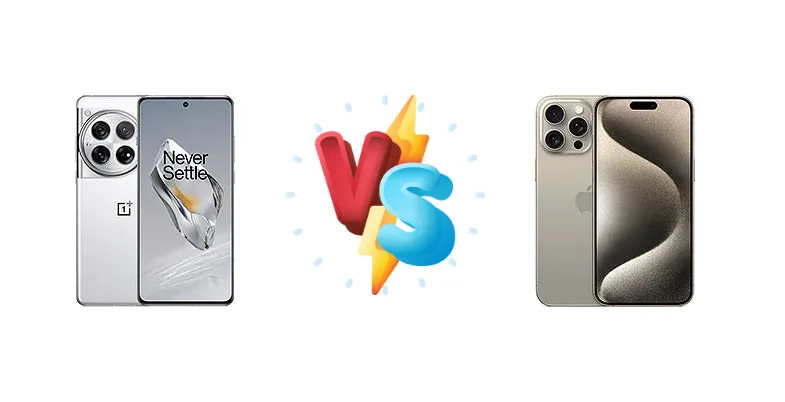
|
🏆 Quick Verdict
For the average user prioritizing battery life and charging speed, the OnePlus 12 offers a compelling value proposition. However, the iPhone 15 Pro Max’s superior display brightness, refined software experience, and long-term software support make it the better choice for those deeply invested in the Apple ecosystem.
| PHONES | ||
|---|---|---|
| Phone Names | OnePlus 12 | Apple iPhone 15 Pro Max |
| Network | ||
|---|---|---|
| 2G bands | GSM 850 / 900 / 1800 / 1900 | GSM 850 / 900 / 1800 / 1900 |
| 3G bands | HSDPA 850 / 900 / 1700(AWS) / 1900 / 2100 - International | HSDPA 850 / 900 / 1700(AWS) / 1900 / 2100 |
| 4G bands | 1, 2, 3, 4, 5, 7, 8, 12, 13, 17, 18, 19, 20, 25, 26, 28, 30, 32, 38, 39, 40, 41, 48, 66, 71 - International | 1, 2, 3, 4, 5, 7, 8, 12, 13, 17, 18, 19, 20, 25, 26, 28, 30, 32, 34, 38, 39, 40, 41, 42, 46, 48, 53, 66 - A3106 |
| 5G bands | 1, 2, 3, 5, 7, 8, 12, 20, 25, 28, 30, 38, 40, 41, 66, 71, 77, 78 SA/NSA - International | 1, 2, 3, 5, 7, 8, 12, 20, 25, 26, 28, 30, 38, 40, 41, 48, 53, 66, 70, 77, 78, 79 SA/NSA/Sub6 - A3106 |
| Speed | HSPA, LTE, 5G | HSPA, LTE, 5G, EV-DO Rev.A 3.1 Mbps |
| Technology | GSM / CDMA / HSPA / CDMA2000 / LTE / 5G | GSM / CDMA / HSPA / EVDO / LTE / 5G |
| Launch | ||
|---|---|---|
| Announced | 2023, December 05 | 2023, September 12 |
| Status | Available. Released 2023, December 11 | Available. Released 2023, September 22 |
| Body | ||
|---|---|---|
| Build | Glass front (Gorilla Glass Victus 2), glass back (Gorilla Glass), aluminum frame | Glass front, glass back, titanium frame (grade 5) |
| Dimensions | 164.3 x 75.8 x 9.2 mm (6.47 x 2.98 x 0.36 in) | 159.9 x 76.7 x 8.3 mm (6.30 x 3.02 x 0.33 in) |
| SIM | · Nano-SIM· Nano-SIM + Nano-SIM + eSIM (max 2 at a time)· Nano-SIM + Nano-SIM | · Nano-SIM + eSIM + eSIM (max 2 at a time; International)· eSIM + eSIM (8 or more, max 2 at a time; USA)· Nano-SIM + Nano-SIM (China) |
| Weight | 220 g (7.76 oz) | 221 g (7.80 oz) |
| Display | ||
|---|---|---|
| Protection | Corning Gorilla Glass Victus 2 | Ceramic Shield glass |
| Resolution | 1440 x 3168 pixels (~510 ppi density) | 1290 x 2796 pixels, 19.5:9 ratio (~460 ppi density) |
| Size | 6.82 inches, 113.0 cm2 (~90.8% screen-to-body ratio) | 6.7 inches, 110.2 cm2 (~89.8% screen-to-body ratio) |
| Type | LTPO AMOLED, 1B colors, 120Hz, 2160Hz PWM, Dolby Vision, HDR10+, 600 nits (typ), 1600 nits (HBM), 4500 nits (peak) | LTPO Super Retina XDR OLED, 120Hz, HDR10, Dolby Vision, 1000 nits (typ), 2000 nits (HBM) |
| Platform | ||
|---|---|---|
| CPU | Octa-core (1x3.3 GHz Cortex-X4 & 3x3.2 GHz Cortex-A720 & 2x3.0 GHz Cortex-A720 & 2x2.3 GHz Cortex-A520) | Hexa-core (2x3.78 GHz + 4x2.11 GHz) |
| Chipset | Qualcomm SM8650-AB Snapdragon 8 Gen 3 (4 nm) | Apple A17 Pro (3 nm) |
| GPU | Adreno 750 | Apple GPU (6-core graphics) |
| OS | Android 14, up to 4 major Android upgrades, OxygenOS 16 (International), ColorOS (China) | iOS 17, upgradable to iOS 26.1 |
| Memory | ||
|---|---|---|
| Card slot | No | No |
| Internal | 256GB 12GB RAM, 256GB 16GB RAM, 512GB 16GB RAM, 1TB 16GB RAM, 1TB 24GB RAM | 256GB 8GB RAM, 512GB 8GB RAM, 1TB 8GB RAM |
| Main Camera | ||
|---|---|---|
| Features | Hasselblad Color Calibration, color spectrum sensor, Dual-LED flash, HDR, panorama | Dual-LED dual-tone flash, HDR (photo/panorama) |
| Triple | 50 MP, f/1.6, 23mm (wide), 1/1.43", 1.12µm, multi-directional PDAF, OIS 64 MP, f/2.6, 70mm (periscope telephoto), 1/2.0", 0.7µm, PDAF, OIS, 3x optical zoom 48 MP, f/2.2, 14mm, 114˚ (ultrawide), 1/2.0", 0.8µm, PDAF | 48 MP, f/1.8, 24mm (wide), 1/1.28", 1.22µm, dual pixel PDAF, sensor-shift OIS 12 MP, f/2.8, 120mm (periscope telephoto), 1/3.06", 1.12µm, dual pixel PDAF, 3D sensor‑shift OIS, 5x optical zoom 12 MP, f/2.2, 13mm, 120˚ (ultrawide), 1/2.55", 1.4µm, dual pixel PDAF TOF 3D LiDAR scanner (depth) |
| Video | 8K@24fps, 4K@30/60fps, 1080p@30/60/240/480fps, Auto HDR, gyro-EIS, Dolby Vision | 4K@24/25/30/60fps, 1080p@25/30/60/120/240fps, 10-bit HDR, Dolby Vision HDR (up to 60fps), ProRes, 3D (spatial) video, stereo sound rec. |
| Selfie camera | ||
|---|---|---|
| Features | HDR, panorama | HDR, Dolby Vision HDR |
| Single | 32 MP, f/2.4, 21mm (wide), 1/2.74", 0.8µm | 12 MP, f/1.9, 23mm (wide), 1/3.6", 1.0µm, PDAF, OIS SL 3D, (depth/biometrics sensor) |
| Video | 4K@30fps, 1080p@30fps, gyro-EIS | 4K@24/25/30/60fps, 1080p@25/30/60/120fps, gyro-EIS |
| Sound | ||
|---|---|---|
| 35mm jack | No | No |
| Loudspeaker | Yes, with stereo speakers | Yes, with stereo speakers |
| Comms | ||
|---|---|---|
| Bluetooth | 5.4, A2DP, LE, aptX HD, LHDC | 5.3, A2DP, LE |
| Infrared port | Yes | - |
| NFC | Yes | Yes |
| Positioning | GPS (L1+L5), GLONASS (G1), BDS (B1I+B1c+B2a), GALILEO (E1+E5a), QZSS (L1+L5), NavIC | GPS (L1+L5), GLONASS, GALILEO, BDS, QZSS, NavIC |
| Radio | No | No |
| USB | USB Type-C 3.2, OTG | USB Type-C 3.2 Gen 2, DisplayPort |
| WLAN | Wi-Fi 802.11 a/b/g/n/ac/6e/7, tri-band, Wi-Fi Direct | Wi-Fi 802.11 a/b/g/n/ac/6e, tri-band, hotspot |
| Features | ||
|---|---|---|
| Sensors | Fingerprint (under display, optical), accelerometer, gyro, proximity, compass | Face ID, accelerometer, gyro, proximity, compass, barometer |
| Battery | ||
|---|---|---|
| Charging | 100W wired, PD, QC, 100% in 26 min (International) 80W wired, PD, QC, 100% in 30 min (USA) 50W wireless, 100% in 55 min 10W reverse wireless | Wired, PD2.0, 50% in 30 min 15W wireless (MagSafe) 15W wireless (Qi2) - requires iOS 17.2 update 4.5W reverse wired |
| Type | Li-Po 5400 mAh | Li-Ion 4441 mAh |
| Misc | ||
|---|---|---|
| Colors | Flowy Emerald, Silky Black, Silver (Glacial White) | Black Titanium, White Titanium, Blue Titanium, Natural Titanium |
| Models | PJD110, CPH2573, CPH2581, CPH2583 | A2849, A3105, A3106, A3108, iPhone16,2 |
| Price | $ 639.99 / C$ 1,099.99 / £ 549.00 / € 527.00 | € 758.79 / $ 579.87 / £ 628.29 |
| SAR | 1.18 W/kg (head) 0.68 W/kg (body) | 1.07 W/kg (head) 1.11 W/kg (body) |
| SAR EU | - | 0.98 W/kg (head) 0.98 W/kg (body) |
OnePlus 12
- Significantly faster wired and wireless charging
- More affordable price point
- Android’s customization options
- Lower peak display brightness
- Potentially less refined camera processing
- Shorter active use battery life
Apple iPhone 15 Pro Max
- Brighter and more color-accurate display
- Superior performance (A17 Pro)
- Long-term software support and ecosystem integration
- Slower charging speeds
- Higher price
- Less customization options (iOS)
Display Comparison
The iPhone 15 Pro Max boasts a significantly brighter display, reaching a measured 1787 nits compared to the OnePlus 12’s 1155 nits. This translates to superior visibility in direct sunlight. Both utilize advanced panel technology, but the iPhone’s higher peak brightness and potentially better color calibration (though unmeasured in our data) provide a more immersive viewing experience. While both are excellent, the iPhone’s display is demonstrably superior for outdoor use and HDR content consumption. The OnePlus 12’s display is still excellent, but falls short of the iPhone’s peak performance.
Camera Comparison
Both phones are equipped with advanced camera systems, but detailed sensor information is missing. However, the market positioning suggests the iPhone 15 Pro Max likely features a larger main sensor and more sophisticated image processing algorithms. Apple’s computational photography is renowned for its natural-looking results, while OnePlus typically leans towards more vibrant, saturated images. Both are capable of excellent photo and video capture, but the iPhone’s consistent performance and video recording capabilities (ProRes) give it an advantage for professional users. The absence of specific sensor details prevents a definitive judgment, but Apple’s history suggests a more refined camera experience.
Performance
The core of each phone is a powerhouse. The iPhone 15 Pro Max’s Apple A17 Pro, fabricated on a 3nm process, is a marvel of silicon engineering. While the OnePlus 12’s Snapdragon 8 Gen 3 (4nm) is no slouch, the A17 Pro’s hexa-core architecture, with its 3.78 GHz performance cores, likely delivers superior single-core performance. The Snapdragon 8 Gen 3’s octa-core configuration, while offering more cores, may be offset by the A17 Pro’s architectural advantages. Real-world performance will be fluid on both, but the A17 Pro has a theoretical edge in demanding tasks. The iPhone’s GPU is also likely to outperform the Snapdragon’s Adreno 750.
Battery Life
The iPhone 15 Pro Max edges out the OnePlus 12 in active use battery life, achieving 16:01 hours versus 14:11 hours. However, the OnePlus 12 compensates with significantly faster charging. Its 100W wired charging (international) can fully charge the battery in just 26 minutes, while the iPhone 15 Pro Max takes 30 minutes for a 50% charge. The OnePlus 12 also offers 50W wireless charging, a substantial advantage over the iPhone’s 15W MagSafe/Qi2. While the iPhone has a longer endurance rating (118h), the OnePlus 12’s charging speed minimizes downtime, making it more convenient for users who frequently need to top up their battery.
Buying Guide
Buy the OnePlus 12 if you need exceptionally fast charging (100W wired, 50W wireless), a vibrant display, and are comfortable with Android’s customization options. It’s ideal for power users who frequently drain their battery and want to minimize downtime. Buy the Apple iPhone 15 Pro Max if you prioritize a consistently bright and color-accurate display, seamless iOS integration, and a proven track record of long-term software updates. It’s the best choice for users already within the Apple ecosystem and those valuing a polished, user-friendly experience.