
OnePlus 11 vs Xiaomi 13 Pro: The Definitive Comparison
| Phones Images | |||||
|---|---|---|---|---|---|
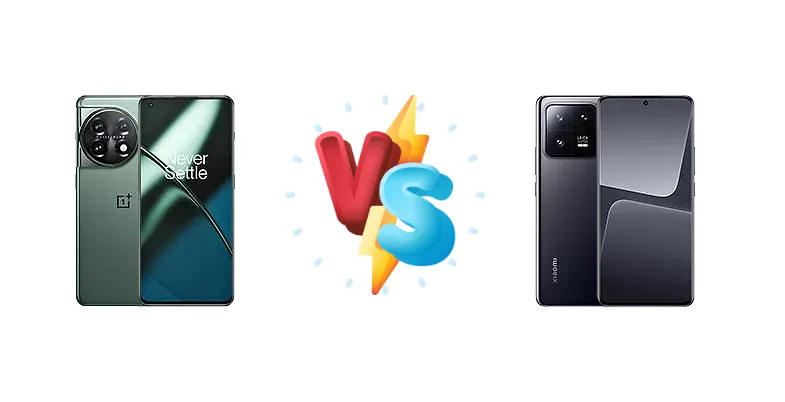
|
🏆 Quick Verdict
The Xiaomi 13 Pro edges out the OnePlus 11 thanks to its significantly brighter display, faster charging (wired and wireless), and slightly better endurance rating. However, the OnePlus 11 offers a compelling alternative with a potentially more refined software experience and competitive pricing.
| PHONES | ||
|---|---|---|
| Phone Names | OnePlus 11 | Xiaomi 13 Pro |
| Network | ||
|---|---|---|
| 2G bands | GSM 850 / 900 / 1800 / 1900 | GSM 850 / 900 / 1800 / 1900 |
| 3G bands | HSDPA 800 / 850 / 900 / 1700(AWS) / 1900 / 2100 | HSDPA 800 / 850 / 900 / 1700(AWS) / 1900 / 2100 |
| 4G bands | 1, 2, 3, 4, 5, 7, 8, 12, 13, 17, 18, 19, 20, 25, 26, 28, 30, 32, 38, 39, 41, 40, 46, 48, 66, 71 - International | 1, 2, 3, 4, 5, 7, 8, 12, 13, 17, 18, 19, 20, 25, 26, 28, 32, 38, 39, 40, 41, 42, 48, 66 - International |
| 5G bands | 1, 2, 3, 5, 7, 8, 20, 25, 28, 30, 38, 40, 41, 66, 71, 75, 77, 78 SA/NSA - International | 1, 3, 5, 7, 8, 20, 28, 38, 40, 41, 66, 71, 75, 77, 78 SA/NSA - International |
| Speed | HSPA, LTE, 5G | HSPA, LTE, 5G |
| Technology | GSM / CDMA / HSPA / EVDO / LTE / 5G | GSM / CDMA / HSPA / CDMA2000 / LTE / 5G |
| 1, 3, 5, 7, 8, 20, 28, 38, 40, 41, 66, 77, 78 SA/NSA - China | 1, 3, 5, 8, 28, 38, 40, 41, 77, 78, 79 SA/NSA - China | |
| Launch | ||
|---|---|---|
| Announced | 2023, January 04 | 2022, December 11 |
| Status | Available. Released 2023, January 09 | Available. Released 2022, December 14 |
| Body | ||
|---|---|---|
| Build | Glass front (Gorilla Glass Victus), glass back (Gorilla Glass 5), aluminum frame | Glass front (Gorilla Glass Victus), ceramic back or silicone polymer back, aluminum frame |
| Dimensions | 163.1 x 74.1 x 8.5 mm (6.42 x 2.92 x 0.33 in) | 162.9 x 74.6 x 8.4 mm or 8.7 mm |
| SIM | · Nano-SIM· Nano-SIM + Nano-SIM + eSIM (max 2 at a time) | · Nano-SIM + eSIM· Nano-SIM + Nano-SIM |
| Weight | 205 g (7.23 oz) | 210 g or 229 g (7.41 oz) |
| IP64 | IP68 dust/water resistant (up to 1.5m for 30 min) | |
| Display | ||
|---|---|---|
| Protection | Corning Gorilla Glass Victus | Corning Gorilla Glass Victus |
| Resolution | 1440 x 3216 pixels, 20:9 ratio (~525 ppi density) | 1440 x 3200 pixels, 20:9 ratio (~522 ppi density) |
| Size | 6.7 inches, 108.4 cm2 (~89.7% screen-to-body ratio) | 6.73 inches, 108.9 cm2 (~89.6% screen-to-body ratio) |
| Type | LTPO3 Fluid AMOLED, 1B colors, 120Hz, Dolby Vision, HDR10+, 500 nits (typ), 800 nits (HBM), 1300 nits (peak) | LTPO AMOLED, 1B colors, 120Hz, Dolby Vision, HDR10+, 1200 nits (HBM), 1900 nits (peak) |
| Always-on display | - | |
| Platform | ||
|---|---|---|
| CPU | Octa-core (1x3.2 GHz Cortex-X3 & 2x2.8 GHz Cortex-A715 & 2x2.8 GHz Cortex-A710 & 3x2.0 GHz Cortex-A510) | Octa-core (1x3.2 GHz Cortex-X3 & 2x2.8 GHz Cortex-A715 & 2x2.8 GHz Cortex-A710 & 3x2.0 GHz Cortex-A510) |
| Chipset | Qualcomm SM8550-AB Snapdragon 8 Gen 2 (4 nm) | Qualcomm SM8550-AB Snapdragon 8 Gen 2 (4 nm) |
| GPU | Adreno 740 | Adreno 740 |
| OS | Android 13, upgradable to Android 15, OxygenOS 15 (International), ColorOS 14 (China) | Android 13, upgradable to Android 14, HyperOS |
| Memory | ||
|---|---|---|
| Card slot | No | No |
| Internal | 128GB 8GB RAM, 256GB 12GB RAM, 256GB 16GB RAM, 512GB 16GB RAM | 128GB 8GB RAM, 256GB 8GB RAM, 256GB 12GB RAM, 512GB 12GB RAM |
| UFS 3.1 - 128GB only UFS 4.0 | UFS 3.1 - 128GB UFS 4.0 - 256/512GB | |
| Main Camera | ||
|---|---|---|
| Features | Hasselblad Color Calibration, color spectrum sensor, Dual-LED flash, HDR, panorama | Laser AF, color spectrum sensor, Leica lens, Dual-LED dual-tone flash, HDR, panorama |
| Single | 16 MP, f/2.5, 25mm (wide), 1.0µm | - |
| Triple | 50 MP, f/1.8, 24mm (wide), 1/1.56", 1.0µm, multi-directional PDAF, OIS 32 MP, f/2.0, 48mm (telephoto), 1/2.74", PDAF, 2x optical zoom 48 MP, f/2.2, 115˚, (ultrawide), 1/2.0", AF | 50.3 MP, f/1.9, 23mm (wide), 1.0"-type, 1.6µm, dual pixel PDAF, OIS 50 MP, f/2.0, 75mm (telephoto), PDAF (10cm - ∞), 3.2x optical zoom 50 MP, f/2.2, 14mm, 115˚ (ultrawide), AF |
| Video | 8K@24fps, 4K@30/60fps, 1080p@30/60/240fps, Auto HDR, gyro-EIS | 8K@24fps (HDR), 4K@24/30/60fps (HDR10+, 10-bit Dolby Vision HDR, 10-bit LOG), 1080p@30/120/240/960fps, 1080p@1920fps, gyro-EIS |
| Selfie camera | ||
|---|---|---|
| Features | HDR, panorama | HDR, panorama |
| Single | 16 MP, f/2.5, 25mm (wide), 1.0µm | 32 MP, f/2.0, 22mm (wide), 1/3.14", 0.7µm |
| Video | 1080p@30fps, gyro-EIS | 1080p@30fps |
| Sound | ||
|---|---|---|
| 3.5mm jack | No | No |
| 35mm jack | No | No |
| Loudspeaker | Yes, with stereo speakers | Yes, with stereo speakers |
| 24-bit/192kHz audio | 24-bit/192kHz audio | |
| Comms | ||
|---|---|---|
| Bluetooth | 5.3, A2DP, LE, aptX HD | 5.3, A2DP, aptX HD, aptX Adaptive |
| Infrared port | - | Yes |
| NFC | Yes | Yes |
| Positioning | GPS (L1+L5), GLONASS (G1), BDS (B1I+B1c+B2a), GALILEO (E1+E5a), QZSS (L1+L5) | GPS (L1+L5), GLONASS (G1), BDS (B1I+B1c+B2a), GALILEO (E1+E5a), QZSS (L1+L5), NavIC (L5) |
| Radio | No | No |
| USB | USB Type-C 2.0, OTG | USB Type-C 2.0, OTG |
| WLAN | Wi-Fi 802.11 a/b/g/n/ac/6/7, dual-band, Wi-Fi Direct | Wi-Fi 802.11 a/b/g/n/ac/6e, dual-band, Wi-Fi Direct |
| Features | ||
|---|---|---|
| Sensors | Fingerprint (under display, optical), accelerometer, gyro, proximity, compass | Fingerprint (under display, optical), accelerometer, proximity, gyro, compass, barometer |
| Battery | ||
|---|---|---|
| Charging | 100W wired, PD, 50% in 10 min, 100% in 25 min - International 80W wired, PD - USA | 120W wired, PD3.0, QC4, 100% in 19 min 50W wireless, 100% in 36 min 10W reverse wireless |
| Type | Li-Po 5000 mAh | Li-Po 4820 mAh |
| Misc | ||
|---|---|---|
| Colors | Titan Black, Eternal Green, Jupiter Rock | Ceramic White, Ceramic Black, Ceramic Flora Green, Mountain Blue |
| Models | PHB110, CPH2449, CPH2447, CPH2451 | 2210132G, 2210132C |
| Price | $ 379.99 / ₹ 33,990 | About 750 EUR |
| SAR | 1.19 W/kg (head) 0.99 W/kg (body) | - |
| Tests | ||
|---|---|---|
| Battery life | Endurance rating 108h | Endurance rating 115h |
| Camera | Photo / Video | Photo / Video |
| Display | Contrast ratio: Infinite (nominal) | Contrast ratio: Infinite (nominal) |
| Loudspeaker | -25.2 LUFS (Very good) | -25.6 LUFS (Very good) |
| Performance | AnTuTu: 1140661 (v9) GeekBench: 4899 (v5.1) GFXBench: 57fps (ES 3.1 onscreen) | AnTuTu: 1281666 (v9) GeekBench: 5087 (v5.1), 5323 (v6) GFXBench: 64fps (ES 3.1 onscreen) |
OnePlus 11
- Fast 100W wired charging (International)
- Clean and smooth OxygenOS
- Competitive pricing
- Excellent performance
- Lower peak brightness compared to Xiaomi 13 Pro
- Less versatile charging options (no wireless)
- Camera slightly behind Xiaomi 13 Pro
Xiaomi 13 Pro
- Brighter display (1253 nits)
- Faster 120W wired charging
- 50W wireless charging
- Excellent camera system
- Premium build quality
- Potentially more complex MIUI software
- Higher price point
- Availability may vary
Display Comparison
The Xiaomi 13 Pro's display is a clear winner. Measuring 1253 nits peak brightness compared to the OnePlus 11's 767 nits, it offers significantly better visibility in direct sunlight. Both have excellent contrast ratios (infinite nominal), but the Xiaomi's sheer brightness provides a more immersive viewing experience. Both utilize AMOLED technology with vibrant colors and smooth refresh rates.
Camera Comparison
Both offer excellent camera systems, but the Xiaomi 13 Pro generally receives higher praise for its image quality, particularly in challenging lighting conditions. The Xiaomi's larger sensor and advanced image processing algorithms contribute to more detailed and vibrant photos. The OnePlus 11's camera is still very capable, offering a pleasing color science and fast autofocus. Video recording capabilities are also excellent on both devices.
Performance
Both phones are powered by the Snapdragon 8 Gen 2, ensuring top-tier performance. Expect incredibly fast app loading, seamless multitasking, and smooth gaming. While benchmarks might show minor differences, real-world performance will be virtually identical for most users. Thermal management will be a key factor in sustained performance, and both manufacturers have implemented cooling solutions.
Battery Life
The Xiaomi 13 Pro holds a slight advantage in battery endurance, with an endurance rating of 115 hours compared to the OnePlus 11's 108 hours. However, the OnePlus 11's 100W wired charging is incredibly fast, reaching 50% in just 10 minutes and 100% in 25 minutes (International). The Xiaomi 13 Pro's 120W wired charging is even faster (100% in 19 minutes) and it also offers 50W wireless charging and 10W reverse wireless charging, providing greater versatility.
Buying Guide
The OnePlus 11 is ideal for users prioritizing a smooth, clean Android experience, fast wired charging, and a slightly more budget-friendly flagship. The Xiaomi 13 Pro is best suited for those who demand the brightest possible display, blazing-fast charging speeds (including wireless), and a premium camera experience.