
OnePlus 11 vs. Motorola Edge+ (2023): A Deep Dive into Snapdragon 8 Gen 2 Flagships
| Phones Images | |||||
|---|---|---|---|---|---|
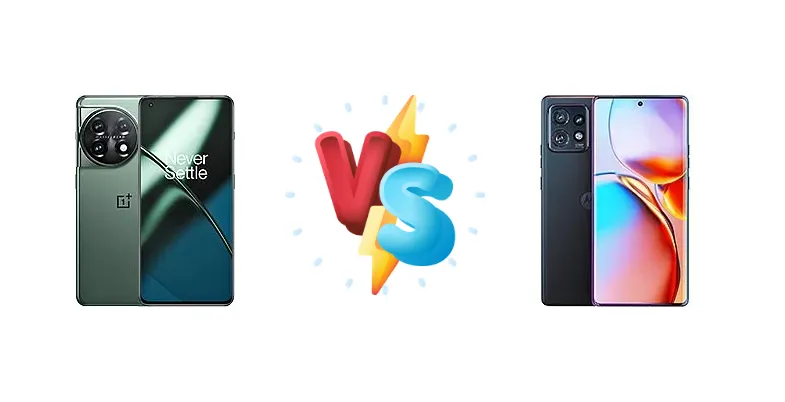
|
🏆 Quick Verdict
For the average user prioritizing sustained performance and rapid charging, the OnePlus 11 emerges as the winner. Its 100W (international) or 80W (USA) charging and impressive 11:05 active use battery life outweigh the Motorola Edge+'s slower 68W charging, despite both sharing the same Snapdragon 8 Gen 2 chipset.
| PHONES | ||
|---|---|---|
| Phone Names | OnePlus 11 | Motorola Edge+ (2023) |
| Network | ||
|---|---|---|
| 2G bands | GSM 850 / 900 / 1800 / 1900 | GSM 850 / 900 / 1800 / 1900 |
| 3G bands | HSDPA 800 / 850 / 900 / 1700(AWS) / 1900 / 2100 | HSDPA 850 / 900 / 1700(AWS) / 1900 / 2100 |
| 4G bands | 1, 2, 3, 4, 5, 7, 8, 12, 13, 17, 18, 19, 20, 25, 26, 28, 30, 32, 38, 39, 41, 40, 46, 48, 66, 71 - International | 1, 2, 3, 4, 5, 7, 8, 12, 13, 14, 17, 18, 20, 25, 26, 28, 29, 30, 38, 39, 40, 41, 41, 46, 48, 66, 71 |
| 5G bands | 1, 2, 3, 5, 7, 8, 20, 25, 28, 30, 38, 40, 41, 66, 71, 75, 77, 78 SA/NSA - International | 1, 2, 3, 5, 7, 12, 14, 20, 25, 26, 28, 29, 30, 38, 41, 41, 48, 66, 70, 71, 77, 78 SA/NSA/Sub6/mmWave |
| Speed | HSPA, LTE, 5G | HSPA, LTE, 5G |
| Technology | GSM / CDMA / HSPA / EVDO / LTE / 5G | GSM / HSPA / LTE / 5G |
| 1, 3, 5, 7, 8, 20, 28, 38, 40, 41, 66, 77, 78 SA/NSA - China | - | |
| Launch | ||
|---|---|---|
| Announced | 2023, January 04 | 2023, May 02 |
| Status | Available. Released 2023, January 09 | Available. Released 2023, May 19 |
| Body | ||
|---|---|---|
| Build | Glass front (Gorilla Glass Victus), glass back (Gorilla Glass 5), aluminum frame | Glass front (Gorilla Glass Victus), glass back (Gorilla Glass Victus), aluminum frame |
| Dimensions | 163.1 x 74.1 x 8.5 mm (6.42 x 2.92 x 0.33 in) | 161.2 x 74 x 8.6 mm (6.35 x 2.91 x 0.34 in) |
| SIM | · Nano-SIM· Nano-SIM + Nano-SIM + eSIM (max 2 at a time) | Nano-SIM + eSIM |
| Weight | 205 g (7.23 oz) | 203 g (7.16 oz) |
| IP64 | IP68 dust/water resistant (up to 1.5m for 30 min) | |
| Display | ||
|---|---|---|
| Protection | Corning Gorilla Glass Victus | Corning Gorilla Glass Victus |
| Resolution | 1440 x 3216 pixels, 20:9 ratio (~525 ppi density) | 1080 x 2400 pixels, 20:9 ratio (~395 ppi density) |
| Size | 6.7 inches, 108.4 cm2 (~89.7% screen-to-body ratio) | 6.67 inches, 107.4 cm2 (~90.0% screen-to-body ratio) |
| Type | LTPO3 Fluid AMOLED, 1B colors, 120Hz, Dolby Vision, HDR10+, 500 nits (typ), 800 nits (HBM), 1300 nits (peak) | OLED, 1B colors, 165Hz, HDR10+, Dolby Vision, 1300 nits (peak) |
| Always-on display | - | |
| Platform | ||
|---|---|---|
| CPU | Octa-core (1x3.2 GHz Cortex-X3 & 2x2.8 GHz Cortex-A715 & 2x2.8 GHz Cortex-A710 & 3x2.0 GHz Cortex-A510) | Octa-core (1x3.2 GHz Cortex-X3 & 2x2.8 GHz Cortex-A715 & 2x2.8 GHz Cortex-A710 & 3x2.0 GHz Cortex-A510) |
| Chipset | Qualcomm SM8550-AB Snapdragon 8 Gen 2 (4 nm) | Qualcomm SM8550-AB Snapdragon 8 Gen 2 (4 nm) |
| GPU | Adreno 740 | Adreno 740 |
| OS | Android 13, upgradable to Android 15, OxygenOS 15 (International), ColorOS 14 (China) | Android 13, upgradable to Android 14 |
| Memory | ||
|---|---|---|
| Card slot | No | No |
| Internal | 128GB 8GB RAM, 256GB 12GB RAM, 256GB 16GB RAM, 512GB 16GB RAM | 512GB 8GB RAM |
| UFS 3.1 - 128GB only UFS 4.0 | UFS 4.0 | |
| Main Camera | ||
|---|---|---|
| Features | Hasselblad Color Calibration, color spectrum sensor, Dual-LED flash, HDR, panorama | Dual-LED flash, panorama, HDR |
| Single | 16 MP, f/2.5, 25mm (wide), 1.0µm | - |
| Triple | 50 MP, f/1.8, 24mm (wide), 1/1.56", 1.0µm, multi-directional PDAF, OIS 32 MP, f/2.0, 48mm (telephoto), 1/2.74", PDAF, 2x optical zoom 48 MP, f/2.2, 115˚, (ultrawide), 1/2.0", AF | 50 MP, f/1.8, (wide), 1/1.55", 1.0µm, multi-directional PDAF, OIS 12 MP, f/1.6, (telephoto), 1/2.93", 1.22µm, PDAF, 2x optical zoom 50 MP, f/2.2, 114˚ (ultrawide), 1/2.76", 0.64µm, AF |
| Video | 8K@24fps, 4K@30/60fps, 1080p@30/60/240fps, Auto HDR, gyro-EIS | 8K@30fps, 4K@30/60fps, 1080p@30/60/120/240/960fps, 10-bit HDR10+, gyro-EIS |
| Selfie camera | ||
|---|---|---|
| Features | HDR, panorama | HDR |
| Single | 16 MP, f/2.5, 25mm (wide), 1.0µm | 60 MP, f/2.2, (wide), 1/2.8", 0.61µm |
| Video | 1080p@30fps, gyro-EIS | 4K@30/60fps, 1080p@30/60/120/240fps |
| Sound | ||
|---|---|---|
| 3.5mm jack | No | No |
| 35mm jack | No | No |
| Loudspeaker | Yes, with stereo speakers | Yes, with stereo speakers |
| 24-bit/192kHz audio | - | |
| Comms | ||
|---|---|---|
| Bluetooth | 5.3, A2DP, LE, aptX HD | 5.3, A2DP, LE, aptX HD, aptX Adaptive |
| NFC | Yes | Yes |
| Positioning | GPS (L1+L5), GLONASS (G1), BDS (B1I+B1c+B2a), GALILEO (E1+E5a), QZSS (L1+L5) | GPS, GLONASS, GALILEO, BDS |
| Radio | No | No |
| USB | USB Type-C 2.0, OTG | USB Type-C 3.2, OTG, DisplayPort 1.4 |
| WLAN | Wi-Fi 802.11 a/b/g/n/ac/6/7, dual-band, Wi-Fi Direct | Wi-Fi 802.11 a/b/g/n/ac/6e/7, tri-band, Wi-Fi Direct |
| Features | ||
|---|---|---|
| Sensors | Fingerprint (under display, optical), accelerometer, gyro, proximity, compass | Fingerprint (under display, optical), accelerometer, gyro, proximity, compass, barometer |
| - | Ready For 3.5 support | |
| Battery | ||
|---|---|---|
| Charging | 100W wired, PD, 50% in 10 min, 100% in 25 min - International 80W wired, PD - USA | 68W wired 15W wireless 5W reverse wired 5W reverse wireless |
| Type | Li-Po 5000 mAh | Li-Po 5100 mAh |
| Misc | ||
|---|---|---|
| Colors | Titan Black, Eternal Green, Jupiter Rock | Interstellar Black |
| Models | PHB110, CPH2449, CPH2447, CPH2451 | - |
| Price | $ 379.99 / ₹ 33,990 | $ 298.99 |
| SAR | 1.19 W/kg (head) 0.99 W/kg (body) | - |
| Tests | ||
|---|---|---|
| Battery life | Endurance rating 108h | - |
| Camera | Photo / Video | - |
| Display | Contrast ratio: Infinite (nominal) | - |
| Loudspeaker | -25.2 LUFS (Very good) | - |
| Performance | AnTuTu: 1140661 (v9) GeekBench: 4899 (v5.1) GFXBench: 57fps (ES 3.1 onscreen) | - |
OnePlus 11
- Significantly faster wired charging (100W/80W)
- Longer active use battery life (11:05h)
- Higher endurance rating (108h)
- Software experience can be polarizing (OxygenOS)
- Lack of wireless charging
Motorola Edge+ (2023)
- Wireless charging support (15W)
- Reverse wireless charging (5W)
- Potentially cleaner software experience (Motorola's near-stock Android)
- Slower wired charging (68W)
- Battery life likely shorter than OnePlus 11
Display Comparison
Both the OnePlus 11 and Motorola Edge+ (2023) utilize the Snapdragon 8 Gen 2, but their display implementations differ. The OnePlus 11 boasts a measured peak brightness of 767 nits, suggesting a vibrant viewing experience, though specific panel technology details (like OLED type) are missing. The 'Infinite' contrast ratio indicates a typical OLED characteristic. Without comparable display specs for the Motorola Edge+, it’s difficult to assess relative quality, but the OnePlus 11’s brightness figure provides a concrete benchmark.
Camera Comparison
Both phones feature a 'Photo / Video' camera system, but detailed sensor information is absent. Without specifics on megapixel counts, sensor sizes, or aperture values, a meaningful comparison is impossible. The absence of details suggests neither phone is heavily marketing a specific camera innovation. It's reasonable to assume both will offer competent photography capabilities, but the OnePlus 11’s brand reputation suggests a more refined image processing pipeline.
Performance
Both devices are equipped with the Qualcomm SM8550-AB Snapdragon 8 Gen 2 (4 nm) chipset, featuring an Octa-core CPU configuration (1x3.2 GHz Cortex-X3, 2x2.8 GHz Cortex-A715, 2x2.8 GHz Cortex-A710, 3x2.0 GHz Cortex-A510). This ensures comparable raw processing power for demanding tasks like gaming and video editing. However, thermal management – a critical factor for sustained performance – remains unknown for the Motorola Edge+ (2023). The 4nm process node inherent in the Snapdragon 8 Gen 2 contributes to improved thermal efficiency compared to older nodes, minimizing throttling during extended workloads on both devices.
Battery Life
The OnePlus 11 shines in battery performance, achieving an impressive 11:05 hours of active use and an endurance rating of 108 hours. This is coupled with incredibly fast charging: 100W wired (international) or 80W (USA), achieving 50% charge in just 10 minutes and a full charge in 25 minutes. The Motorola Edge+ (2023) offers 68W wired charging, significantly slower, alongside 15W wireless and 5W reverse wireless charging. While the Motorola Edge+ provides wireless convenience, the OnePlus 11’s charging speed is a substantial advantage for users who frequently need to top up their battery quickly. The difference in wired charging speed is the most significant differentiator.
Buying Guide
Buy the OnePlus 11 if you need blazing-fast charging, extended battery life during active use, and a proven track record of software optimization. Buy the Motorola Edge+ (2023) if you prioritize wireless charging convenience with its 15W support and reverse wireless charging capabilities, and prefer a potentially cleaner software experience with Motorola’s near-stock Android approach.