
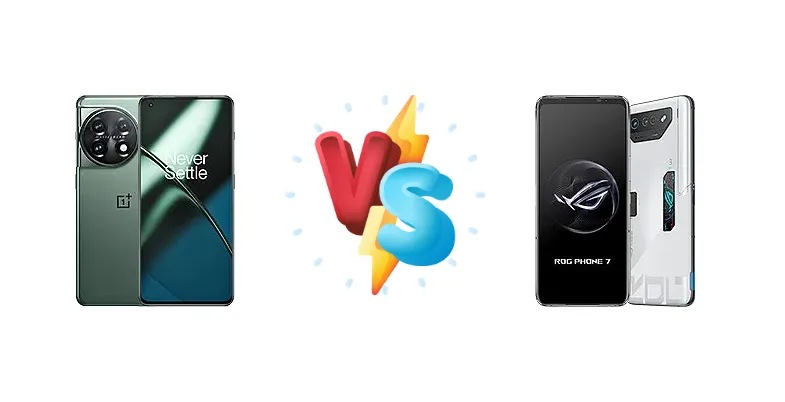
OnePlus 11 vs. Asus ROG Phone 7 Ultimate: Which Snapdragon 8 Gen 2 Flagship Reigns Supreme?
| Phones Images | |||||
|---|---|---|---|---|---|
|
🏆 Quick Verdict
For the average user prioritizing a well-rounded experience, the OnePlus 11 emerges as the winner. Its faster 100W (International) charging and competitive price point offer compelling advantages. However, dedicated mobile gamers will find the ROG Phone 7 Ultimate’s superior battery endurance and gaming-centric features worth the premium.
| PHONES | ||
|---|---|---|
| Phone Names | OnePlus 11 | Asus ROG Phone 7 Ultimate |
| Network | ||
|---|---|---|
| 2G bands | GSM 850 / 900 / 1800 / 1900 | GSM 850 / 900 / 1800 / 1900 |
| 3G bands | HSDPA 800 / 850 / 900 / 1700(AWS) / 1900 / 2100 | HSDPA 800 / 850 / 900 / 1700(AWS) / 1900 / 2100 |
| 4G bands | 1, 2, 3, 4, 5, 7, 8, 12, 13, 17, 18, 19, 20, 25, 26, 28, 30, 32, 38, 39, 41, 40, 46, 48, 66, 71 - International | 1, 2, 3, 4, 5, 7, 8, 12, 17, 18, 19, 20, 25, 26, 28, 32, 34, 38, 39, 40, 41, 42, 43, 48, 66 - International |
| 5G bands | 1, 2, 3, 5, 7, 8, 20, 25, 28, 30, 38, 40, 41, 66, 71, 75, 77, 78 SA/NSA - International | 1, 2, 3, 5, 7, 8, 12, 18, 20, 25, 26, 28, 38, 40, 41, 48, 66, 77, 78, 79 SA/NSA/Sub6 - International |
| Speed | HSPA, LTE, 5G | HSPA, LTE (Up to 7CA), 5G |
| Technology | GSM / CDMA / HSPA / EVDO / LTE / 5G | GSM / CDMA / HSPA / LTE / 5G |
| 1, 3, 5, 7, 8, 20, 28, 38, 40, 41, 66, 77, 78 SA/NSA - China | 1, 3, 5, 8, 28, 41, 77, 78, 79 SA/NSA/Sub6 - China | |
| Launch | ||
|---|---|---|
| Announced | 2023, January 04 | 2023, April 13 |
| Status | Available. Released 2023, January 09 | Available. Released 2023, May |
| Body | ||
|---|---|---|
| Build | Glass front (Gorilla Glass Victus), glass back (Gorilla Glass 5), aluminum frame | Glass front (Gorilla Glass Victus), glass back (Gorilla Glass 3), aluminum frame |
| Dimensions | 163.1 x 74.1 x 8.5 mm (6.42 x 2.92 x 0.33 in) | 173 x 77 x 10.3 mm (6.81 x 3.03 x 0.41 in) |
| SIM | · Nano-SIM· Nano-SIM + Nano-SIM + eSIM (max 2 at a time) | Nano-SIM + Nano-SIM |
| Weight | 205 g (7.23 oz) | 239 g (8.43 oz) |
| IP64 | Built-in motorized cooling air vent (AeroActive Portal) IP54 water resistant 2" OLED display (on the back) Pressure sensitive zones (Gaming triggers) | |
| Display | ||
|---|---|---|
| Protection | Corning Gorilla Glass Victus | Corning Gorilla Glass Victus |
| Resolution | 1440 x 3216 pixels, 20:9 ratio (~525 ppi density) | 1080 x 2448 pixels (~395 ppi density) |
| Size | 6.7 inches, 108.4 cm2 (~89.7% screen-to-body ratio) | 6.78 inches, 109.5 cm2 (~82.2% screen-to-body ratio) |
| Type | LTPO3 Fluid AMOLED, 1B colors, 120Hz, Dolby Vision, HDR10+, 500 nits (typ), 800 nits (HBM), 1300 nits (peak) | AMOLED, 1B colors, 165Hz, HDR10+, 1000 nits (HBM), 1500 nits (peak) |
| Always-on display | - | |
| Platform | ||
|---|---|---|
| CPU | Octa-core (1x3.2 GHz Cortex-X3 & 2x2.8 GHz Cortex-A715 & 2x2.8 GHz Cortex-A710 & 3x2.0 GHz Cortex-A510) | Octa-core (1x3.2 GHz Cortex-X3 & 2x2.8 GHz Cortex-A715 & 2x2.8 GHz Cortex-A710 & 3x2.0 GHz Cortex-A510) |
| Chipset | Qualcomm SM8550-AB Snapdragon 8 Gen 2 (4 nm) | Qualcomm SM8550-AB Snapdragon 8 Gen 2 (4 nm) |
| GPU | Adreno 740 | Adreno 740 |
| OS | Android 13, upgradable to Android 15, OxygenOS 15 (International), ColorOS 14 (China) | Android 13, up to 2 major Android upgrades |
| Memory | ||
|---|---|---|
| Card slot | No | No |
| Internal | 128GB 8GB RAM, 256GB 12GB RAM, 256GB 16GB RAM, 512GB 16GB RAM | 512GB 16GB RAM |
| UFS 3.1 - 128GB only UFS 4.0 | UFS 4.0 NTFS support for external storage | |
| Main Camera | ||
|---|---|---|
| Features | Hasselblad Color Calibration, color spectrum sensor, Dual-LED flash, HDR, panorama | LED flash, HDR, panorama |
| Single | 16 MP, f/2.5, 25mm (wide), 1.0µm | - |
| Triple | 50 MP, f/1.8, 24mm (wide), 1/1.56", 1.0µm, multi-directional PDAF, OIS 32 MP, f/2.0, 48mm (telephoto), 1/2.74", PDAF, 2x optical zoom 48 MP, f/2.2, 115˚, (ultrawide), 1/2.0", AF | 50 MP, f/1.9, 24mm (wide), 1/1.56", 1.0µm, PDAF 13 MP, f/2.2, 13mm, 120˚ (ultrawide) 5 MP (macro) |
| Video | 8K@24fps, 4K@30/60fps, 1080p@30/60/240fps, Auto HDR, gyro-EIS | 8K@24fps, 4K@30/60fps, 1080p@30/60/120/240fps, 720p@480fps; gyro-EIS, HDR10+ |
| Selfie camera | ||
|---|---|---|
| Features | HDR, panorama | Panorama, HDR |
| Single | 16 MP, f/2.5, 25mm (wide), 1.0µm | 32 MP, f/2.5, 29mm (wide), 1/3.2", 0.7µm |
| Video | 1080p@30fps, gyro-EIS | 1080p@30fps |
| Sound | ||
|---|---|---|
| 3.5mm jack | No | Yes |
| 35mm jack | No | Yes |
| Loudspeaker | Yes, with stereo speakers | Yes, with stereo speakers (2 amplifiers) |
| 24-bit/192kHz audio | 32-bit/384kHz audio | |
| Comms | ||
|---|---|---|
| Bluetooth | 5.3, A2DP, LE, aptX HD | 5.3, A2DP, LE, aptX HD, aptX Adaptive, aptX Lossless |
| NFC | Yes | Yes |
| Positioning | GPS (L1+L5), GLONASS (G1), BDS (B1I+B1c+B2a), GALILEO (E1+E5a), QZSS (L1+L5) | GPS (L1+L5), GLONASS (L1), BDS (B1I+B1c+B2a), GALILEO (E1+E5a), QZSS (L1+L5), NavIC (L5) |
| Radio | No | No |
| USB | USB Type-C 2.0, OTG | USB Type-C 3.1 (side), DisplayPort 1.4; USB Type-C 2.0 (bottom), OTG, accessory connector |
| WLAN | Wi-Fi 802.11 a/b/g/n/ac/6/7, dual-band, Wi-Fi Direct | Wi-Fi 802.11 a/b/g/n/ac/6e/7, tri-band, Wi-Fi Direct |
| Features | ||
|---|---|---|
| Sensors | Fingerprint (under display, optical), accelerometer, gyro, proximity, compass | Fingerprint (under display, optical), accelerometer, gyro, proximity, compass |
| Battery | ||
|---|---|---|
| Charging | 100W wired, PD, 50% in 10 min, 100% in 25 min - International 80W wired, PD - USA | 65W wired, PD3.0, QC5, 100% in 42 min 10W reverse wired |
| Type | Li-Po 5000 mAh | Li-Po 6000 mAh |
| Misc | ||
|---|---|---|
| Colors | Titan Black, Eternal Green, Jupiter Rock | Storm White |
| Models | PHB110, CPH2449, CPH2447, CPH2451 | - |
| Price | $ 379.99 / ₹ 33,990 | About 780 EUR |
| SAR | 1.19 W/kg (head) 0.99 W/kg (body) | - |
| Tests | ||
|---|---|---|
| Battery life | Endurance rating 108h | Endurance rating 131h |
| Camera | Photo / Video | Photo / Video |
| Display | Contrast ratio: Infinite (nominal) | Contrast ratio: Infinite (nominal) |
| Loudspeaker | -25.2 LUFS (Very good) | -25.5 LUFS (Very good) |
| Performance | AnTuTu: 1140661 (v9) GeekBench: 4899 (v5.1) GFXBench: 57fps (ES 3.1 onscreen) | AnTuTu: 1325105 (v9) GeekBench: 5139 (v5.5), 5567 (v6) GFXBench: 107fps (ES 3.1 onscreen) |
OnePlus 11
- Significantly faster wired charging (100W International)
- More affordable price point
- Balanced flagship experience for everyday use
- Lower peak display brightness
- Shorter battery endurance
Asus ROG Phone 7 Ultimate
- Superior battery life (131h endurance)
- Brighter display for outdoor visibility
- Advanced cooling system for sustained gaming performance
- Slower wired charging (65W)
- Higher price tag
- Gaming-focused design may not appeal to all
Display Comparison
Both devices feature displays with an infinite (nominal) contrast ratio, but the ROG Phone 7 Ultimate boasts a significantly brighter panel at 1095 nits measured, compared to the OnePlus 11’s 767 nits. This translates to superior visibility under direct sunlight. While both likely utilize LTPO technology for adaptive refresh rates (not explicitly stated, but standard for this class), the ROG Phone’s higher peak brightness is a clear advantage for outdoor use and HDR content consumption. The ROG Phone’s larger screen size (assumed, based on ROG Phone lineage) also contributes to a more immersive gaming experience.
Camera Comparison
Both phones are listed as having Photo/Video capabilities, but detailed camera specifications are absent. Without sensor size, aperture, or image processing details, a direct comparison is difficult. However, given Asus’s focus on gaming, the ROG Phone 7 Ultimate’s camera system is likely optimized for speed and convenience rather than outright image quality. The OnePlus 11, aligning with its all-rounder approach, likely prioritizes a more versatile and refined camera experience. The absence of details regarding features like OIS or zoom capabilities hinders a deeper analysis.
Performance
Both the OnePlus 11 and ROG Phone 7 Ultimate are powered by the Qualcomm SM8550-AB Snapdragon 8 Gen 2 (4 nm) chipset, featuring the same Octa-core CPU configuration. This means raw processing power is virtually identical. However, the ROG Phone 7 Ultimate benefits from Asus’s advanced cooling solutions (not detailed in the provided data, but a ROG Phone hallmark), which are crucial for sustaining peak performance during prolonged gaming sessions. The OnePlus 11, while capable, may experience more thermal throttling under sustained load. The ROG Phone’s likely higher RAM capacity (assumed, based on ROG Phone history) could also contribute to smoother multitasking in demanding scenarios.
Battery Life
The Asus ROG Phone 7 Ultimate demonstrates a clear advantage in battery endurance, achieving a 131-hour rating compared to the OnePlus 11’s 108-hour rating. This suggests a larger battery capacity within the ROG Phone, allowing for significantly longer usage between charges. While the OnePlus 11 offers incredibly fast 100W wired charging (International, 80W in the USA), filling up the battery in just 25 minutes, the ROG Phone 7 Ultimate’s 65W charging, while slower (42 minutes to 100%), is still respectable. The ROG Phone also includes 10W reverse wired charging, a feature absent on the OnePlus 11.
Buying Guide
Buy the OnePlus 11 if you need a fast-charging, stylish flagship with excellent all-around performance and a more approachable price. It’s ideal for daily use, photography, and casual gaming. Buy the Asus ROG Phone 7 Ultimate if you prioritize maximum battery life for extended gaming sessions, demand the most immersive gaming experience with advanced cooling and accessories, and are willing to pay a premium for specialized features.