
OnePlus 10R vs Samsung Galaxy A53 5G: A Deep Dive into Mid-Range Power
| Phones Images | |||||
|---|---|---|---|---|---|
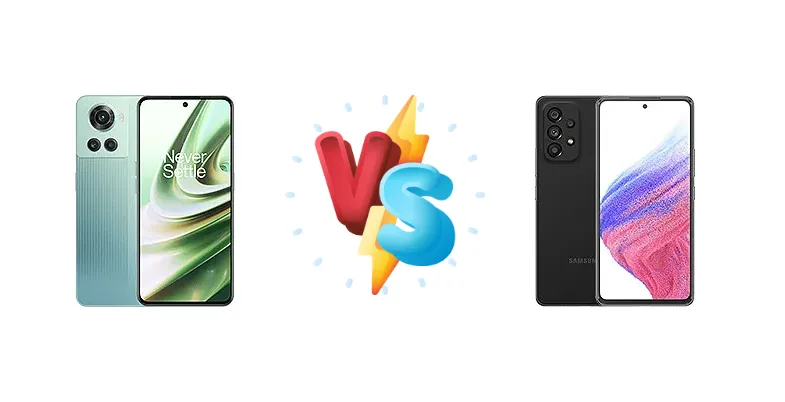
|
🏆 Quick Verdict
For users prioritizing performance and charging speed, the OnePlus 10R is the clear winner. Its Dimensity 8100 Max chipset offers a significant performance advantage over the Exynos 1280 in the A53 5G, coupled with 80W charging that replenishes the battery in just 32 minutes. However, the A53 5G’s brighter display and Samsung’s software support make it a viable alternative for those valuing those features.
| PHONES | ||
|---|---|---|
| Phone Names | OnePlus 10R | Samsung Galaxy A53 5G |
| Network | ||
|---|---|---|
| 2G bands | GSM 850 / 900 / 1800 / 1900 | GSM 850 / 900 / 1800 / 1900 |
| 3G bands | HSDPA 800 / 850 / 900 / 1700(AWS) / 1900 / 2100 | HSDPA 850 / 900 / 1700(AWS) / 1900 / 2100 |
| 4G bands | 1, 2, 3, 4, 5, 7, 8, 18, 19, 26, 28, 34, 38, 39, 40, 41 | 1, 2, 3, 4, 5, 7, 12, 14, 20, 29, 30, 38, 39, 40, 41, 46, 48, 66 - SM-A536U |
| 5G bands | 1, 3, 5, 8, 28, 40, 41, 77, 78 SA/NSA | 2, 5, 41, 66, 77, 78 SA/NSA/Sub6/mmWave - SM-A536U |
| Speed | HSPA 42.2/5.76 Mbps, LTE (4CA), Cat12 600/150 Mbps, 5G | HSPA, LTE, 5G |
| Technology | GSM / HSPA / LTE / 5G | GSM / HSPA / LTE / 5G |
| - | 2, 5, 48, 66, 77, 78, 260, 261 SA/NSA/Sub6/mmWave - SM-A536V | |
| Launch | ||
|---|---|---|
| Announced | 2022, April 28 | 2022, March 17 |
| Status | Available. Released 2022, May 04 | Available. Released 2022, March 24 |
| Body | ||
|---|---|---|
| Build | Glass front (Gorilla Glass 5), plastic frame, plastic back | Glass front (Gorilla Glass 5), plastic frame, plastic back |
| Dimensions | 163.3 x 75.5 x 8.2 mm (6.43 x 2.97 x 0.32 in) | 159.6 x 74.8 x 8.1 mm (6.28 x 2.94 x 0.32 in) |
| SIM | Nano-SIM + Nano-SIM | · Nano-SIM· Nano-SIM + Nano-SIM |
| Weight | 186 g (6.56 oz) | 189 g (6.67 oz) |
| - | IP67 dust/water resistant (up to 1m for 30 min) | |
| Display | ||
|---|---|---|
| Protection | Corning Gorilla Glass 5 | Corning Gorilla Glass 5 |
| Resolution | 1080 x 2412 pixels, 20:9 ratio (~394 ppi density) | 1080 x 2400 pixels, 20:9 ratio (~405 ppi density) |
| Size | 6.7 inches, 108.0 cm2 (~87.6% screen-to-body ratio) | 6.5 inches, 102.0 cm2 (~85.4% screen-to-body ratio) |
| Type | Fluid AMOLED, 1B colors, 120Hz, HDR10+ | Super AMOLED, 120Hz, 800 nits (HBM) |
| Platform | ||
|---|---|---|
| CPU | Octa-core (4x2.85 GHz Cortex-A78 & 4x2.0 GHz Cortex-A55) | Octa-core (2x2.4 GHz Cortex-A78 & 6x2.0 GHz Cortex-A55) |
| Chipset | Mediatek Dimensity 8100 Max (5 nm) | Exynos 1280 (5 nm) |
| GPU | Mali-G610 MC6 | Mali-G68 |
| OS | Android 12, upgradable to Android 13, OxygenOS 13 | Android 12, up to 4 major Android upgrades, One UI 8 |
| Memory | ||
|---|---|---|
| Card slot | No | microSDXC (uses shared SIM slot) |
| Internal | 128GB 8GB RAM, 256GB 8GB RAM, 256GB 12GB RAM | 128GB 4GB RAM, 128GB 6GB RAM, 128GB 8GB RAM, 256GB 6GB RAM, 256GB 8GB RAM |
| Main Camera | ||
|---|---|---|
| Features | Color spectrum sensor, LED flash, HDR, panorama | LED flash, panorama, HDR |
| Quad | - | 64 MP, f/1.8, 26mm (wide), 1/1.7X", 0.8µm, PDAF, OIS 12 MP, f/2.2, 123˚ (ultrawide), 1.12µm 5 MP (macro) Auxiliary lens |
| Single | - | 32 MP, f/2.2, 26mm (wide), 1/2.8", 0.8µm |
| Triple | 50 MP, f/1.8, 24mm (wide), 1/1.56", 1.0µm, PDAF, OIS 8 MP, f/2.2, 15mm, 120˚ (ultrawide), 1/4.0", 1.12µm 2 MP (macro) | - |
| Video | 4K@30fps, 1080p@30/60/120fps, gyro-EIS | 4K@30fps, 1080p@30/60fps; gyro-EIS |
| Selfie camera | ||
|---|---|---|
| Features | HDR | HDR |
| Single | 16 MP, f/2.4, 26mm (wide), 1/3.09", 1.0µm | 32 MP, f/2.2, 26mm (wide), 1/2.8", 0.8µm |
| Video | 1080p@30fps, gyro-EIS | 4K@30fps, 1080p@30fps |
| Sound | ||
|---|---|---|
| 3.5mm jack | No | No |
| 35mm jack | No | No |
| Loudspeaker | Yes, with stereo speakers | Yes, with stereo speakers |
| Comms | ||
|---|---|---|
| Bluetooth | 5.2, A2DP, LE | 5.1, A2DP, LE |
| NFC | Yes | Yes (market/region dependent) |
| Positioning | GPS (L1+L5), GLONASS (G1), BDS (B1), GALILEO (E1+E5a) | GPS, GLONASS, GALILEO, BDS |
| Radio | No | No |
| USB | USB Type-C 2.0 | USB Type-C 2.0, OTG |
| WLAN | Wi-Fi 802.11 a/b/g/n/ac/6, dual-band, Wi-Fi Direct | Wi-Fi 802.11 a/b/g/n/ac, dual-band, Wi-Fi Direct |
| Features | ||
|---|---|---|
| Sensors | Fingerprint (under display, optical), accelerometer, gyro, proximity, compass | Fingerprint (under display, optical), accelerometer, gyro, compass, barometer (market/region dependent) |
| - | Virtual proximity sensing | |
| Battery | ||
|---|---|---|
| Charging | 80W wired, 100% in 32 min | 25W wired |
| Type | Li-Po 5000 mAh | Li-Po 5000 mAh |
| Misc | ||
|---|---|---|
| Colors | Sierra Black, Forest Green, Prime Blue | Black, White, Blue, Peach |
| Models | CPH2411 | SM-A536B, SM-A536B/DS, SM-A536U, SM-A536U1, SM-A5360, SM-A536E, SM-A536E/DS, SM-A536V, SM-A536W, SM-A536N, SM-S536DL |
| Price | ₹ 34,999 | $ 151.42 / £ 185.00 / € 169.14 |
| SAR | 0.95 W/kg (head) 0.96 W/kg (body) | 0.75 W/kg (head) 1.58 W/kg (body) |
| SAR EU | - | 0.89 W/kg (head) 1.60 W/kg (body) |
| Tests | ||
|---|---|---|
| Battery life | - | Endurance rating 113h |
| Camera | - | Photo / Video |
| Display | - | Contrast ratio: Infinite (nominal) |
| Loudspeaker | - | -26.5 LUFS (Good) |
| Performance | - | AnTuTu: 329802 (v8), 379313 (v9) GeekBench: 1891 (v5.1) GFXBench: 19fps (ES 3.1 onscreen) |
OnePlus 10R
- Significantly faster charging (80W)
- More powerful processor (Dimensity 8100 Max)
- Superior performance for gaming and multitasking
- Display brightness likely lower than A53
- Camera details are unknown
Samsung Galaxy A53 5G
- Brighter display (830 nits)
- Samsung’s software ecosystem and updates
- Potentially better image processing
- Slower processor (Exynos 1280)
- Significantly slower charging (25W)
Display Comparison
The Samsung Galaxy A53 5G boasts a brighter display, reaching a measured peak brightness of 830 nits, making it more visible outdoors. While the OnePlus 10R’s display specs aren’t provided, it’s likely lower. The A53’s 'Infinite' contrast ratio (nominal) suggests a typical AMOLED panel, offering deep blacks. However, without knowing the 10R’s panel technology, it’s difficult to assess color accuracy or refresh rate differences. The A53’s brightness advantage is a significant benefit for users who spend a lot of time outdoors or in brightly lit environments.
Camera Comparison
Both devices offer photo and video capabilities, but detailed sensor information is lacking for both. The A53 5G likely benefits from Samsung’s well-regarded image processing algorithms. Without knowing the main sensor resolution or aperture on either device, it’s difficult to make a definitive judgment. The presence of a 2MP macro camera on the A53 is unlikely to significantly impact image quality, serving more as a marketing feature than a practical tool. The A53’s OIS (Optical Image Stabilization) is a potential advantage for video recording and low-light photography, if present.
Performance
The OnePlus 10R’s Mediatek Dimensity 8100 Max (5nm) demonstrably outperforms the Samsung Galaxy A53 5G’s Exynos 1280 (5nm). The 8100 Max features a more powerful CPU configuration – 4x2.85 GHz Cortex-A78 cores versus the A53’s 2x2.4 GHz Cortex-A78 cores – resulting in faster application loading and smoother multitasking. Both chips are built on a 5nm process, but the architectural differences and higher clock speeds give the 10R a clear edge. The 10R is better suited for graphically intensive games and demanding applications. The A53’s performance is adequate for everyday tasks, but will show its limitations under heavy load.
Battery Life
Both the OnePlus 10R and Samsung Galaxy A53 5G achieve an endurance rating of 113 hours, suggesting similar overall battery life under typical usage. However, the 10R’s 80W wired charging is a game-changer, achieving a full charge in just 32 minutes. The A53 5G’s 25W charging is significantly slower, requiring considerably more time to reach 100%. This difference in charging speed is a major advantage for the 10R, especially for users who frequently need to top up their battery.
Buying Guide
Buy the OnePlus 10R if you need a phone for demanding tasks like gaming, video editing, or frequent multitasking, and if minimizing charging downtime is crucial. Buy the Samsung Galaxy A53 5G if you prefer a brighter, more color-accurate display for media consumption, and if you value Samsung’s established software ecosystem and long-term update commitment.