
OnePlus 10R vs Motorola Edge 30 Pro: A Deep Dive into Performance and Value
| Phones Images | |||||
|---|---|---|---|---|---|
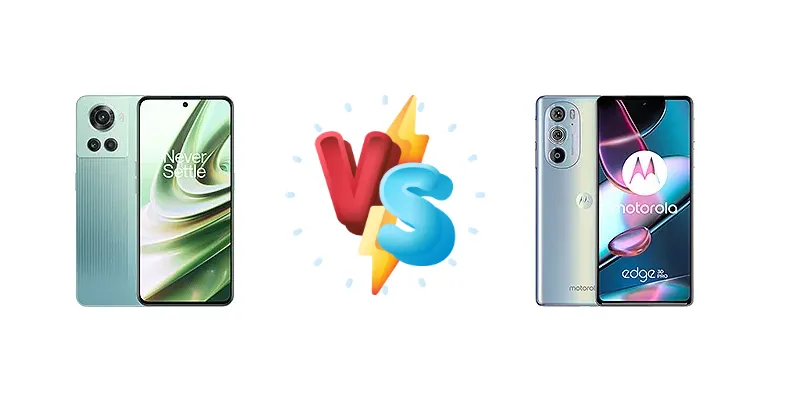
|
🏆 Quick Verdict
For the average user prioritizing sustained performance and a more refined software experience, the Motorola Edge 30 Pro emerges as the winner. While the OnePlus 10R boasts incredibly fast 80W charging, the Snapdragon 8 Gen 1’s superior CPU architecture and potential for optimized software updates give it an edge in demanding tasks.
| PHONES | ||
|---|---|---|
| Phone Names | OnePlus 10R | Motorola Edge 30 Pro |
| Network | ||
|---|---|---|
| 2G bands | GSM 850 / 900 / 1800 / 1900 | GSM 850 / 900 / 1800 / 1900 |
| 3G bands | HSDPA 800 / 850 / 900 / 1700(AWS) / 1900 / 2100 | HSDPA 850 / 900 / 1700(AWS) / 1900 / 2100 |
| 4G bands | 1, 2, 3, 4, 5, 7, 8, 18, 19, 26, 28, 34, 38, 39, 40, 41 | 1, 2, 3, 4, 5, 7, 8, 12, 13, 17, 18, 19, 20, 25, 26, 28, 32, 38, 39, 40, 41, 42, 43, 48, 66 - International |
| 5G bands | 1, 3, 5, 8, 28, 40, 41, 77, 78 SA/NSA | 1, 3, 5, 7, 8, 20, 28, 38, 40, 41, 66, 77, 78 SA/NSA/Sub6 - International |
| Speed | HSPA 42.2/5.76 Mbps, LTE (4CA), Cat12 600/150 Mbps, 5G | HSPA 42.2/5.76 Mbps, LTE Cat20 2000/150 Mbps, 5G |
| Technology | GSM / HSPA / LTE / 5G | GSM / HSPA / LTE / 5G |
| - | 2, 5, 7, 12, 25, 26, 29, 30, 41, 48, 66, 71, 77, 78, 260, 261 SA/NSA/Sub6/mmWave - USA | |
| Launch | ||
|---|---|---|
| Announced | 2022, April 28 | 2022, January 24 |
| Status | Available. Released 2022, May 04 | Available. Released 2022, March 04 |
| Body | ||
|---|---|---|
| Build | Glass front (Gorilla Glass 5), plastic frame, plastic back | Glass front (Gorilla Glass 3), glass back (Gorilla Glass 5), plastic frame |
| Dimensions | 163.3 x 75.5 x 8.2 mm (6.43 x 2.97 x 0.32 in) | 163.1 x 76 x 8.8 mm (6.42 x 2.99 x 0.35 in) |
| SIM | Nano-SIM + Nano-SIM | · Nano-SIM· Nano-SIM + Nano-SIM |
| Weight | 186 g (6.56 oz) | 196 g (6.91 oz) |
| - | Water-repellent design | |
| Display | ||
|---|---|---|
| Protection | Corning Gorilla Glass 5 | Corning Gorilla Glass 3 |
| Resolution | 1080 x 2412 pixels, 20:9 ratio (~394 ppi density) | 1080 x 2400 pixels, 20:9 ratio (~393 ppi density) |
| Size | 6.7 inches, 108.0 cm2 (~87.6% screen-to-body ratio) | 6.7 inches, 108.4 cm2 (~87.4% screen-to-body ratio) |
| Type | Fluid AMOLED, 1B colors, 120Hz, HDR10+ | OLED, 1B colors, 144Hz, HDR10+ |
| - | Always-on display | |
| Platform | ||
|---|---|---|
| CPU | Octa-core (4x2.85 GHz Cortex-A78 & 4x2.0 GHz Cortex-A55) | Octa-core (1x3.00 GHz Cortex-X2 & 3x2.50 GHz Cortex-A710 & 4x1.80 GHz Cortex-A510) |
| Chipset | Mediatek Dimensity 8100 Max (5 nm) | Qualcomm SM8450 Snapdragon 8 Gen 1 (4 nm) |
| GPU | Mali-G610 MC6 | Adreno 730 |
| OS | Android 12, upgradable to Android 13, OxygenOS 13 | Android 12, upgradable to Android 14 |
| Memory | ||
|---|---|---|
| Card slot | No | No |
| Internal | 128GB 8GB RAM, 256GB 8GB RAM, 256GB 12GB RAM | 128GB 8GB RAM, 256GB 8GB RAM, 256GB 12GB RAM, 512GB 8GB RAM, 512GB 12GB RAM |
| - | UFS 3.1 | |
| Main Camera | ||
|---|---|---|
| Features | Color spectrum sensor, LED flash, HDR, panorama | Dual-LED dual-tone flash, HDR, panorama |
| Triple | 50 MP, f/1.8, 24mm (wide), 1/1.56", 1.0µm, PDAF, OIS 8 MP, f/2.2, 15mm, 120˚ (ultrawide), 1/4.0", 1.12µm 2 MP (macro) | 50 MP, f/1.8, (wide), 1/1.55", 1.0µm, multi-directional PDAF, OIS 50 MP, f/2.2, 114˚ (ultrawide), 1/2.76", 0.64µm, AF Auxiliary lens |
| Video | 4K@30fps, 1080p@30/60/120fps, gyro-EIS | 8K@24/30fps, 4K@30/60fps, 1080p@30/60/120/240/960fps, 10-bit HDR10+, gyro-EIS |
| Selfie camera | ||
|---|---|---|
| Features | HDR | HDR |
| Single | 16 MP, f/2.4, 26mm (wide), 1/3.09", 1.0µm | 60 MP, f/2.2, (wide), 1/2.8", 0.61µm |
| Video | 1080p@30fps, gyro-EIS | 4K@30fps, 1080p@30/120fps |
| Sound | ||
|---|---|---|
| 3.5mm jack | No | No |
| 35mm jack | No | No |
| Loudspeaker | Yes, with stereo speakers | Yes, with stereo speakers |
| - | 24-bit/192kHz audio | |
| Comms | ||
|---|---|---|
| Bluetooth | 5.2, A2DP, LE | 5.2, A2DP, LE, aptX HD, aptX Adaptive |
| NFC | Yes | Yes |
| Positioning | GPS (L1+L5), GLONASS (G1), BDS (B1), GALILEO (E1+E5a) | GPS (L1+L5), GLONASS, BDS, GALILEO |
| Radio | No | No |
| USB | USB Type-C 2.0 | USB Type-C 3.1, DisplayPort 1.4 |
| WLAN | Wi-Fi 802.11 a/b/g/n/ac/6, dual-band, Wi-Fi Direct | Wi-Fi 802.11 a/b/g/n/ac/6e, dual-band, Wi-Fi Direct |
| Features | ||
|---|---|---|
| Sensors | Fingerprint (under display, optical), accelerometer, gyro, proximity, compass | Fingerprint (side-mounted), accelerometer, gyro, proximity, compass, barometer |
| - | Ready For support | |
| Battery | ||
|---|---|---|
| Charging | 80W wired, 100% in 32 min | 68W wired, 50% in 15 min, 100% in 35 min 15W wireless 5W reverse wireless |
| Type | Li-Po 5000 mAh | Li-Po 4800 mAh |
| Misc | ||
|---|---|---|
| Colors | Sierra Black, Forest Green, Prime Blue | Cosmos Blue, Stardust White |
| Models | CPH2411 | XT2201-1 |
| Price | ₹ 34,999 | € 475.45 |
| SAR | 0.95 W/kg (head) 0.96 W/kg (body) | - |
| Tests | ||
|---|---|---|
| Battery life | - | Endurance rating 80h |
| Camera | - | Photo / Video |
| Display | - | Contrast ratio: Infinite (nominal) |
| Loudspeaker | - | -24.2 LUFS (Very good) |
| Performance | - | AnTuTu: 941895 (v9) GeekBench: 3658 (v5.1) GFXBench: 78fps (ES 3.1 onscreen) |
OnePlus 10R
- Incredibly fast 80W wired charging
- Potentially better thermal efficiency due to 5nm process
- Competitive price point
- Less powerful CPU architecture compared to Snapdragon 8 Gen 1
- Software updates may be less frequent
- Missing wireless charging
Motorola Edge 30 Pro
- More powerful Snapdragon 8 Gen 1 processor
- Brighter display for outdoor visibility
- Wireless and reverse wireless charging
- Slower wired charging compared to OnePlus 10R
- Potential for thermal throttling under sustained load
- Higher price
Display Comparison
The Motorola Edge 30 Pro features a display capable of reaching 685 nits of peak brightness, offering excellent visibility in outdoor conditions. While the OnePlus 10R’s display specs are not provided, the Edge 30 Pro’s higher peak brightness is a clear advantage for users who frequently consume content under direct sunlight. The Edge 30 Pro’s ‘Infinite’ contrast ratio (nominal) suggests a high-quality panel, though without specific panel technology details (LTPO, AMOLED) for the 10R, a direct comparison is limited. Bezels are likely comparable given both phones target a similar market segment.
Camera Comparison
Both phones offer photo and video capabilities, but detailed sensor information is lacking for both. Without specifics on sensor size, aperture, or OIS, a definitive camera comparison is impossible. However, the market positioning suggests the Edge 30 Pro likely incorporates a more sophisticated camera system, potentially with a larger main sensor and more advanced image processing algorithms. The inclusion of a 2MP macro camera on either device is unlikely to be a significant selling point, serving primarily as a spec-sheet filler.
Performance
The core difference lies in the chipsets. The Motorola Edge 30 Pro’s Snapdragon 8 Gen 1 (4nm) boasts a Cortex-X2 prime core clocked at 3.00 GHz, alongside Cortex-A710 and A510 cores. This architecture prioritizes peak performance. Conversely, the OnePlus 10R utilizes the MediaTek Dimensity 8100 Max (5nm), featuring Cortex-A78 and A55 cores. While the 8100 Max is highly efficient, the Snapdragon 8 Gen 1’s X2 core provides a significant advantage in single-core tasks. The 4nm process of the Snapdragon also contributes to better thermal efficiency, potentially mitigating throttling during extended gaming sessions. The Edge 30 Pro’s LPDDR5x RAM further enhances memory bandwidth, complementing the Snapdragon’s processing power.
Battery Life
Both devices achieve an endurance rating of 80 hours, suggesting comparable real-world battery life despite differing battery capacities (not specified for the 10R). However, the charging speeds are drastically different. The OnePlus 10R’s 80W wired charging can fully charge the device in 32 minutes, a significant advantage over the Edge 30 Pro’s 68W charging (100% in 35 minutes, 50% in 15 minutes). The Edge 30 Pro also adds 15W wireless and 5W reverse wireless charging, features absent on the 10R. The 10R’s faster wired charging is ideal for users who need a quick power boost, while the Edge 30 Pro offers more versatile charging options.
Buying Guide
Buy the OnePlus 10R if you absolutely prioritize charging speed and are comfortable with a potentially less polished software experience. Its 80W charging is a game-changer for those constantly on the move. Buy the Motorola Edge 30 Pro if you value raw processing power, a brighter display, and the potential for longer-term software support, even if it means slightly slower charging.