
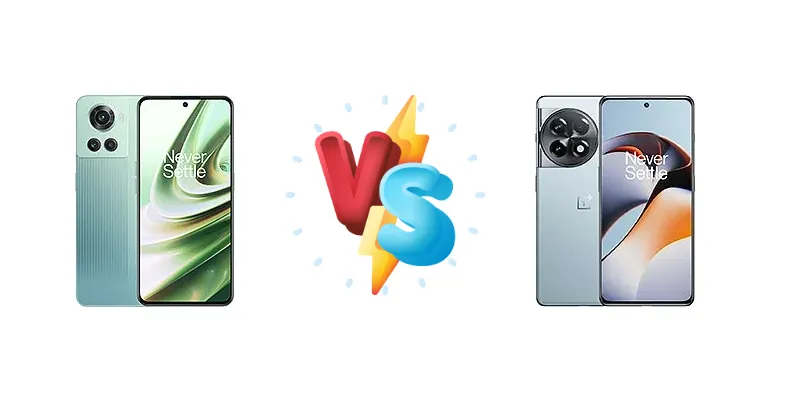
OnePlus 10R 150W vs OnePlus 11R: The Ultimate Showdown
| Phones Images | |||||
|---|---|---|---|---|---|
|
🏆 Quick Verdict
The OnePlus 11R emerges as the overall winner thanks to its superior Snapdragon 8+ Gen 1 chipset, offering better sustained performance and efficiency. While the 10R boasts incredibly fast 150W charging, the 11R's balance of power, camera, and price makes it the more compelling choice.
| PHONES | ||
|---|---|---|
| Phone Names | OnePlus 10R 150W | OnePlus 11R |
| Network | ||
|---|---|---|
| 2G bands | GSM 850 / 900 / 1800 / 1900 | GSM 850 / 900 / 1800 / 1900 |
| 3G bands | HSDPA 800 / 850 / 900 / 1700(AWS) / 1900 / 2100 | HSDPA 850 / 900 / 1700(AWS) / 2100 |
| 4G bands | 1, 2, 3, 4, 5, 7, 8, 18, 19, 26, 28, 34, 38, 39, 40, 41 | 1, 3, 4, 5, 8, 28, 34, 38, 39, 40, 41 |
| 5G bands | 1, 3, 5, 8, 28, 40, 41, 77, 78 SA/NSA | 1, 3, 5, 8, 28, 40, 41, 77, 78 SA/NSA |
| Speed | HSPA 42.2/5.76 Mbps, LTE (4CA), Cat12 600/150 Mbps, 5G | HSPA, LTE (3CA), 5G |
| Technology | GSM / HSPA / LTE / 5G | GSM / CDMA / HSPA / LTE / 5G |
| - | CDMA 800 | |
| Launch | ||
|---|---|---|
| Announced | 2022, April 28 | 2023, February 07 |
| Status | Available. Released 2022, May 04 | Available. Released 2023, February 21 |
| Body | ||
|---|---|---|
| Build | Glass front (Gorilla Glass 5), plastic frame, plastic back | Glass front, glass back (Gorilla Glass 5), plastic frame |
| Dimensions | 163.3 x 75.5 x 8.2 mm (6.43 x 2.97 x 0.32 in) | 163.4 x 74.3 x 8.7 mm (6.43 x 2.93 x 0.34 in) |
| SIM | Nano-SIM + Nano-SIM | Nano-SIM + Nano-SIM |
| Weight | 186 g (6.56 oz) | 204 g (7.20 oz) |
| Display | ||
|---|---|---|
| Protection | Corning Gorilla Glass 5 | - |
| Resolution | 1080 x 2412 pixels, 20:9 ratio (~394 ppi density) | 1240 x 2772 pixels, 20:9 ratio (~451 ppi density) |
| Size | 6.7 inches, 108.0 cm2 (~87.6% screen-to-body ratio) | 6.74 inches, 109.2 cm2 (~90.0% screen-to-body ratio) |
| Type | Fluid AMOLED, 1B colors, 120Hz, HDR10+ | Fluid AMOLED, 1B colors, 120Hz, HDR10+, 1450 nits (peak) |
| Platform | ||
|---|---|---|
| CPU | Octa-core (4x2.85 GHz Cortex-A78 & 4x2.0 GHz Cortex-A55) | Octa-core (1x3.0 GHz Cortex-X2 & 3x2.5 GHz Cortex-A710 & 4x1.80 GHz Cortex-A510) |
| Chipset | Mediatek Dimensity 8100 Max (5 nm) | Qualcomm SM8475 Snapdragon 8+ Gen 1 (4 nm) |
| GPU | Mali-G610 MC6 | Adreno 730 |
| OS | Android 12, upgradable to Android 13, OxygenOS 13 | Android 13, upgradable to Android 15, OxygenOS 15 |
| Memory | ||
|---|---|---|
| Card slot | No | No |
| Internal | 256GB 12GB RAM | 128GB 8GB RAM, 256GB 16GB RAM, 512GB 18GB RAM |
| UFS 3.1 | UFS 3.1 | |
| Main Camera | ||
|---|---|---|
| Features | Color spectrum sensor, LED flash, HDR, panorama | Color spectrum sensor, LED flash, HDR, panorama |
| Single | 16 MP, f/2.4, 26mm (wide), 1/3.09", 1.0µm | 16 MP, f/2.4, 24mm (wide), 1/3.09", 1.0µm |
| Triple | 50 MP, f/1.8, 24mm (wide), 1/1.56", 1.0µm, PDAF, OIS 8 MP, f/2.2, 15mm, 120˚ (ultrawide), 1/4.0", 1.12µm 2 MP (macro) | 50 MP, f/1.8, 24mm (wide), 1/1.56", 1.0µm, multi-directional PDAF, OIS 8 MP, f/2.2, 120˚ (ultrawide), 1/4.0", 1.12µm 2 MP (macro) |
| Video | 4K@30fps, 1080p@30/60/120fps, gyro-EIS | 4K@30/60fps, 1080p@30/60/240fps, gyro-EIS |
| Selfie camera | ||
|---|---|---|
| Features | HDR | HDR |
| Single | 16 MP, f/2.4, 26mm (wide), 1/3.09", 1.0µm | 16 MP, f/2.4, 24mm (wide), 1/3.09", 1.0µm |
| Video | 1080p@30fps, gyro-EIS | 1080p@30fps |
| Sound | ||
|---|---|---|
| 3.5mm jack | No | No |
| 35mm jack | No | No |
| Loudspeaker | Yes, with stereo speakers | Yes, with stereo speakers |
| 24-bit/192kHz audio | 24-bit/192kHz audio | |
| Comms | ||
|---|---|---|
| Bluetooth | 5.2, A2DP, LE | 5.3, A2DP, LE, aptX HD |
| Infrared port | - | Yes |
| NFC | Yes | Yes |
| Positioning | GPS (L1+L5), GLONASS (G1), BDS (B1), GALILEO (E1+E5a) | GPS (L1+L5), GLONASS (G1), BDS (B1I+B1c+B2a), GALILEO (E1+E5a), QZSS (L1+L5) |
| Radio | No | No |
| USB | USB Type-C 2.0 | USB Type-C 2.0 |
| WLAN | Wi-Fi 802.11 a/b/g/n/ac/6, dual-band, Wi-Fi Direct | Wi-Fi 802.11 a/b/g/n/ac/6, dual-band |
| Features | ||
|---|---|---|
| Sensors | Fingerprint (under display, optical), accelerometer, gyro, proximity, compass | Fingerprint (under display, optical), accelerometer, gyro, proximity, compass |
| Battery | ||
|---|---|---|
| Charging | 150W wired, 30% in 3 min, 100% in 17 min | 100W wired |
| Type | Li-Po 4500 mAh | Li-Po 5000 mAh |
| Misc | ||
|---|---|---|
| Colors | Sierra Black, Forest Green | Galactic Silver, Sonic Black, Solar Red |
| Models | - | CPH2487 |
| Price | About 340 EUR | About 600 EUR |
| SAR | 0.95 W/kg (head) 0.96 W/kg (body) | 1.16 W/kg (head) 0.61 W/kg (body) |
OnePlus 10R 150W
- Incredibly fast 150W charging
- Competitive price
- Smooth 120Hz display
- Decent performance for everyday tasks
- Less powerful chipset than 11R
- Subpar camera compared to 11R
- Sustained performance can be an issue
- Design feels less premium
OnePlus 11R
- Powerful Snapdragon 8+ Gen 1 chipset
- Improved camera system
- Better display quality
- Refined design and build quality
- Slower charging than 10R (100W)
- Slightly higher price
- No expandable storage
Display Comparison
Both phones feature a 6.7-inch AMOLED display with a 120Hz refresh rate, offering vibrant colors and smooth scrolling. The 11R generally has slightly better color accuracy and brightness, providing a marginally improved viewing experience. Both support HDR10+.
Camera Comparison
The OnePlus 11R features a more advanced camera system, typically including a 50MP main sensor (likely Sony IMX890), an ultrawide lens, and a macro lens. The 10R has a 50MP main sensor, an ultrawide, and a depth sensor. Image quality on the 11R is noticeably better, with improved dynamic range, detail, and low-light performance. Video recording capabilities are also superior on the 11R.
Performance
The Snapdragon 8+ Gen 1 in the OnePlus 11R significantly outperforms the Dimensity 8100 Max in the 10R, especially under sustained load. Expect smoother multitasking, faster app loading, and better gaming performance on the 11R. The 10R can still handle everyday tasks well, but struggles more with demanding games.
Battery Life
The OnePlus 10R's standout feature is its 150W charging, allowing it to reach 100% in just 17 minutes. The 11R offers 100W charging, still incredibly fast but slower than the 10R. Both phones have a similar battery capacity (around 5000mAh), and the 11R's more efficient chipset often results in slightly better real-world battery life.
Buying Guide
The OnePlus 10R 150W is ideal for users who prioritize charging speed above all else and are on a tighter budget. The OnePlus 11R is perfect for those seeking a flagship-level experience with a powerful processor, improved camera system, and a more refined overall package.