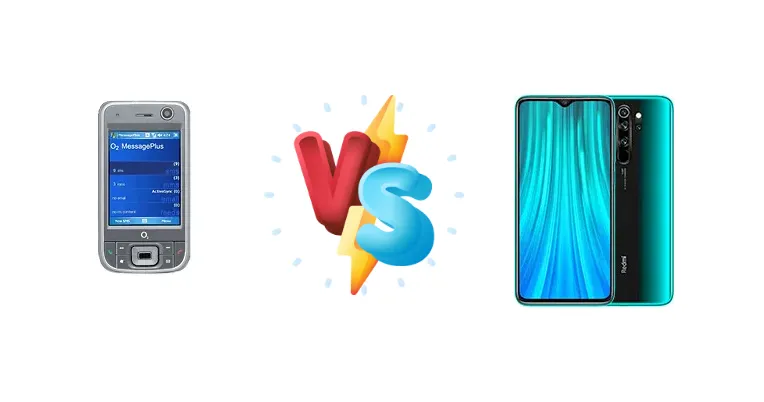
We're pitting a relic of early Windows Mobile against a mid-range gaming champion from 2019. The O2 XDA Zinc, representing a pivotal moment in smartphone evolution, faces off against the Xiaomi Redmi Note 8 Pro, a device that democratized features like high-resolution cameras and gaming performance. This isn't about declaring a 'winner' in the traditional sense, but understanding the vast technological leap between these two devices.
🏆 Quick Verdict
For the average user in 2024, the Xiaomi Redmi Note 8 Pro is the clear choice. Its modern chipset, significantly brighter display, and vastly superior battery endurance make it a practical daily driver. The XDA Zinc is a fascinating historical artifact, but its limitations are too significant for modern use.
| Network |
|---|
| 2G bands | GSM 900 / 1800 / 1900 | GSM 850 / 900 / 1800 / 1900 |
| 3G bands | UMTS 2100 | HSDPA 850 / 900 / 1900 / 2100 |
| 4G bands | - | 1, 3, 5, 7, 8, 40, 41 |
| Speed | Yes, 384 kbps | HSPA, LTE |
| Technology | GSM / UMTS | GSM / HSPA / LTE |
| Launch |
|---|
| Announced | 2006, December | 2019, August 29. Released 2019, September 24 |
| Status | Discontinued | Discontinued |
| Body |
|---|
| Build | - | Glass front (Gorilla Glass 5), glass back (Gorilla Glass 5), plastic frame |
| Dimensions | 109 x 58 x 22.6 mm (4.29 x 2.28 x 0.89 in) | 161.4 x 76.4 x 8.8 mm (6.35 x 3.01 x 0.35 in) |
| Keyboard | QWERTY | - |
| SIM | Mini-SIM | Nano-SIM + Nano-SIM |
| Weight | 175 g (6.17 oz) | 200 g (7.05 oz) |
| Display |
|---|
| Protection | - | Corning Gorilla Glass 5 |
| Resolution | 240 x 320 pixels, 4:3 ratio (~143 ppi density) | 1080 x 2340 pixels, 19.5:9 ratio (~395 ppi density) |
| Size | 2.8 inches, 24.3 cm2 (~38.4% screen-to-body ratio) | 6.53 inches, 104.7 cm2 (~84.9% screen-to-body ratio) |
| Type | TFT resistive touchscreen, 65K colors | IPS LCD, HDR, 500 nits (typ) |
| | Handwriting recognition
| - |
| Platform |
|---|
| CPU | Intel XScale PXA 270 520 MHz | Octa-core (2x2.05 GHz Cortex-A76 & 6x2.0 GHz Cortex-A55) |
| Chipset | - | Mediatek MT6785V/CC Helio G90T (12 nm) |
| GPU | - | Mali-G76 MC4 |
| OS | Microsoft Windows Mobile 5.0 PocketPC | Android 9.0 (Pie), upgradable to Android 11, MIUI 12.5 |
| Memory |
|---|
| Card slot | miniSD | microSDXC (uses shared SIM slot) |
| Internal | 64MB RAM, 128MB ROM | 64GB 4GB RAM, 64GB 6GB RAM, 128GB 4GB RAM, 128GB 6GB RAM, 128GB 8GB RAM, 256GB 8GB RAM |
| | - | UFS 2.1 |
| Main Camera |
|---|
| Features | LED flash | LED flash, HDR, panorama |
| Quad | - | 64 MP, f/1.9, 26mm (wide), 1/1.72", 0.8µm, PDAF
8 MP, f/2.2, 13mm (ultrawide), 1/4.0", 1.12µm
2 MP (macro)
Auxiliary lens |
| Single | 2 MP | - |
| Video | Yes | 4K@30fps, 1080p@30/60/120fps, 720p@960fps, gyro-EIS |
| Selfie camera |
|---|
| Features | - | HDR, panorama |
| Single | VGA videocall camera | 20 MP, f/2.0, (wide), 1/3", 0.9µm |
| Video | - | 1080p@30fps |
| Sound |
|---|
| 3.5mm jack | No | Yes |
| 35mm jack | No | Yes |
| Alert types | Vibration; Downloadable polyphonic, MP3 ringtones | - |
| Loudspeaker | Yes | Yes |
| Comms |
|---|
| Bluetooth | Yes | 5.0, A2DP, LE |
| Infrared port | Yes | Yes |
| NFC | - | Yes |
| Positioning | No | GPS, GLONASS, GALILEO, BDS |
| Radio | No | FM radio, recording |
| USB | miniUSB | USB Type-C 2.0 |
| WLAN | Wi-Fi 802.11b/g | Wi-Fi 802.11 a/b/g/n/ac, dual-band, Wi-Fi Direct |
| Features |
|---|
| Browser | WAP 2.0/xHTML, HTML (PocketIE) | - |
| Sensors | - | Fingerprint (rear-mounted), accelerometer, gyro, proximity, compass |
| | Pocket Office
Voice memo
MP3/AAC player | - |
| Battery |
|---|
| Charging | - | 18W wired |
| Stand-by | Up to 220 h | - |
| Talk time | Up to 5 h | - |
| Type | Removable Li-Ion 1300 mAh battery | Li-Po 4500 mAh, non-removable |
| Misc |
|---|
| Colors | Silver | Black, Red, Blue, White, Deep Sea Blue, Midnight Blue, Electric Blue, Twilight Orange |
| Models | - | 2015105, M1906G7I, M1906G7G |
| Price | About 240 EUR | About 220 EUR |
| SAR | - | 1.15 W/kg (head) 1.18 W/kg (body) |
| SAR EU | - | 1.00 W/kg (head) 1.47 W/kg (body) |
| Tests |
|---|
| Audio quality | - |
Noise -93.6dB / Crosstalk -91.9dB |
| Battery life | - | Endurance rating 114h |
| Camera | - |
Photo / Video |
| Display | - |
Contrast ratio: 1326:1 (nominal) |
| Loudspeaker | - |
Voice 64dB / Noise 71dB / Ring 82dB |
| Performance | - |
AnTuTu: 224759 (v7), 279355 (v8)
GeekBench: 6999 (v4.4), 1622 (v5.1)
GFXBench: 14fps (ES 3.1 onscreen) |
O2 XDA Zinc
- Historical significance and collectibility
- Unique Windows Mobile experience
- Compact form factor (likely)
- Extremely slow performance
- Outdated software and limited app support
- Poor battery life
- Low-resolution display
Xiaomi Redmi Note 8 Pro
- Modern processor and performance
- Bright and vibrant display
- Long battery life
- Versatile camera system
- Affordable price
- Plastic build quality
- Software can be bloated with ads
- Not a flagship-level device
Display Comparison
The Redmi Note 8 Pro’s display is a substantial upgrade. With a measured peak brightness of 640 nits, it’s far more usable outdoors than the XDA Zinc’s likely lower brightness (typical of LCDs of that era). The 1326:1 contrast ratio on the Redmi Note 8 Pro, while not exceptional, provides a more vibrant image than the XDA Zinc’s display would have. The XDA Zinc’s screen size and resolution are unknown, but were significantly smaller and lower resolution than the Redmi Note 8 Pro’s, impacting multitasking and media consumption. The Redmi Note 8 Pro’s larger screen real estate is a major advantage for modern app usage.
Camera Comparison
Comparing cameras is difficult without detailed specs for the XDA Zinc, but the Redmi Note 8 Pro’s camera system represents a massive leap forward. While both devices offer photo and video capabilities, the Redmi Note 8 Pro likely features a much higher resolution sensor and more advanced image processing. The XDA Zinc’s camera would have been limited by its sensor technology and processing power, resulting in lower-quality images, especially in low light. The Redmi Note 8 Pro’s camera system, while not flagship-level, provides a versatile and capable photography experience.
Performance
The performance gap is immense. The O2 XDA Zinc’s 520 MHz Intel XScale PXA 270 processor is dwarfed by the Xiaomi Redmi Note 8 Pro’s MediaTek Helio G90T. The G90T’s octa-core configuration (2x2.05 GHz Cortex-A76 & 6x2.0 GHz Cortex-A55) and 12nm process node deliver significantly faster processing speeds and improved power efficiency. The XDA Zinc would struggle with even basic modern apps, while the Redmi Note 8 Pro can handle moderate gaming and multitasking. The G90T’s GPU is also far superior, enabling a smoother gaming experience.
Battery Life
The Redmi Note 8 Pro boasts an endurance rating of 114 hours, a testament to its efficient chipset and battery optimization. The XDA Zinc’s battery life would have been considerably shorter, typical of devices from that era. The Redmi Note 8 Pro’s 18W wired charging is also a significant advantage, allowing for faster top-ups compared to the XDA Zinc’s likely slower charging capabilities. The Redmi Note 8 Pro’s battery life allows for all-day use, while the XDA Zinc would likely require daily charging, even with minimal use.
Buying Guide
Buy the O2 XDA Zinc if you're a collector of vintage technology, a mobile history enthusiast, or require a device for retro software experimentation. Its appeal lies entirely in its historical significance. Buy the Xiaomi Redmi Note 8 Pro if you need a functional, affordable smartphone with a decent camera, acceptable gaming performance, and all-day battery life. It's a practical choice for basic smartphone tasks.
Frequently Asked Questions
❓ Can the Xiaomi Redmi Note 8 Pro still receive software updates in 2024?
While official major Android updates have ceased, the Redmi Note 8 Pro still receives security patches from Xiaomi, ensuring a reasonable level of security. Custom ROM development is also active, offering users the option to install newer versions of Android.
❓ Is it possible to use modern apps on the O2 XDA Zinc?
No, the O2 XDA Zinc’s outdated hardware and Windows Mobile operating system are incompatible with modern Android or iOS apps. While some legacy software may still function, the vast majority of apps will not run.
❓ What kind of gaming performance can I expect from the Redmi Note 8 Pro today?
The Redmi Note 8 Pro can handle many popular mobile games at medium settings. While it won't run the most demanding titles at maximum settings, it provides a playable experience for games like PUBG Mobile, Call of Duty Mobile, and Genshin Impact.
❓ Is the Redmi Note 8 Pro's camera good enough for social media?
Yes, the Redmi Note 8 Pro's camera is perfectly adequate for social media. It captures detailed photos and videos in good lighting conditions, and its various modes allow for creative shots.