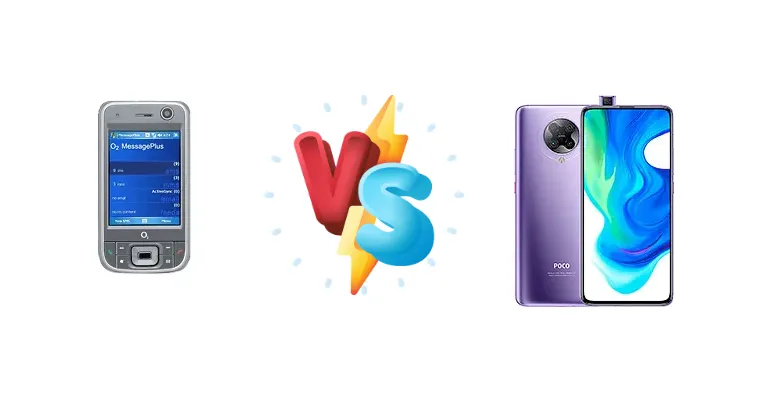
Comparing the O2 XDA Zinc and the Xiaomi Poco F2 Pro is less about a direct competition and more about witnessing a decade of smartphone evolution. The XDA Zinc, representing the early Windows Mobile era, clashes with the Poco F2 Pro, a modern Android powerhouse. This comparison isn't about finding a 'better' phone in a vacuum, but understanding the monumental shifts in processing power, display technology, and user experience.
🏆 Quick Verdict
For the vast majority of users, the Xiaomi Poco F2 Pro is the clear winner. Its Snapdragon 865 chipset, vibrant 854-nit display, and fast 30W charging represent a generational leap over the O2 XDA Zinc's aging Intel XScale processor and limited capabilities. The XDA Zinc appeals only to collectors or those seeking a retro experience.
| Network |
|---|
| 2G bands | GSM 900 / 1800 / 1900 | GSM 850 / 900 / 1800 / 1900 |
| 3G bands | UMTS 2100 | HSDPA 850 / 900 / 1700(AWS) / 1900 / 2100 - International |
| 4G bands | - | 1, 2, 3, 4, 5, 7, 8, 20, 28, 38, 40, 41 - International |
| 5G bands | - | 77, 78 Sub6 |
| Speed | Yes, 384 kbps | HSPA, LTE, 5G |
| Technology | GSM / UMTS | GSM / HSPA / LTE / 5G |
| Launch |
|---|
| Announced | 2006, December | 2020, May 12 |
| Status | Discontinued | Available. Released 2020, May 19 |
| Body |
|---|
| Build | - | Glass front (Gorilla Glass 5), glass back (Gorilla Glass 5), aluminum frame |
| Dimensions | 109 x 58 x 22.6 mm (4.29 x 2.28 x 0.89 in) | 163.3 x 75.4 x 8.9 mm (6.43 x 2.97 x 0.35 in) |
| Keyboard | QWERTY | - |
| SIM | Mini-SIM | Nano-SIM + Nano-SIM |
| Weight | 175 g (6.17 oz) | 219 g (7.72 oz) |
| Display |
|---|
| Protection | - | Corning Gorilla Glass 5 |
| Resolution | 240 x 320 pixels, 4:3 ratio (~143 ppi density) | 1080 x 2400 pixels, 20:9 ratio (~395 ppi density) |
| Size | 2.8 inches, 24.3 cm2 (~38.4% screen-to-body ratio) | 6.67 inches, 107.4 cm2 (~87.2% screen-to-body ratio) |
| Type | TFT resistive touchscreen, 65K colors | Super AMOLED, HDR10+, 500 nits (typ) |
| | Handwriting recognition
| - |
| Platform |
|---|
| CPU | Intel XScale PXA 270 520 MHz | Octa-core (1x2.84 GHz Cortex-A77 & 3x2.42 GHz Cortex-A77 & 4x1.80 GHz Cortex-A55) |
| Chipset | - | Qualcomm SM8250 Snapdragon 865 5G (7 nm+) |
| GPU | - | Adreno 650 |
| OS | Microsoft Windows Mobile 5.0 PocketPC | Android 10, upgradable to Android 12, MIUI 14 |
| Memory |
|---|
| Card slot | miniSD | No |
| Internal | 64MB RAM, 128MB ROM | 64GB 6GB RAM, 128GB 6GB RAM, 256GB 8GB RAM |
| | - | UFS 3.1
6GB RAM (LPDDR4X)
8GB RAM (LPDDR5) |
| Main Camera |
|---|
| Features | LED flash | Dual-LED dual-tone flash, HDR, panorama |
| Quad | - | 64 MP, f/1.9, 26mm (wide), 1/1.72", 0.8µm, PDAF
5 MP, f/2.2, 50mm (telephoto macro), AF
13 MP, f/2.4, 123˚ (ultrawide), 1.12µm
Auxiliary lens |
| Single | 2 MP | - |
| Video | Yes | 8K@24/30fps, 4K@30/60fps, 1080p@30/60/120/240fps, 1080p@960fps; gyro-EIS |
| Selfie camera |
|---|
| Features | - | HDR |
| Single | VGA videocall camera | Motorized pop-up 20 MP, f/2.2, (wide), 1/3.4", 0.8µm |
| Video | - | 1080p@30fps, 720p@120fps |
| Sound |
|---|
| 3.5mm jack | No | Yes |
| 35mm jack | No | Yes |
| Alert types | Vibration; Downloadable polyphonic, MP3 ringtones | - |
| Loudspeaker | Yes | Yes |
| | - | 24-bit/192kHz audio
|
| Comms |
|---|
| Bluetooth | Yes | 5.1, A2DP, LE, aptX HD, aptX Adaptive |
| Infrared port | Yes | Yes |
| NFC | - | Yes |
| Positioning | No | GPS (L1+L5), GLONASS (G1), BDS (B1), GALILEO (E1+E5a), QZSS (L1+L5) |
| Radio | No | No |
| USB | miniUSB | USB Type-C 2.0, OTG |
| WLAN | Wi-Fi 802.11b/g | Wi-Fi 802.11 a/b/g/n/ac/6, dual-band, Wi-Fi Direct |
| Features |
|---|
| Browser | WAP 2.0/xHTML, HTML (PocketIE) | - |
| Sensors | - | Fingerprint (under display, optical), accelerometer, gyro, proximity, compass, barometer |
| | Pocket Office
Voice memo
MP3/AAC player | - |
| Battery |
|---|
| Charging | - | 30W wired, PD3.0, QC4, 100% in 63 min |
| Stand-by | Up to 220 h | - |
| Talk time | Up to 5 h | - |
| Type | Removable Li-Ion 1300 mAh battery | Li-Po 4700 mAh |
| Misc |
|---|
| Colors | Silver | Neon Blue, Phantom White, Electric Purple, Cyber Gray |
| Models | - | M2004J11G |
| Price | About 240 EUR | About 150 EUR |
| SAR | - | 1.09 W/kg (head) 0.51 W/kg (body) |
| SAR EU | - | 0.79 W/kg (head) 1.03 W/kg (body) |
| Tests |
|---|
| Battery life | - |
Endurance rating 120h
|
| Camera | - |
Photo / Video |
| Display | - |
Contrast ratio: Infinite (nominal) |
| Loudspeaker | - |
-25.6 LUFS (Very good)
|
| Performance | - |
AnTuTu: 538221 (v8)
GeekBench: 3332 (v5.1)
GFXBench: 40fps (ES 3.1 onscreen) |
O2 XDA Zinc
- Nostalgia factor for retro tech enthusiasts
- Runs Windows Mobile (for specific legacy needs)
- Compact size (likely)
- Extremely slow processor
- Outdated display technology
- Poor camera quality
- Limited app availability
Xiaomi Poco F2 Pro
- Powerful Snapdragon 865 processor
- Bright and vibrant display
- Fast 30W charging
- Modern Android operating system
- Excellent battery life
- May be larger and heavier than the XDA Zinc
- Software support may eventually end
Display Comparison
The disparity in display technology is stark. The Xiaomi Poco F2 Pro boasts a significantly brighter display, peaking at 854 nits, ensuring excellent visibility even outdoors. While the XDA Zinc's display specifications are unavailable, it's safe to assume it pales in comparison, likely utilizing an older LCD technology with lower brightness and contrast. The F2 Pro's 'Infinite' contrast ratio (nominal) suggests a modern panel capable of deep blacks, a feature absent in the XDA Zinc. The F2 Pro's larger screen size and higher resolution also contribute to a far more immersive viewing experience.
Camera Comparison
Both devices offer photo and video capabilities, but the quality difference is substantial. The Poco F2 Pro benefits from modern image processing algorithms and likely a much larger and more sophisticated camera sensor. While specific sensor details are missing, the F2 Pro's camera system is designed for capturing detailed photos and videos in various lighting conditions. The XDA Zinc's camera, typical of its era, would produce low-resolution images with limited dynamic range and poor low-light performance. The F2 Pro's camera is geared towards social media sharing and casual photography, while the XDA Zinc's camera is largely a historical artifact.
Performance
The performance gap is immense. The O2 XDA Zinc's 520 MHz Intel XScale PXA 270 processor is dwarfed by the Xiaomi Poco F2 Pro's Qualcomm Snapdragon 865 5G (7nm+). The Snapdragon 865 features an octa-core CPU configuration – a 2.84 GHz Cortex-A77 prime core, three 2.42 GHz Cortex-A77 cores, and four 1.80 GHz Cortex-A55 cores – offering significantly higher processing power and efficiency. The 7nm+ fabrication process further enhances performance and reduces heat. The XDA Zinc would struggle with even basic modern applications, while the Poco F2 Pro can handle demanding games and multitasking with ease. The F2 Pro's Adreno 650 GPU also provides a substantial graphical advantage.
Battery Life
The Xiaomi Poco F2 Pro's endurance rating of 120 hours suggests a well-optimized battery life, aided by the efficient Snapdragon 865 chipset. The 30W wired charging with PD3.0 and QC4 support allows for a full charge in just 63 minutes. The O2 XDA Zinc's battery life is unknown, but given its older processor and smaller battery capacity, it would likely require more frequent charging. The F2 Pro's fast charging capability is a significant convenience feature absent in the XDA Zinc.
Buying Guide
Buy the O2 XDA Zinc if you're a collector of vintage technology, fascinated by the history of mobile computing, or specifically require a device running Windows Mobile for legacy applications. Buy the Xiaomi Poco F2 Pro if you need a capable, modern smartphone for everyday tasks, gaming, photography, and benefit from fast charging and a bright, high-quality display. The F2 Pro is for anyone who wants a functional, powerful device.
Frequently Asked Questions
❓ Can the Poco F2 Pro handle demanding mobile games like Genshin Impact or Call of Duty Mobile?
Yes, the Qualcomm Snapdragon 865 in the Poco F2 Pro is more than capable of running demanding games like Genshin Impact and Call of Duty Mobile at high settings. While it's not the latest flagship chipset, it still provides excellent gaming performance, and the phone's thermal management system helps prevent overheating during extended gaming sessions.
❓ Is the O2 XDA Zinc compatible with modern mobile networks like 4G or 5G?
No, the O2 XDA Zinc is a 2G/3G device and is not compatible with modern 4G or 5G networks. Its cellular capabilities are limited to older standards, meaning it won't be able to connect to current mobile data networks in most regions.
❓ What kind of storage options does the Poco F2 Pro offer, and is it expandable?
The Xiaomi Poco F2 Pro typically comes with 128GB or 256GB of UFS 3.1 storage. Unfortunately, it does *not* offer expandable storage via microSD card, so you'll need to choose a storage capacity that meets your needs upfront.
❓ Can I use modern apps like WhatsApp or Facebook on the O2 XDA Zinc?
No, modern apps like WhatsApp and Facebook are not compatible with the O2 XDA Zinc's Windows Mobile operating system. These apps are designed for Android or iOS and require a more powerful processor and modern software environment.