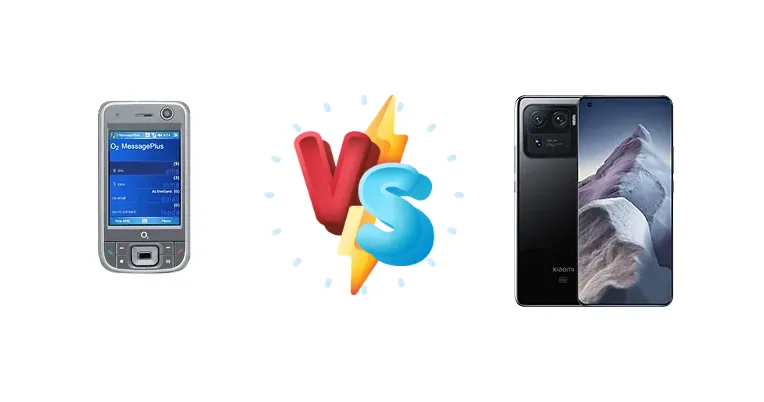
Comparing the O2 XDA Zinc and the Xiaomi Mi 11 Ultra is less about a head-to-head contest and more about witnessing two decades of mobile evolution. The XDA Zinc, a representative of the early smartphone era running Windows Mobile, faces off against the Mi 11 Ultra, a 2021 Android flagship boasting cutting-edge technology. This isn't about choosing a 'winner' in the traditional sense, but understanding the monumental progress made in mobile computing.
🏆 Quick Verdict
For the average user in 2024, the Xiaomi Mi 11 Ultra is the clear choice. Its Snapdragon 888 chipset, superior display, and advanced camera system offer a level of performance and functionality the XDA Zinc simply cannot match. However, the XDA Zinc holds significant historical value for enthusiasts.
| Network |
|---|
| 2G bands | GSM 900 / 1800 / 1900 | GSM 850 / 900 / 1800 / 1900 |
| 3G bands | UMTS 2100 | HSDPA 850 / 900 / 1700(AWS) / 1900 / 2100 |
| 4G bands | - | 1, 2, 3, 4, 5, 7, 8, 12, 17, 20, 28, 32, 38, 40, 41, 42, 66 - International |
| 5G bands | - | 1, 3, 5, 7, 8, 20, 28, 38, 40, 41, 77, 78, 79 SA/NSA - International |
| Speed | Yes, 384 kbps | HSPA, LTE, 5G |
| Technology | GSM / UMTS | GSM / CDMA / HSPA / EVDO / LTE / 5G |
| | - | 1, 3, 28, 41, 77, 78, 79 SA/NSA - China |
| Launch |
|---|
| Announced | 2006, December | 2021, March 29 |
| Status | Discontinued | Available. Released 2021, April 02 |
| Body |
|---|
| Build | - | Glass front (Gorilla Glass Victus), ceramic back, aluminum frame |
| Dimensions | 109 x 58 x 22.6 mm (4.29 x 2.28 x 0.89 in) | 164.3 x 74.6 x 8.4 mm (6.47 x 2.94 x 0.33 in) |
| Keyboard | QWERTY | - |
| SIM | Mini-SIM | Nano-SIM + Nano-SIM |
| Weight | 175 g (6.17 oz) | 234 g (8.25 oz) |
| | - | IP68 dust/water resistant (up to 1.5m for 30 min) |
| Display |
|---|
| Protection | - | Corning Gorilla Glass Victus |
| Resolution | 240 x 320 pixels, 4:3 ratio (~143 ppi density) | 1440 x 3200 pixels, 20:9 ratio (~515 ppi density) |
| Size | 2.8 inches, 24.3 cm2 (~38.4% screen-to-body ratio) | 6.81 inches, 112.0 cm2 (~91.4% screen-to-body ratio) |
| Type | TFT resistive touchscreen, 65K colors | AMOLED, 1B colors, 120Hz, HDR10+, Dolby Vision, 900 nits (HBM), 1700 nits (peak) |
| | Handwriting recognition
| - |
| Platform |
|---|
| CPU | Intel XScale PXA 270 520 MHz | Octa-core (1x2.84 GHz Cortex-X1 & 3x2.42 GHz Cortex-A78 & 4x1.80 GHz Cortex-A55) |
| Chipset | - | Qualcomm SM8350 Snapdragon 888 5G (5 nm) |
| GPU | - | Adreno 660 |
| OS | Microsoft Windows Mobile 5.0 PocketPC | Android 11, upgradable to Android 13, MIUI 14 |
| Memory |
|---|
| Card slot | miniSD | No |
| Internal | 64MB RAM, 128MB ROM | 256GB 8GB RAM, 256GB 12GB RAM, 512GB 12GB RAM |
| | - | UFS 3.1 |
| Main Camera |
|---|
| Features | LED flash | Laser AF, color spectrum sensor, Dual-LED flash, HDR, panorama, 1.1” AMOLED selfie display |
| Single | 2 MP | 20 MP, f/2.2, 27mm (wide), 1/3.4", 0.8µm |
| Triple | - | 50 MP, f/2.0, 24mm (wide), 1/1.12", 1.4µm, dual pixel PDAF, OIS
48 MP, f/4.1, 120mm (periscope telephoto), 1/2.0", 0.8µm, PDAF, OIS, 5x optical zoom
48 MP, f/2.2, 12mm, 128˚ (ultrawide), 1/2.0", 0.8µm, PDAF |
| Video | Yes | 8K@24fps, 4K@30/60fps, 1080p@30/60/120/240/960/1920fps, gyro-EIS, HDR10+ rec. |
| Selfie camera |
|---|
| Features | - | HDR, panorama |
| Single | VGA videocall camera | 20 MP, f/2.2, 27mm (wide), 1/3.4", 0.8µm |
| Video | - | 1080p@30/60fps, 720p@120fps, gyro-EIS |
| Sound |
|---|
| 3.5mm jack | No | No |
| 35mm jack | No | No |
| Alert types | Vibration; Downloadable polyphonic, MP3 ringtones | - |
| Loudspeaker | Yes | Yes, with stereo speakers |
| | - | 24-bit/192kHz audio
Tuned by Harman Kardon |
| Comms |
|---|
| Bluetooth | Yes | 5.2, A2DP, LE, aptX HD, aptX Adaptive |
| Infrared port | Yes | Yes |
| NFC | - | Yes |
| Positioning | No | GPS (L1+L5), GLONASS (L1), BDS (B1I+B1c+B2a), GALILEO (E1+E5a), QZSS (L1+L5), NavIC (L5) |
| Radio | No | No |
| USB | miniUSB | USB Type-C 2.0, OTG |
| WLAN | Wi-Fi 802.11b/g | Wi-Fi 802.11 a/b/g/n/ac/6e, dual-band, Wi-Fi Direct, DLNA |
| Features |
|---|
| Browser | WAP 2.0/xHTML, HTML (PocketIE) | - |
| Sensors | - | Fingerprint (under display, optical), accelerometer, gyro, compass |
| | Pocket Office
Voice memo
MP3/AAC player | Virtual proximity sensing |
| Battery |
|---|
| Charging | - | 67W wired, PD3.0, QC4, 100% in 36 min
67W wireless, 100% in 39 min
10W reverse wireless |
| Stand-by | Up to 220 h | - |
| Talk time | Up to 5 h | - |
| Type | Removable Li-Ion 1300 mAh battery | Li-Po 5000 mAh |
| Misc |
|---|
| Colors | Silver | Ceramic White (Cosmic White), Ceramic Black (Cosmic Black) |
| Models | - | M2102K1G, M2102K1C |
| Price | About 240 EUR | About 1500 EUR |
| SAR | - | 1.08 W/kg (head) 0.81 W/kg (body) |
| SAR EU | - | 0.55 W/kg (head) 0.99 W/kg (body) |
| Tests |
|---|
| Battery life | - |
Endurance rating 95h
|
| Camera | - |
Photo / Video |
| Display | - |
Contrast ratio: Infinite (nominal) |
| Loudspeaker | - |
-24.3 LUFS (Very good)
|
| Performance | - |
AnTuTu: 688720 (v8)
GeekBench: 3191 (v5.1)
GFXBench: 33fps (ES 3.1 onscreen) |
O2 XDA Zinc
- Historical significance and collector's value
- Unique Windows Mobile experience
- Compact and lightweight design (likely)
- Extremely limited performance
- Outdated display technology
- Poor camera quality
- Limited app availability
Xiaomi Mi 11 Ultra
- Exceptional performance with Snapdragon 888
- Bright and vibrant display
- Advanced camera system
- Fast charging and long battery life
- Access to modern Android apps and services
- Larger and heavier design
- Potentially higher price (depending on current market)
- May require software updates to maintain security
Display Comparison
The contrast between the displays is immense. The Xiaomi Mi 11 Ultra boasts a peak brightness of 943 nits, offering excellent visibility even in direct sunlight. While the XDA Zinc’s display specifications are unavailable, it would have utilized older LCD technology with significantly lower brightness and contrast. The Mi 11 Ultra’s infinite (nominal) contrast ratio, likely achieved through OLED technology, delivers richer blacks and more vibrant colors, a feature entirely absent in the XDA Zinc’s era. The Mi 11 Ultra’s display is also likely to have a much higher pixel density, resulting in sharper images and text.
Camera Comparison
The camera capabilities are worlds apart. The Xiaomi Mi 11 Ultra features a sophisticated camera system (Photo/Video capabilities are noted, but specific details are missing), likely including multiple lenses and advanced image processing algorithms. The XDA Zinc’s camera, typical of its time, would have been a low-resolution sensor with limited features. The Mi 11 Ultra’s camera likely benefits from features like Optical Image Stabilization (OIS) and advanced computational photography, resulting in significantly better image quality, especially in low-light conditions. The XDA Zinc’s camera would be primarily suited for basic snapshots.
Performance
The performance gap is perhaps the most striking. The O2 XDA Zinc’s Intel XScale PXA 270 520 MHz processor, while innovative for its time, is dwarfed by the Xiaomi Mi 11 Ultra’s Qualcomm Snapdragon 888 5G (5 nm). The Snapdragon 888’s octa-core architecture (1x2.84 GHz Cortex-X1, 3x2.42 GHz Cortex-A78, 4x1.80 GHz Cortex-A55) provides significantly more processing power and efficiency. The 5nm fabrication process of the Snapdragon 888 further enhances performance and reduces heat generation, something the older XScale processor would struggle with. The XDA Zinc would be limited to basic tasks, while the Mi 11 Ultra can handle demanding games, video editing, and multitasking with ease.
Battery Life
The Xiaomi Mi 11 Ultra’s endurance rating of 95 hours indicates a substantial battery life, supported by its 67W wired and wireless charging capabilities (36 minutes to 100% wired, 39 minutes wireless). The XDA Zinc’s battery capacity and charging time are unknown, but would have been significantly lower. The Mi 11 Ultra’s fast charging allows for quick top-ups, while the XDA Zinc would likely require hours to fully charge. The inclusion of 10W reverse wireless charging on the Mi 11 Ultra adds further convenience, a feature unavailable on the XDA Zinc.
Buying Guide
Buy the O2 XDA Zinc if you're a collector of vintage technology, interested in the history of mobile computing, or seeking a unique conversation piece. Its appeal lies in its retro charm and the experience of using an early smartphone OS. Buy the Xiaomi Mi 11 Ultra if you prioritize performance, camera quality, battery life, and access to modern apps and services. It's a powerful device for everyday use, photography, and entertainment.
Frequently Asked Questions
❓ Can I still use the O2 XDA Zinc with modern mobile networks?
The O2 XDA Zinc supports 2G and potentially 3G networks, but it is unlikely to be compatible with modern 4G or 5G networks. Its connectivity is limited by its age and the available cellular technologies at the time of its release.
❓ What kind of apps can I run on the O2 XDA Zinc?
The O2 XDA Zinc runs Windows Mobile, meaning you can only run applications specifically designed for that operating system. The app ecosystem is extremely limited compared to modern Android or iOS, and many popular apps are unavailable.
❓ Is the Xiaomi Mi 11 Ultra still a good buy in 2024?
Despite being a 2021 model, the Xiaomi Mi 11 Ultra remains a capable device in 2024, particularly if found at a discounted price. Its Snapdragon 888 processor and excellent camera system still deliver a good user experience for most tasks. However, newer models offer improved performance and features.
❓ Does the Xiaomi Mi 11 Ultra support expandable storage?
No, the Xiaomi Mi 11 Ultra does not support expandable storage via microSD card. Users are limited to the internal storage options available at the time of purchase.