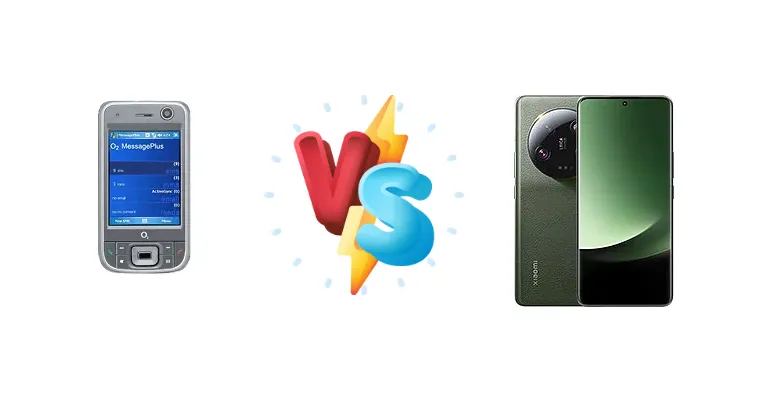
Comparing the O2 XDA Zinc and the Xiaomi 13 Ultra is less about a head-to-head contest and more about witnessing two decades of mobile evolution. The XDA Zinc, a representative of the early smartphone/PDA era, showcases a time when functionality prioritized compactness, while the Xiaomi 13 Ultra embodies the modern pursuit of uncompromising performance and imaging capabilities.
🏆 Quick Verdict
For the vast majority of users, the Xiaomi 13 Ultra is the clear winner. Its Snapdragon 8 Gen 2 chipset, advanced camera system, and modern features offer an experience light-years ahead of the XDA Zinc. However, the XDA Zinc holds significant historical and collector value.
| Network |
|---|
| 2G bands | GSM 900 / 1800 / 1900 | GSM 850 / 900 / 1800 / 1900 |
| 3G bands | UMTS 2100 | HSDPA 800 / 850 / 900 / 1700(AWS) / 1900 / 2100 |
| 4G bands | - | 1, 2, 3, 4, 5, 7, 8, 18, 19, 20, 26, 28, 38, 40, 41, 66 - International |
| 5G bands | - | 1, 3, 5, 7, 8, 20, 28, 38, 40, 41, 77, 78, 79 SA/NSA - International |
| Speed | Yes, 384 kbps | HSPA, LTE, 5G |
| Technology | GSM / UMTS | GSM / CDMA / HSPA / EVDO / LTE / 5G |
| | - | CDMA2000 1xEV-DO |
| Launch |
|---|
| Announced | 2006, December | 2023, April 18 |
| Status | Discontinued | Available. Released 2023, April 21 |
| Body |
|---|
| Build | - | Glass front (Gorilla Glass Victus), eco leather back, aluminum frame |
| Dimensions | 109 x 58 x 22.6 mm (4.29 x 2.28 x 0.89 in) | 163.2 x 74.6 x 9.1 mm (6.43 x 2.94 x 0.36 in) |
| Keyboard | QWERTY | - |
| SIM | Mini-SIM | Nano-SIM + Nano-SIM |
| Weight | 175 g (6.17 oz) | 227 g (8.01 oz) |
| | - | IP68 dust/water resistant (up to 1.5m for 30 min) |
| Display |
|---|
| Protection | - | Corning Gorilla Glass Victus |
| Resolution | 240 x 320 pixels, 4:3 ratio (~143 ppi density) | 1440 x 3200 pixels, 20:9 ratio (~522 ppi density) |
| Size | 2.8 inches, 24.3 cm2 (~38.4% screen-to-body ratio) | 6.73 inches, 108.9 cm2 (~89.5% screen-to-body ratio) |
| Type | TFT resistive touchscreen, 65K colors | LTPO AMOLED, 68B colors, 120Hz, Dolby Vision, HDR10+, 1300 nits (HBM), 2600 nits (peak) |
| | Handwriting recognition
| - |
| Platform |
|---|
| CPU | Intel XScale PXA 270 520 MHz | Octa-core (1x3.2 GHz Cortex-X3 & 2x2.8 GHz Cortex-A715 & 2x2.8 GHz Cortex-A710 & 3x2.0 GHz Cortex-A510) |
| Chipset | - | Qualcomm SM8550-AB Snapdragon 8 Gen 2 (4 nm) |
| GPU | - | Adreno 740 |
| OS | Microsoft Windows Mobile 5.0 PocketPC | Android 13, upgradable to Android 14, HyperOS |
| Memory |
|---|
| Card slot | miniSD | No |
| Internal | 64MB RAM, 128MB ROM | 256GB 12GB RAM, 512GB 12GB RAM, 512GB 16GB RAM, 1TB 16GB RAM |
| | - | UFS 4.0 |
| Main Camera |
|---|
| Features | LED flash | Laser AF, color spectrum sensor, Leica lenses, Dual-LED flash, HDR, panorama, 67mm filter ring holder (optional) |
| Quad | - | 50 MP, f/1.9 or f/4.0, 23mm (wide), 1.0"-type, 1.6µm, dual pixel PDAF, OIS
50 MP, f/1.8, 75mm (telephoto), 1/2.51", 0.7µm, dual pixel PDAF, OIS, 3.2x optical zoom
50 MP, f/3.0, 120mm (periscope telephoto), 1/2.51", 0.7µm, dual pixel PDAF, OIS, 5x optical zoom
50 MP, f/1.8, 12mm, 122˚ (ultrawide), 1/2.51", 0.7µm, dual pixel PDAF
TOF 3D, (depth) |
| Single | 2 MP | - |
| Video | Yes | 8K@24fps, 4K@24/30/60fps, 1080p@30/60/120/240/480/960/1920fps, gyro-EIS, Dolby Vision HDR 10-bit rec. (4K@60fps, 1080p) |
| Selfie camera |
|---|
| Features | - | HDR, panorama |
| Single | VGA videocall camera | 32 MP, f/2.0, 22mm (wide), 1/3.14", 0.7µm |
| Video | - | 1080p@30/60fps, gyro-EIS |
| Sound |
|---|
| 3.5mm jack | No | No |
| 35mm jack | No | No |
| Alert types | Vibration; Downloadable polyphonic, MP3 ringtones | - |
| Loudspeaker | Yes | Yes, with stereo speakers |
| | - | 24-bit/192kHz audio |
| Comms |
|---|
| Bluetooth | Yes | 5.3, A2DP, LE, aptX HD, aptX Adaptive |
| Infrared port | Yes | Yes |
| NFC | - | Yes |
| Positioning | No | GPS (L1+L5), GLONASS (L1), BDS (B1I+B1c+B2a), GALILEO (E1+E5a), QZSS (L1+L5), NavIC (L5) |
| Radio | No | No |
| USB | miniUSB | USB Type-C 3.2, DisplayPort, OTG |
| WLAN | Wi-Fi 802.11b/g | Wi-Fi 802.11 a/b/g/n/ac/6e/7, tri-band, Wi-Fi Direct |
| Features |
|---|
| Browser | WAP 2.0/xHTML, HTML (PocketIE) | - |
| Sensors | - | Fingerprint (under display, optical), accelerometer, proximity, gyro, compass, barometer |
| | Pocket Office
Voice memo
MP3/AAC player | Virtual proximity sensing |
| Battery |
|---|
| Charging | - | 90W wired, PD3.0, QC4, 100% in 35 min
50W wireless, 100% in 49 min
10W reverse wireless |
| Stand-by | Up to 220 h | - |
| Talk time | Up to 5 h | - |
| Type | Removable Li-Ion 1300 mAh battery | Li-Po 5000 mAh |
| Misc |
|---|
| Colors | Silver | Black, Olive Green, White, Orange, Yellow, Blue |
| Models | - | 2304FPN6DC, 2304FPN6DG |
| Price | About 240 EUR | € 797.98 / $ 389.69 |
| SAR EU | - | 0.99 W/kg (head) 1.00 W/kg (body) |
O2 XDA Zinc
- Extremely compact and pocketable
- Historical significance and collector's value
- Simple and straightforward operating system (Windows Mobile)
- Severely outdated processor and performance
- Poor camera quality
- Limited app availability and functionality
Xiaomi 13 Ultra
- Exceptional performance with Snapdragon 8 Gen 2
- Professional-grade camera system
- Fast charging (90W wired, 50W wireless)
- Larger size and weight
- Higher price point
- Complex software with potential bloatware
Display Comparison
The Xiaomi 13 Ultra boasts a significantly brighter display, reaching a measured 1207 nits, compared to the XDA Zinc’s likely lower, and unrecorded, brightness. The 13 Ultra’s modern panel likely utilizes LTPO technology for variable refresh rates, enhancing power efficiency and smoothness, a feature entirely absent in the XDA Zinc’s older display technology. The XDA Zinc’s screen size and resolution are dwarfed by the 13 Ultra, resulting in a vastly superior viewing experience for media consumption and productivity.
Camera Comparison
The Xiaomi 13 Ultra’s camera system is in a different league. While details on the XDA Zinc’s camera are limited, it’s safe to assume it pales in comparison to the 13 Ultra’s sophisticated array. The 13 Ultra’s focus on photo and video capabilities, likely including a large main sensor and advanced image processing algorithms, delivers professional-quality results. The XDA Zinc’s camera was primarily for basic snapshots, lacking the features and image quality of modern smartphone cameras.
Performance
The performance gap is immense. The O2 XDA Zinc’s Intel XScale PXA 270 520 MHz processor is a relic of the past. In contrast, the Xiaomi 13 Ultra’s Qualcomm Snapdragon 8 Gen 2 (4nm) is an octa-core powerhouse, featuring Cortex-X3, A715, and A710 cores clocked up to 3.2 GHz. The 4nm fabrication process of the Snapdragon 8 Gen 2 delivers significantly improved thermal efficiency, allowing for sustained peak performance without excessive throttling. The XDA Zinc would struggle with even basic modern applications, while the 13 Ultra handles demanding games and multitasking with ease.
Battery Life
The Xiaomi 13 Ultra offers a substantial battery life advantage. Its active use score of 10:09h and endurance rating of 108h demonstrate its ability to last a full day with heavy usage. Furthermore, the 90W wired charging (100% in 35 min) and 50W wireless charging provide incredibly fast replenishment. The XDA Zinc’s battery life, while adequate for its time, would be severely limited by modern usage patterns and lacks any form of fast charging.
Buying Guide
Buy the O2 XDA Zinc if you're a collector of vintage technology, interested in the history of mobile computing, or require a supremely compact device for very basic tasks. Buy the Xiaomi 13 Ultra if you demand top-tier performance, a professional-grade camera system, fast charging, and a modern smartphone experience with access to current apps and services.
Frequently Asked Questions
❓ Is the O2 XDA Zinc still usable in 2024 for everyday tasks?
While technically functional, the O2 XDA Zinc is impractical for modern use. Its limited processing power, outdated operating system, and lack of app support make it unsuitable for tasks like browsing the web, using social media, or running modern applications. It's best suited for collectors or those interested in experiencing early smartphone technology.
❓ How does the Snapdragon 8 Gen 2 in the Xiaomi 13 Ultra handle demanding games like Genshin Impact?
The Snapdragon 8 Gen 2 in the Xiaomi 13 Ultra excels at gaming. It can run Genshin Impact at high settings with stable frame rates. The 4nm process and advanced thermal management minimize throttling, ensuring sustained performance during extended gaming sessions. The Adreno GPU provides excellent graphics rendering capabilities.
❓ Can I easily find replacement parts or accessories for the O2 XDA Zinc?
Finding replacement parts or accessories for the O2 XDA Zinc is extremely difficult. As a vintage device, its components are no longer manufactured, and availability is limited to online marketplaces and collector communities. Expect to pay a premium for any available parts.