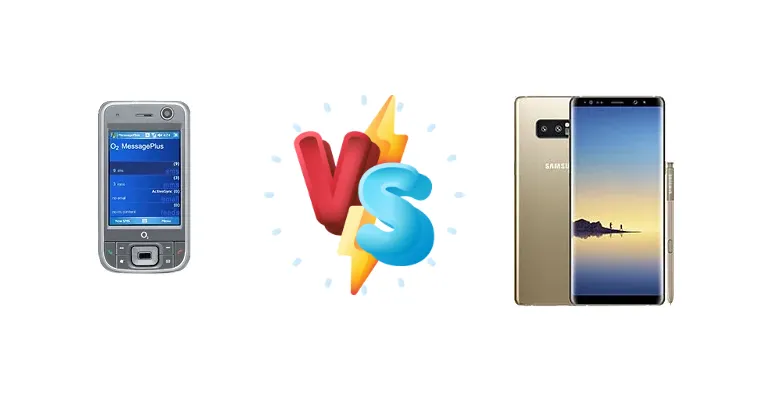
Comparing the O2 XDA Zinc and the Samsung Galaxy Note8 is a study in contrasts. The Zinc, representing a peak in Windows Mobile devices, prioritizes compact efficiency. The Note8, a late-era flagship, embodies the burgeoning Android ecosystem and the rise of the 'phablet' with its large display and S Pen. This comparison isn't about crowning a single winner, but understanding how these devices catered to vastly different user needs and technological landscapes.
🏆 Quick Verdict
For the average user in 2024, the Samsung Galaxy Note8 is the more practical choice. Its superior processing power, significantly better camera capabilities, and continued software support (albeit unofficial) outweigh the XDA Zinc’s compact form factor. However, enthusiasts seeking a retro computing experience or a highly secure, offline device may find value in the Zinc.
| Network |
|---|
| 2G bands | GSM 900 / 1800 / 1900 | GSM 850 / 900 / 1800 / 1900 - SIM 1 & SIM 2 (dual-SIM model only) |
| 3G bands | UMTS 2100 | HSDPA 850 / 900 / 1700(AWS) / 1900 / 2100 |
| 4G bands | - | 1, 2, 3, 4, 5, 7, 8, 12, 13, 17, 18, 19, 20, 25, 26, 28, 32, 38, 39, 40, 41, 66 |
| Speed | Yes, 384 kbps | HSPA 42.2/5.76 Mbps, LTE (5CA) Cat16 1024/150 Mbps |
| Technology | GSM / UMTS | GSM / HSPA / LTE |
| Launch |
|---|
| Announced | 2006, December | 2017, August 23. Released 2017, September |
| Status | Discontinued | Discontinued |
| Body |
|---|
| Build | - | Glass front (Gorilla Glass 5), glass back (Gorilla Glass 5), aluminum frame |
| Dimensions | 109 x 58 x 22.6 mm (4.29 x 2.28 x 0.89 in) | 162.5 x 74.8 x 8.6 mm (6.40 x 2.94 x 0.34 in) |
| Keyboard | QWERTY | - |
| SIM | Mini-SIM | · Nano-SIM· Nano-SIM + Nano-SIM |
| Weight | 175 g (6.17 oz) | 195 g (6.88 oz) |
| | - | IP68 dust/water resistant (up to 1.5m for 30 min)
Stylus |
| Display |
|---|
| Protection | - | Corning Gorilla Glass 5 |
| Resolution | 240 x 320 pixels, 4:3 ratio (~143 ppi density) | 1440 x 2960 pixels, 18.5:9 ratio (~521 ppi density) |
| Size | 2.8 inches, 24.3 cm2 (~38.4% screen-to-body ratio) | 6.3 inches, 101.1 cm2 (~83.2% screen-to-body ratio) |
| Type | TFT resistive touchscreen, 65K colors | Super AMOLED, HDR10 |
| | Handwriting recognition
| 3D Touch (home button only)
Always-on display |
| Platform |
|---|
| CPU | Intel XScale PXA 270 520 MHz | Octa-core (4x2.3 GHz Mongoose M2 & 4x1.7 GHz Cortex-A53) - EMEAOcta-core (4x2.35 GHz Kryo & 4x1.9 GHz Kryo) - USA & China |
| Chipset | - | Exynos 8895 (10 nm) - EMEAQualcomm MSM8998 Snapdragon 835 (10 nm) - USA & China |
| GPU | - | Mali-G71 MP20 - EMEAAdreno 540 - USA & China |
| OS | Microsoft Windows Mobile 5.0 PocketPC | Android 7.1.1 (Nougat), upgradable to Android 9.0 (Pie) |
| Memory |
|---|
| Card slot | miniSD | microSDXC (uses shared SIM slot) - dual SIM model only |
| Internal | 64MB RAM, 128MB ROM | 64GB 6GB RAM, 128GB 6GB RAM, 256GB 6GB RAM |
| | - | UFS 2.1 |
| Main Camera |
|---|
| Dual | - | 12 MP, f/1.7, 26mm (wide), 1/2.55", 1.4µm, dual pixel PDAF, OIS
12 MP, f/2.4, 52mm (telephoto), 1/3.6", 1.0µm, AF, OIS, 2x optical zoom |
| Features | LED flash | LED flash, auto-HDR, panorama |
| Single | 2 MP | - |
| Video | Yes | 4K@30fps, 1080p@30/60fps, 720p@240fps, stereo sound rec., HDR, gyro-EIS |
| Selfie camera |
|---|
| Dual | - | 8 MP, f/1.7, 25mm (wide), 1/3.6", 1.22µm, AF
2 MP (dedicated iris scanner camera) |
| Features | - | HDR |
| Single | VGA videocall camera | - |
| Video | - | 1440p@30fps |
| Sound |
|---|
| 3.5mm jack | No | Yes |
| 35mm jack | No | Yes |
| Alert types | Vibration; Downloadable polyphonic, MP3 ringtones | - |
| Loudspeaker | Yes | Yes |
| | - | 32-bit/384kHz audio
|
| Comms |
|---|
| Bluetooth | Yes | 5.0, A2DP, LE, aptX |
| Infrared port | Yes | - |
| NFC | - | Yes |
| Positioning | No | GPS, GLONASS, BDS, GALILEO |
| Radio | No | No |
| USB | miniUSB | USB Type-C 3.1 |
| WLAN | Wi-Fi 802.11b/g | Wi-Fi 802.11 a/b/g/n/ac, dual-band, Wi-Fi Direct |
| Features |
|---|
| Browser | WAP 2.0/xHTML, HTML (PocketIE) | - |
| Sensors | - | Iris scanner, fingerprint (rear-mounted), accelerometer, gyro, proximity, compass, barometer, heart rate, SpO2 |
| | Pocket Office
Voice memo
MP3/AAC player | Samsung DeX (desktop experience support)
ANT+
Bixby natural language commands and dictation
Samsung Pay (Visa, MasterCard certified) |
| Battery |
|---|
| Charging | - | 15W wired, QC2
Wireless (Qi) (market dependent) |
| Music play | - | Up to 74 h |
| Stand-by | Up to 220 h | - |
| Talk time | Up to 5 h | Up to 22 h (3G) |
| Type | Removable Li-Ion 1300 mAh battery | Li-Ion 3300 mAh, non-removable |
| Misc |
|---|
| Colors | Silver | Midnight Black, Maple Gold, Orchid Gray, Deep Sea Blue, Star Pink |
| Models | - | SM-N950F, SM-N950U, SM-N9500, SM-N950U1, SM-N950N, SM-N950W, SC-01K, SM-N950FD |
| Price | About 240 EUR | About 500 EUR |
| SAR | - | 0.61 W/kg (head) 0.56 W/kg (body) |
| SAR EU | - | 0.17 W/kg (head) 1.29 W/kg (body) |
| Tests |
|---|
| Audio quality | - |
Noise -92.5dB / Crosstalk -93.2dB |
| Battery life | - |
Endurance rating 89h
|
| Camera | - |
Photo / Video |
| Display | - |
Contrast ratio: Infinite (nominal), 4.148(sunlight) |
| Loudspeaker | - |
Voice 67dB / Noise 69dB / Ring 71dB
|
| Performance | - |
AnTuTu: 201065 (v7)
GeekBench: 6784 (v4.4)
GFXBench: 13fps (ES 3.1 onscreen) |
O2 XDA Zinc
- Extremely compact and pocketable
- Secure Windows Mobile operating system
- Offline functionality and simplicity
- Outdated processor and limited performance
- Poor camera quality
- Limited app availability and software support
Samsung Galaxy Note8
- Powerful processor and ample RAM
- Excellent camera system with advanced features
- Large, vibrant display and S Pen support
- Larger size and weight
- Android OS requires custom ROMs for security updates
- Battery life, while good, is not exceptional by modern standards
Display Comparison
The Note8’s display is a significant leap forward. While both devices boast an 'Infinite' contrast ratio (a marketing term common at the time), the Note8’s larger 6.3-inch Super AMOLED panel offers a far more immersive experience than the XDA Zinc’s smaller screen. The Note8’s 4.148 sunlight contrast ratio suggests superior outdoor visibility, crucial for usability in bright conditions. The XDA Zinc’s display specs are less readily available, but given its age, it likely lacks the color accuracy and brightness of the Note8’s advanced AMOLED technology.
Camera Comparison
The Note8’s camera system is a clear winner. While both devices offer photo and video capabilities, the Note8’s sensor size, lens apertures, and image processing algorithms are far more advanced. The Note8 likely features Optical Image Stabilization (OIS), a feature absent on the XDA Zinc. The XDA Zinc’s camera, typical of its era, would produce lower-resolution images with limited dynamic range and poor low-light performance. The Note8’s dual-camera setup (specifications not provided) offered features like Live Focus, enhancing portrait photography.
Performance
The performance gap is substantial. The O2 XDA Zinc’s Intel XScale PXA 270 520 MHz processor is dwarfed by the Samsung Galaxy Note8’s Exynos 8895 (EMEA) or Qualcomm MSM8998 Snapdragon 835 (USA & China) – both 10nm octa-core chips clocked at up to 2.35 GHz. The Note8’s architecture, utilizing Mongoose M2 or Kryo cores, provides significantly faster processing speeds and improved multi-tasking capabilities. The Note8’s chipset also benefits from a modern GPU, enabling smoother graphics performance for gaming and video playback, something the XDA Zinc would struggle with. The Note8’s RAM configuration (not specified in the data, but typically 6GB) further enhances its performance.
Battery Life
The Samsung Galaxy Note8’s 89h endurance rating demonstrates a significant advantage in battery life. While the XDA Zinc’s battery capacity is unknown, its older processor and smaller form factor likely result in shorter runtimes. The Note8’s 15W wired charging with Quick Charge 2.0 and optional Qi wireless charging provide convenient and faster charging options compared to the XDA Zinc’s likely slower charging capabilities. The Note8’s power efficiency, stemming from its 10nm chipset, contributes to its extended battery life.
Buying Guide
Buy the O2 XDA Zinc if you need a highly portable, secure device for basic tasks and appreciate the Windows Mobile ecosystem. Its strength lies in its simplicity and offline functionality. Buy the Samsung Galaxy Note8 if you prioritize a large, vibrant display for media consumption, a versatile camera system, and the extensive app ecosystem of Android, even if it requires custom ROM support to remain current.
Frequently Asked Questions
❓ Does the Exynos 8895 chip in the Note8 overheat during prolonged use?
The Exynos 8895 was known to exhibit some thermal throttling under sustained heavy loads, particularly in the early production runs. However, the Note8’s thermal management system is generally effective at preventing overheating, and throttling is typically only noticeable during extended gaming sessions or video recording. The Snapdragon 835 variant generally performs better in this regard.
❓ Is the 2MP front-facing camera on the XDA Zinc sufficient for video calls?
The 2MP front-facing camera on the XDA Zinc is extremely low resolution by modern standards. While it may be functional for basic video calls in well-lit conditions, image quality will be poor, and it will struggle in low light. Expect a grainy and pixelated image.
❓ Can the Samsung Galaxy Note8 still receive security updates?
Official security updates from Samsung ended for the Note8 several years ago. However, the Note8 remains a popular device for the custom ROM community. Installing a custom ROM like LineageOS can provide ongoing security updates and a more modern Android experience, but requires technical expertise and voids the warranty.
❓ What kind of storage options did the O2 XDA Zinc offer?
The O2 XDA Zinc typically came with 128MB of ROM and supported microSD card expansion for additional storage. This was standard for Windows Mobile devices of that era, but significantly less than the Note8’s internal storage options (typically 64GB or 128GB, expandable via microSD).