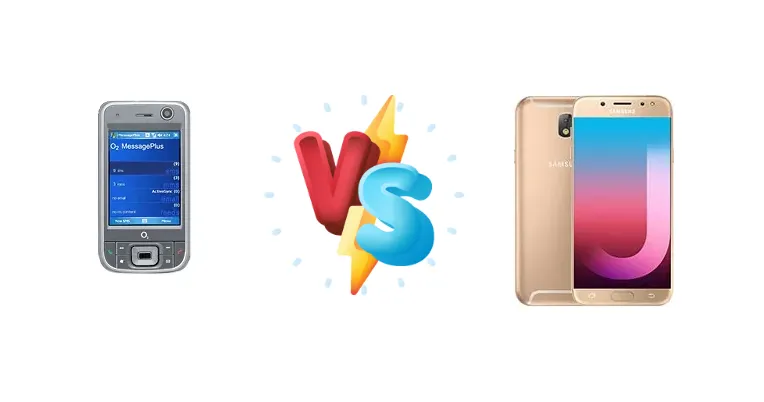
The O2 XDA Zinc, representing the waning days of Windows Mobile, and the Samsung Galaxy J7 Pro, a mid-range Android contender from 2017, seem worlds apart. This comparison isn't about crowning a 'winner' in the traditional sense, but understanding how vastly different architectures and operating systems translate to real-world usability, especially given the age of both devices.
🏆 Quick Verdict
For the average user in 2024, the Samsung Galaxy J7 Pro is the more practical choice. Its Exynos 7870 chipset, while not a powerhouse, offers significantly better performance and software support than the aging Intel XScale PXA270 in the XDA Zinc. The J7 Pro’s 107-hour endurance rating also provides a substantial advantage.
| Network |
|---|
| 2G bands | GSM 900 / 1800 / 1900 | GSM 850 / 900 / 1800 / 1900 - SIM 1 & SIM 2 (dual-SIM model only) |
| 3G bands | UMTS 2100 | HSDPA 850 / 900 / 1700(AWS) / 1900 / 2100 |
| 4G bands | - | 1, 2, 3, 4, 5, 7, 8, 12, 17, 20, 28, 38, 40, 41, 66 |
| Speed | Yes, 384 kbps | HSPA 42.2/5.76 Mbps, LTE (2CA) Cat6 300/50 Mbps |
| Technology | GSM / UMTS | GSM / HSPA / LTE |
| Launch |
|---|
| Announced | 2006, December | 2017, June. Released 2017, July |
| Status | Discontinued | Discontinued |
| Body |
|---|
| Build | - | Glass front, aluminum back, aluminum frame |
| Dimensions | 109 x 58 x 22.6 mm (4.29 x 2.28 x 0.89 in) | 152.5 x 74.8 x 8 mm (6.00 x 2.94 x 0.31 in) |
| Keyboard | QWERTY | - |
| SIM | Mini-SIM | · Nano-SIM· Nano-SIM + Nano-SIM |
| Weight | 175 g (6.17 oz) | 181 g (6.38 oz) |
| Display |
|---|
| Resolution | 240 x 320 pixels, 4:3 ratio (~143 ppi density) | 1080 x 1920 pixels, 16:9 ratio (~401 ppi density) |
| Size | 2.8 inches, 24.3 cm2 (~38.4% screen-to-body ratio) | 5.5 inches, 83.4 cm2 (~73.1% screen-to-body ratio) |
| Type | TFT resistive touchscreen, 65K colors | Super AMOLED |
| | Handwriting recognition
| Always-on display |
| Platform |
|---|
| CPU | Intel XScale PXA 270 520 MHz | Octa-core 1.6 GHz Cortex-A53 |
| Chipset | - | Exynos 7870 Octa (14 nm) |
| GPU | - | Mali-T830 MP1 |
| OS | Microsoft Windows Mobile 5.0 PocketPC | Android 7.0 (Nougat), upgradable to Android 9.0 (Pie), One UI |
| Memory |
|---|
| Card slot | miniSD | microSDXC (dedicated slot) |
| Internal | 64MB RAM, 128MB ROM | 16GB 3GB RAM, 32GB 3GB RAM, 64GB 3GB RAM |
| | - | eMMC 5.1 |
| Main Camera |
|---|
| Features | LED flash | LED flash, panorama, HDR |
| Single | 2 MP | 13 MP, f/1.7, 27mm (wide), AF |
| Video | Yes | 1080p@30fps |
| Selfie camera |
|---|
| Features | - | LED flash |
| Single | VGA videocall camera | 13 MP, f/1.9, 28mm (wide), 1/3.1", 1.12µm |
| Video | - | 1080p@30fps |
| Sound |
|---|
| 3.5mm jack | No | Yes |
| 35mm jack | No | Yes |
| Alert types | Vibration; Downloadable polyphonic, MP3 ringtones | - |
| Loudspeaker | Yes | Yes |
| Comms |
|---|
| Bluetooth | Yes | 4.1, A2DP, LE |
| Infrared port | Yes | - |
| NFC | - | Yes |
| Positioning | No | GPS, GLONASS, BDS |
| Radio | No | FM radio |
| USB | miniUSB | microUSB 2.0, OTG |
| WLAN | Wi-Fi 802.11b/g | Wi-Fi 802.11 a/b/g/n/ac, dual-band, Wi-Fi Direct |
| Features |
|---|
| Browser | WAP 2.0/xHTML, HTML (PocketIE) | - |
| Sensors | - | Fingerprint (front-mounted), accelerometer, gyro, proximity, compass |
| | Pocket Office
Voice memo
MP3/AAC player | ANT+ |
| Battery |
|---|
| Music play | - | Up to 91 h |
| Stand-by | Up to 220 h | - |
| Talk time | Up to 5 h | Up to 24 h (3G) |
| Type | Removable Li-Ion 1300 mAh battery | Li-Ion 3600 mAh, non-removable |
| Misc |
|---|
| Colors | Silver | Black, Blue, Gold, Rose Gold |
| Models | - | SM-J730G, SM-J730GM |
| Price | About 240 EUR | About 200 EUR |
| SAR | - | 0.71 W/kg (head) |
| SAR EU | - | 0.57 W/kg (head) 1.33 W/kg (body) |
| Tests |
|---|
| Audio quality | - |
Noise -92.7dB / Crosstalk -92.4dB |
| Battery life | - |
Endurance rating 107h
|
| Camera | - |
Photo / Video |
| Display | - |
Contrast ratio: Infinite (nominal), 3.998 (sunlight) |
| Loudspeaker | - |
Voice 68dB / Noise 69dB / Ring 82dB
|
| Performance | - |
GeekBench: 3768 (v4.4)
GFXBench: 1.9fps (ES 3.1 onscreen) |
O2 XDA Zinc
- Collector's item appeal
- Unique Windows Mobile experience
- Compact form factor (assumed)
- Extremely slow performance
- Outdated software and security vulnerabilities
- Poor battery life (estimated)
- Limited app availability
Samsung Galaxy J7 Pro
- Modern Android operating system
- Octa-core processor for better performance
- Long battery life (107h endurance)
- Access to a wide range of apps
- Not a high-end device
- May show its age in demanding tasks
- Software updates are likely discontinued
Display Comparison
Both devices share a reported contrast ratio of 'Infinite (nominal)' and 3.998 in sunlight, suggesting similar outdoor visibility. However, the XDA Zinc’s display resolution is unknown, while the J7 Pro’s likely benefits from the advancements in LCD technology over the years. The XDA Zinc’s smaller screen size (assumed, based on its form factor) may offer a slightly higher pixel density, but the J7 Pro’s larger display is more practical for media consumption. The J7 Pro’s display technology is likely to be more power efficient.
Camera Comparison
Both devices offer 'Photo / Video' capabilities, but details are scarce. The XDA Zinc’s camera is likely a low-resolution sensor by today’s standards, limited by the processor’s image signal processing capabilities. The J7 Pro, while not a camera phone champion, likely features a more capable sensor and image processing pipeline. The J7 Pro’s camera benefits from the Exynos 7870’s ISP, allowing for better image quality and features. The absence of specific camera specs for the XDA Zinc makes a detailed comparison impossible, but it’s safe to assume the J7 Pro offers a significantly superior photographic experience.
Performance
The performance gap is substantial. The O2 XDA Zinc’s 520 MHz Intel XScale PXA 270 is a single-core processor designed for early smartphone tasks. In contrast, the Samsung Galaxy J7 Pro boasts an octa-core 1.6 GHz Exynos 7870 built on a 14nm process. This means the J7 Pro can handle multitasking, modern apps, and even light gaming with relative ease, while the XDA Zinc will struggle with even basic operations. The Exynos 7870’s architecture (Cortex-A53) is far more efficient, leading to better battery life and thermal management. The XScale processor’s age also means it lacks the hardware acceleration features found in the Exynos, impacting video decoding and graphics performance.
Battery Life
The Samsung Galaxy J7 Pro’s 107-hour endurance rating is a key advantage. While the XDA Zinc’s battery capacity is unknown, the power-hungry Intel XScale processor and older battery technology will result in significantly shorter runtimes. The Exynos 7870’s 14nm process contributes to better power efficiency, allowing the J7 Pro to deliver all-day battery life under moderate use. The J7 Pro’s charging speed is also likely faster, given the advancements in charging technology since the XDA Zinc’s release.
Buying Guide
Buy the O2 XDA Zinc if you're a collector of vintage smartphones, a developer interested in reverse engineering older operating systems, or specifically need a Windows Mobile device for legacy applications. Buy the Samsung Galaxy J7 Pro if you require a functional, albeit basic, smartphone experience with access to modern Android apps and a significantly longer battery life. The J7 Pro is the only viable option for daily use.
Frequently Asked Questions
❓ Is the Exynos 7870 in the Galaxy J7 Pro capable of running modern games like PUBG Mobile?
While the Exynos 7870 isn't a gaming powerhouse, it can run PUBG Mobile at lower settings and frame rates. Expect to play at medium or low graphics with a stable 30fps. Demanding titles may require further compromises in settings to achieve playable performance.
❓ Can I still find apps for the O2 XDA Zinc, and are they secure?
Finding compatible apps for the O2 XDA Zinc is extremely difficult. Windows Mobile app support has largely ceased. Any apps you do find are likely outdated and may contain security vulnerabilities, making the device unsuitable for sensitive tasks like online banking or shopping.
❓ What kind of storage options does the Samsung Galaxy J7 Pro offer, and is it expandable?
The Samsung Galaxy J7 Pro typically came with 16GB of internal storage, expandable via microSD card up to 256GB. This allows for ample storage of photos, videos, and apps, a significant advantage over the limited storage options likely available on the XDA Zinc.
❓ Is the battery on the Samsung Galaxy J7 Pro replaceable by the user?
No, the Samsung Galaxy J7 Pro features a non-removable battery. While the 107-hour endurance rating is excellent, battery degradation over time is inevitable. Replacing the battery requires professional repair.