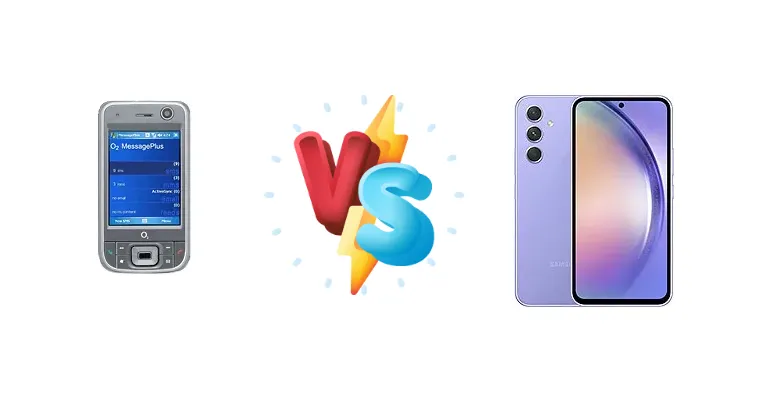
We're pitting a relic of early Windows Mobile against a modern Android contender. The O2 XDA Zinc, representing a pivotal moment in smartphone history, faces off against the Samsung Galaxy A54, a mainstream device focused on delivering a well-rounded experience. This isn't about declaring a 'winner' in the traditional sense, but understanding how far smartphone technology has advanced and who each device serves best.
🏆 Quick Verdict
For the vast majority of users, the Samsung Galaxy A54 is the clear choice. Its vastly superior processing power, significantly longer battery life (119h endurance rating), and modern features outweigh the XDA Zinc’s historical significance. However, enthusiasts seeking a retro experience or a unique tinkering project will find value in the XDA Zinc.
| Network |
|---|
| 2G bands | GSM 900 / 1800 / 1900 | GSM 850 / 900 / 1800 / 1900 |
| 3G bands | UMTS 2100 | HSDPA 850 / 900 / 1700(AWS) / 1900 / 2100 |
| 4G bands | - | 1, 2, 3, 4, 5, 7, 8, 12, 17, 20, 26, 28, 32, 38, 40, 41, 66 - International |
| 5G bands | - | 1, 3, 7, 8, 20, 28, 38, 40, 41, 77, 78 SA/NSA/Sub6 - International |
| Speed | Yes, 384 kbps | HSPA, LTE, 5G |
| Technology | GSM / UMTS | GSM / HSPA / LTE / 5G |
| | - | 25, 41, 66, 71 SA/NSA/Sub6/mmWave - USA |
| Launch |
|---|
| Announced | 2006, December | 2023, March 15 |
| Status | Discontinued | Available. Released 2023, March 24 |
| Body |
|---|
| Build | - | Glass front (Gorilla Glass 5), glass back (Gorilla Glass 5), plastic frame |
| Dimensions | 109 x 58 x 22.6 mm (4.29 x 2.28 x 0.89 in) | 158.2 x 76.7 x 8.2 mm (6.23 x 3.02 x 0.32 in) |
| Keyboard | QWERTY | - |
| SIM | Mini-SIM | · Nano-SIM + eSIM· Nano-SIM + Nano-SIM |
| Weight | 175 g (6.17 oz) | 202 g (7.13 oz) |
| | - | IP67 dust/water resistant (up to 1m for 30 min) |
| Display |
|---|
| Protection | - | Corning Gorilla Glass 5 |
| Resolution | 240 x 320 pixels, 4:3 ratio (~143 ppi density) | 1080 x 2340 pixels, 19.5:9 ratio (~403 ppi density) |
| Size | 2.8 inches, 24.3 cm2 (~38.4% screen-to-body ratio) | 6.4 inches, 100.5 cm2 (~82.9% screen-to-body ratio) |
| Type | TFT resistive touchscreen, 65K colors | Super AMOLED, 120Hz, HDR10+, 1000 nits (HBM) |
| | Handwriting recognition
| - |
| Platform |
|---|
| CPU | Intel XScale PXA 270 520 MHz | Octa-core (4x2.4 GHz Cortex-A78 & 4x2.0 GHz Cortex-A55) |
| Chipset | - | Exynos 1380 (5 nm) |
| GPU | - | Mali-G68 MP5 |
| OS | Microsoft Windows Mobile 5.0 PocketPC | Android 13, up to 4 major Android upgrades, One UI 7 |
| Memory |
|---|
| Card slot | miniSD | microSDXC (uses shared SIM slot) |
| Internal | 64MB RAM, 128MB ROM | 128GB 4GB RAM, 128GB 6GB RAM, 128GB 8GB RAM, 256GB 6GB RAM, 256GB 8GB RAM |
| Main Camera |
|---|
| Features | LED flash | LED flash, panorama, HDR |
| Single | 2 MP | 32 MP, f/2.2, 26mm (wide), 1/2.8", 0.8µm |
| Triple | - | 50 MP, f/1.8, 23mm (wide), 1/1.56", 1.0µm, PDAF, OIS
12 MP, f/2.2, 13mm, 123˚ (ultrawide), 1/3.X", 1.12µm
5 MP (macro) |
| Video | Yes | 4K@30fps, 1080p@30/60fps, 720p@480fps, gyro-EIS |
| Selfie camera |
|---|
| Single | VGA videocall camera | 32 MP, f/2.2, 26mm (wide), 1/2.8", 0.8µm |
| Video | - | 4K@30fps, 1080p@30/60fps |
| Sound |
|---|
| 3.5mm jack | No | No |
| 35mm jack | No | No |
| Alert types | Vibration; Downloadable polyphonic, MP3 ringtones | - |
| Loudspeaker | Yes | Yes, with stereo speakers |
| Comms |
|---|
| Bluetooth | Yes | 5.3, A2DP, LE |
| Infrared port | Yes | - |
| NFC | - | Yes (market/region dependent) |
| Positioning | No | GPS, GLONASS, GALILEO, BDS |
| Radio | No | No |
| USB | miniUSB | USB Type-C 2.0, OTG |
| WLAN | Wi-Fi 802.11b/g | Wi-Fi 802.11 a/b/g/n/ac/6, dual-band, Wi-Fi Direct |
| Features |
|---|
| Browser | WAP 2.0/xHTML, HTML (PocketIE) | - |
| Sensors | - | Fingerprint (under display, optical), accelerometer, gyro, compass, barometer (USA only) |
| | Pocket Office
Voice memo
MP3/AAC player | Virtual proximity sensing |
| Battery |
|---|
| Charging | - | 25W wired |
| Stand-by | Up to 220 h | - |
| Talk time | Up to 5 h | - |
| Type | Removable Li-Ion 1300 mAh battery | 5000 mAh |
| Misc |
|---|
| Colors | Silver | Lime, Graphite, Violet, White |
| Models | - | SM-A546V, SM-A546U, SM-A546U1, SM-A546B, SM-A546B/DS, SM-A546E, SM-A546E/DS, SM-A5460, SM-A546M, SM-A546M/DS, SM-A546W |
| Price | About 240 EUR | € 210.00 / $ 119.11 / £ 169.95 / ₹ 28,999 |
| SAR | - | 0.81 W/kg (head) 0.67 W/kg (body) |
| SAR EU | - | 0.69 W/kg (head) 1.34 W/kg (body) |
| Tests |
|---|
| Battery life | - |
Endurance rating 119h
|
| Camera | - |
Photo / Video |
| Display | - |
Contrast ratio: Infinite (nominal) |
| Loudspeaker | - |
-26.6 LUFS (Good)
|
| Performance | - |
AnTuTu: 506678 (v9)
GeekBench: 2703 (v5.1), 2797 (v6)
GFXBench: 25fps (ES 3.1 onscreen) |
O2 XDA Zinc
- Historical significance – a piece of smartphone history.
- Unique retro experience.
- Potential for tinkering and customization.
- Extremely slow processor.
- Outdated operating system (Windows Mobile).
- Poor battery life compared to modern standards.
- Limited app availability.
Samsung Galaxy A54
- Excellent battery life (119h endurance).
- Bright and vibrant 980 nit display.
- Powerful Exynos 1380 processor.
- Modern Android operating system.
- Versatile camera system.
- May not appeal to users seeking a retro experience.
- Plastic build may feel less premium than some competitors.
- 25W charging is not the fastest available.
Display Comparison
The contrast between the displays is stark. The Samsung Galaxy A54 boasts a modern panel capable of 980 nits peak brightness, ensuring excellent visibility even outdoors. While the XDA Zinc’s display specifications are unavailable, its age suggests a significantly lower brightness and contrast ratio. The A54’s ‘Infinite’ contrast ratio (nominal) indicates a VA or AMOLED panel, offering deeper blacks and more vibrant colors compared to the likely LCD of the XDA Zinc. The A54’s larger screen size and higher resolution also contribute to a more immersive viewing experience.
Camera Comparison
Comparing the cameras is difficult without detailed specifications for the XDA Zinc. However, the Galaxy A54’s ‘Photo / Video’ capability suggests a more versatile and higher-quality camera system. Modern smartphone cameras prioritize features like optical image stabilization (OIS), larger sensors, and advanced image processing algorithms – all likely absent in the XDA Zinc. While the XDA Zinc may have offered basic photography functionality, the A54 provides a significantly improved photographic experience, especially in low-light conditions.
Performance
The performance gap is immense. The O2 XDA Zinc’s 520 MHz Intel XScale PXA 270 processor is dwarfed by the Samsung Galaxy A54’s Exynos 1380 (5 nm) chipset. The Exynos 1380’s octa-core configuration (4x2.4 GHz Cortex-A78 & 4x2.0 GHz Cortex-A55) delivers significantly faster processing speeds and improved multi-tasking capabilities. The 5nm fabrication process of the Exynos 1380 also translates to better power efficiency and reduced thermal throttling, crucial for sustained performance. The XDA Zinc, while innovative for its time, would struggle with even basic modern applications.
Battery Life
Battery technology has evolved dramatically. The Samsung Galaxy A54’s endurance rating of 119 hours and 11:15h of active use demonstrate a substantial improvement over what the XDA Zinc could offer. The A54’s 25W wired charging further enhances usability, allowing for quicker top-ups. The XDA Zinc, limited by its older battery technology and likely smaller capacity, would require significantly more frequent charging and offer a much shorter runtime.
Buying Guide
Buy the O2 XDA Zinc if you need a collectible piece of smartphone history, enjoy retro technology, or are a developer interested in exploring early Windows Mobile. Buy the Samsung Galaxy A54 if you prioritize all-day battery life (11:15h active use), a vibrant 980 nit display, a capable camera, and a modern, feature-rich Android experience.
Frequently Asked Questions
❓ Is the Exynos 1380 in the Galaxy A54 prone to overheating during extended gaming sessions?
The Exynos 1380, built on a 5nm process, is generally efficient and manages heat well. While some throttling may occur during prolonged, graphically intensive gaming, it's unlikely to cause significant performance drops or discomfort. The larger surface area of the A54 also aids in heat dissipation.
❓ Can the O2 XDA Zinc run modern Android apps, or is it limited to Windows Mobile software?
The O2 XDA Zinc is fundamentally limited to running software designed for Windows Mobile. While custom ROMs exist for some older devices, porting a modern Android version to the XDA Zinc would be extremely challenging due to its outdated hardware and architecture. Compatibility would be severely limited, and performance would be unusable for most apps.
❓ What kind of connectivity options does the O2 XDA Zinc offer compared to the Galaxy A54?
The XDA Zinc’s connectivity is limited to technologies available in the mid-2000s, such as 2G/3G cellular data, Wi-Fi 802.11b/g, and Bluetooth. The Galaxy A54, in contrast, supports 5G, Wi-Fi 6, and Bluetooth 5.3, offering significantly faster and more reliable connectivity.