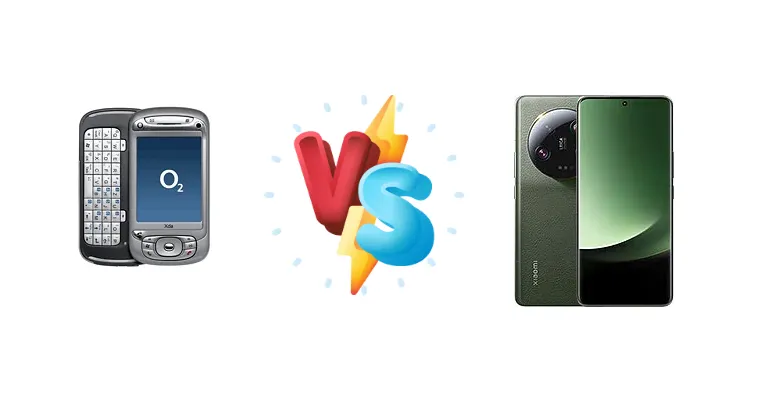
Comparing the O2 XDA Trion and the Xiaomi 13 Ultra is akin to examining the evolution of mobile computing itself. The Trion, a relic of early smartphone design, represents a pivotal moment in the industry, while the 13 Ultra embodies the pinnacle of modern smartphone engineering. This isn't a fair fight, but a revealing look at how far we've come – and what compromises were made along the way.
🏆 Quick Verdict
For the vast majority of users, the Xiaomi 13 Ultra is the clear winner. Its Snapdragon 8 Gen 2 chipset, exceptional camera system, and rapid charging capabilities offer a user experience light-years ahead of the Trion. The Trion serves primarily as a historical artifact or a niche collector's item.
| Network |
|---|
| 2G bands | GSM 850 / 900 / 1800 / 1900 | GSM 850 / 900 / 1800 / 1900 |
| 3G bands | UMTS 850 / 1900 / 2100 | HSDPA 800 / 850 / 900 / 1700(AWS) / 1900 / 2100 |
| 4G bands | - | 1, 2, 3, 4, 5, 7, 8, 18, 19, 20, 26, 28, 38, 40, 41, 66 - International |
| 5G bands | - | 1, 3, 5, 7, 8, 20, 28, 38, 40, 41, 77, 78, 79 SA/NSA - International |
| Speed | Yes, 384 kbps | HSPA, LTE, 5G |
| Technology | GSM / UMTS | GSM / CDMA / HSPA / EVDO / LTE / 5G |
| | - | CDMA2000 1xEV-DO |
| Launch |
|---|
| Announced | 2006, May | 2023, April 18 |
| Status | Discontinued | Available. Released 2023, April 21 |
| Body |
|---|
| Build | - | Glass front (Gorilla Glass Victus), eco leather back, aluminum frame |
| Dimensions | 113 x 58 x 22 mm (4.45 x 2.28 x 0.87 in) | 163.2 x 74.6 x 9.1 mm (6.43 x 2.94 x 0.36 in) |
| Keyboard | QWERTY | - |
| SIM | Mini-SIM | Nano-SIM + Nano-SIM |
| Weight | 160 g (5.64 oz) | 227 g (8.01 oz) |
| | - | IP68 dust/water resistant (up to 1.5m for 30 min) |
| Display |
|---|
| Protection | - | Corning Gorilla Glass Victus |
| Resolution | 240 x 320 pixels, 4:3 ratio (~143 ppi density) | 1440 x 3200 pixels, 20:9 ratio (~522 ppi density) |
| Size | 2.8 inches, 42 x 57 mm, 24.3 cm2 (~37.0% screen-to-body ratio) | 6.73 inches, 108.9 cm2 (~89.5% screen-to-body ratio) |
| Type | TFT resistive touchscreen, 65K colors | LTPO AMOLED, 68B colors, 120Hz, Dolby Vision, HDR10+, 1300 nits (HBM), 2600 nits (peak) |
| | Handwriting recognition
| - |
| Platform |
|---|
| CPU | 400 MHz Samsung | Octa-core (1x3.2 GHz Cortex-X3 & 2x2.8 GHz Cortex-A715 & 2x2.8 GHz Cortex-A710 & 3x2.0 GHz Cortex-A510) |
| Chipset | - | Qualcomm SM8550-AB Snapdragon 8 Gen 2 (4 nm) |
| GPU | - | Adreno 740 |
| OS | Microsoft Windows Mobile 5.0 PocketPC | Android 13, upgradable to Android 14, HyperOS |
| Memory |
|---|
| Card slot | microSD (dedicated slot) | No |
| Internal | 64MB RAM, 128MB ROM | 256GB 12GB RAM, 512GB 12GB RAM, 512GB 16GB RAM, 1TB 16GB RAM |
| | - | UFS 4.0 |
| Main Camera |
|---|
| Features | LED flash | Laser AF, color spectrum sensor, Leica lenses, Dual-LED flash, HDR, panorama, 67mm filter ring holder (optional) |
| Quad | - | 50 MP, f/1.9 or f/4.0, 23mm (wide), 1.0"-type, 1.6µm, dual pixel PDAF, OIS
50 MP, f/1.8, 75mm (telephoto), 1/2.51", 0.7µm, dual pixel PDAF, OIS, 3.2x optical zoom
50 MP, f/3.0, 120mm (periscope telephoto), 1/2.51", 0.7µm, dual pixel PDAF, OIS, 5x optical zoom
50 MP, f/1.8, 12mm, 122˚ (ultrawide), 1/2.51", 0.7µm, dual pixel PDAF
TOF 3D, (depth) |
| Single | 2 MP | - |
| Video | Yes | 8K@24fps, 4K@24/30/60fps, 1080p@30/60/120/240/480/960/1920fps, gyro-EIS, Dolby Vision HDR 10-bit rec. (4K@60fps, 1080p) |
| Selfie camera |
|---|
| Features | - | HDR, panorama |
| Single | QCIF videocall camera | 32 MP, f/2.0, 22mm (wide), 1/3.14", 0.7µm |
| Video | - | 1080p@30/60fps, gyro-EIS |
| Sound |
|---|
| 3.5mm jack | No | No |
| 35mm jack | No | No |
| Alert types | Vibration; Downloadable polyphonic, MP3 ringtones | - |
| Loudspeaker | Yes | Yes, with stereo speakers |
| | - | 24-bit/192kHz audio |
| Comms |
|---|
| Bluetooth | 2.0 | 5.3, A2DP, LE, aptX HD, aptX Adaptive |
| Infrared port | Yes | Yes |
| NFC | - | Yes |
| Positioning | No | GPS (L1+L5), GLONASS (L1), BDS (B1I+B1c+B2a), GALILEO (E1+E5a), QZSS (L1+L5), NavIC (L5) |
| Radio | No | No |
| USB | Proprietary | USB Type-C 3.2, DisplayPort, OTG |
| WLAN | Wi-Fi 802.11b/g | Wi-Fi 802.11 a/b/g/n/ac/6e/7, tri-band, Wi-Fi Direct |
| Features |
|---|
| Browser | WAP 2.0/xHTML, HTML (PocketIE) | - |
| Sensors | - | Fingerprint (under display, optical), accelerometer, proximity, gyro, compass, barometer |
| | Pocket Office
Voice memo
MP3/AAC player | Virtual proximity sensing |
| Battery |
|---|
| Charging | - | 90W wired, PD3.0, QC4, 100% in 35 min
50W wireless, 100% in 49 min
10W reverse wireless |
| Stand-by | Up to 300 h | - |
| Talk time | Up to 5 h | - |
| Type | Removable Li-Ion 1350 mAh battery | Li-Po 5000 mAh |
| Misc |
|---|
| Colors | Silver | Black, Olive Green, White, Orange, Yellow, Blue |
| Models | - | 2304FPN6DC, 2304FPN6DG |
| Price | About 360 EUR | € 797.98 / $ 389.69 |
| SAR EU | - | 0.99 W/kg (head) 1.00 W/kg (body) |
O2 XDA Trion
- Historical significance
- Compact size (likely)
- Simplicity of operation
- Extremely limited performance
- Outdated software
- Poor camera quality
- Limited app compatibility
Xiaomi 13 Ultra
- Exceptional performance (Snapdragon 8 Gen 2)
- Advanced camera system
- Fast charging (90W wired, 50W wireless)
- Long battery life
- High-resolution, bright display
- High price
- Large size and weight
- Complex software features
Display Comparison
The Xiaomi 13 Ultra boasts a significantly more advanced display, reaching a measured peak brightness of 1207 nits. This contrasts sharply with the Trion, which lacks detailed display specifications, but would have offered a far dimmer and lower-resolution experience. Modern displays like the 13 Ultra’s likely incorporate LTPO technology for variable refresh rates, conserving battery life, a feature entirely absent in the Trion’s era. The difference in pixel density and color accuracy is also substantial, making the 13 Ultra ideal for media consumption.
Camera Comparison
The Xiaomi 13 Ultra’s camera system is a leap forward in mobile photography. While the Trion’s camera capabilities are unknown, it’s safe to assume they are rudimentary compared to the 13 Ultra’s advanced sensors and image processing. The 13 Ultra likely features a multi-camera setup with large sensors, optical image stabilization (OIS), and sophisticated computational photography algorithms. The Trion would likely offer limited resolution and dynamic range, lacking features like night mode or portrait mode. The 13 Ultra’s focus on both photo and video capabilities positions it as a tool for serious content creators.
Performance
The performance gap is astronomical. The O2 XDA Trion’s 400 MHz Samsung CPU is dwarfed by the Xiaomi 13 Ultra’s Qualcomm Snapdragon 8 Gen 2 (4nm). The Snapdragon 8 Gen 2’s octa-core architecture – featuring a Cortex-X3 prime core clocked at 3.2 GHz – delivers processing power orders of magnitude greater than the Trion’s single-core processor. The 4nm fabrication process of the Snapdragon 8 Gen 2 also provides superior thermal efficiency, preventing throttling during demanding tasks. The Trion would struggle with even basic modern applications, while the 13 Ultra handles intensive gaming and multitasking with ease.
Battery Life
Battery technology has dramatically improved. The Xiaomi 13 Ultra achieves an impressive 10:09 hours of active use and boasts an endurance rating of 108 hours. It also supports incredibly fast charging: 90W wired (100% in 35 minutes) and 50W wireless (100% in 49 minutes). The Trion’s battery capacity and charging speed are unknown, but would have been significantly lower. The 13 Ultra’s fast charging capabilities are particularly beneficial for users who need to quickly top up their battery throughout the day.
Buying Guide
Buy the O2 XDA Trion if you're a mobile history enthusiast, collector, or require a device solely for basic communication with no expectation of modern app compatibility. Buy the Xiaomi 13 Ultra if you demand flagship performance, a professional-grade camera, all-day battery life, and the latest features in a premium smartphone package.
Frequently Asked Questions
❓ Is the Xiaomi 13 Ultra's 90W charging safe for the battery's long-term health?
Xiaomi employs sophisticated charging algorithms and thermal management systems to mitigate the potential impact of fast charging on battery health. While all batteries degrade over time, the 13 Ultra's charging system is designed to minimize this effect, and the phone includes features like optimized charging schedules to further prolong battery lifespan.
❓ Can the O2 XDA Trion run any modern apps, even basic ones like WhatsApp?
No. The O2 XDA Trion runs an outdated operating system (likely Windows Mobile) that is incompatible with modern Android or iOS apps. Even basic apps like WhatsApp require a significantly more powerful processor and a modern operating system to function.
❓ What kind of user would genuinely choose the O2 XDA Trion over the Xiaomi 13 Ultra in 2024?
The O2 XDA Trion would appeal almost exclusively to collectors of vintage technology or individuals interested in experiencing the early days of smartphone development. It's a historical artifact, not a practical daily driver.
❓ Does the Xiaomi 13 Ultra overheat during prolonged gaming sessions?
The Snapdragon 8 Gen 2 in the Xiaomi 13 Ultra is known for its thermal efficiency. While some heat generation is inevitable during intensive gaming, the 13 Ultra’s advanced cooling system (likely including vapor chamber technology) effectively dissipates heat, preventing significant throttling and maintaining consistent performance.