
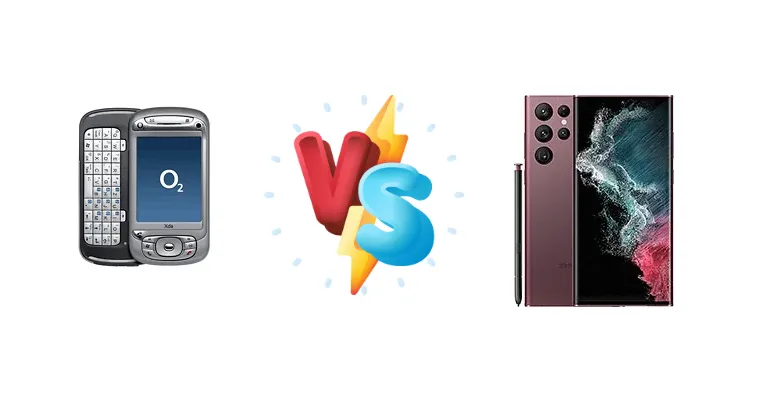
O2 XDA Trion vs. Samsung Galaxy S22 Ultra 5G: A 20-Year Tech Divide
| Phones Images | |||||
|---|---|---|---|---|---|
|
🏆 Quick Verdict
The Samsung Galaxy S22 Ultra 5G unequivocally wins this comparison. Its vastly superior processing power, display technology, camera capabilities, and battery life make it a modern smartphone powerhouse. The O2 XDA Trion serves as a fascinating historical artifact, but is impractical for daily use in 2024.
| PHONES | ||
|---|---|---|
| Phone Names | O2 XDA Trion | Samsung Galaxy S22 Ultra 5G |
| Network | ||
|---|---|---|
| 2G bands | GSM 850 / 900 / 1800 / 1900 | GSM 850 / 900 / 1800 / 1900 |
| 3G bands | UMTS 850 / 1900 / 2100 | HSDPA 850 / 900 / 1700(AWS) / 1900 / 2100 |
| 4G bands | - | 1, 2, 3, 4, 5, 7, 8, 12, 13, 17, 18, 19, 20, 25, 26, 28, 32, 38, 39, 40, 41, 66 - International |
| 5G bands | - | 1, 2, 3, 5, 7, 8, 12, 20, 25, 28, 38, 40, 41, 66, 75, 77, 78 SA/NSA/Sub6 - International |
| Speed | Yes, 384 kbps | HSPA 42.2/5.76 Mbps, LTE (7CA) Cat20 2000/200 Mbps, 5G (5+ Gbps DL) |
| Technology | GSM / UMTS | GSM / CDMA / HSPA / EVDO / LTE / 5G |
| - | 1, 3, 5, 7, 8, 20, 28, 38, 41, 66, 71, 260, 261 SA/NSA/Sub6/mmWave - USA | |
| Launch | ||
|---|---|---|
| Announced | 2006, May | 2022, February 09 |
| Status | Discontinued | Available. Released 2022, February 25 |
| Body | ||
|---|---|---|
| Build | - | Glass front (Gorilla Glass Victus+), glass back (Gorilla Glass Victus+), aluminum frame |
| Dimensions | 113 x 58 x 22 mm (4.45 x 2.28 x 0.87 in) | 163.3 x 77.9 x 8.9 mm (6.43 x 3.07 x 0.35 in) |
| Keyboard | QWERTY | - |
| SIM | Mini-SIM | · Nano-SIM + eSIM· Nano-SIM + Nano-SIM + eSIM (max 2 at a time) |
| Weight | 160 g (5.64 oz) | 228 g / 229 g (mmWave) (8.04 oz) |
| - | IP68 dust/water resistant (up to 1.5m for 30 min) Armor aluminum frame with tougher drop and scratch resistance (advertised) Stylus, 2.8ms latency (Bluetooth integration, accelerometer, gyro) | |
| Display | ||
|---|---|---|
| Protection | - | Corning Gorilla Glass Victus+ |
| Resolution | 240 x 320 pixels, 4:3 ratio (~143 ppi density) | 1440 x 3088 pixels, 19.3:9 ratio (~500 ppi density) |
| Size | 2.8 inches, 42 x 57 mm, 24.3 cm2 (~37.0% screen-to-body ratio) | 6.8 inches, 114.7 cm2 (~90.2% screen-to-body ratio) |
| Type | TFT resistive touchscreen, 65K colors | Dynamic AMOLED 2X, 120Hz, HDR10+, 1750 nits (peak) |
| Handwriting recognition | Always-on display | |
| Platform | ||
|---|---|---|
| CPU | 400 MHz Samsung | Octa-core (1x2.8 GHz Cortex-X2 & 3x2.50 GHz Cortex-A710 & 4x1.8 GHz Cortex-A510) - EuropeOcta-core (1x3.00 GHz Cortex-X2 & 3x2.50 GHz Cortex-A710 & 4x1.80 GHz Cortex-A510) - ROW |
| Chipset | - | Exynos 2200 (4 nm) - EuropeQualcomm SM8450 Snapdragon 8 Gen 1 (4 nm) - ROW |
| GPU | - | Xclipse 920 - EuropeAdreno 730 - ROW |
| OS | Microsoft Windows Mobile 5.0 PocketPC | Android 12, up to 4 major Android upgrades, One UI 8 |
| Memory | ||
|---|---|---|
| Card slot | microSD (dedicated slot) | No |
| Internal | 64MB RAM, 128MB ROM | 128GB 8GB RAM, 256GB 12GB RAM, 512GB 12GB RAM, 1TB 12GB RAM |
| - | UFS 3.1 | |
| Main Camera | ||
|---|---|---|
| Features | LED flash | Laser AF, LED flash, auto-HDR, panorama |
| Quad | - | 108 MP, f/1.8, 23mm (wide), 1/1.33", 0.8µm, PDAF, OIS 10 MP, f/2.4, 70mm (telephoto), 1/3.52", 1.12µm, PDAF, OIS, 3x optical zoom 10 MP, f/4.9, 230mm (periscope telephoto), 1/3.52", 1.12µm, PDAF, OIS, 10x optical zoom 12 MP, f/2.2, 13mm, 120˚ (ultrawide), 1/2.55", 1.4µm, dual pixel PDAF, Super Steady video |
| Single | 2 MP | - |
| Video | Yes | 8K@24fps, 4K@30/60fps, 1080p@30/60/120/240fps, HDR10+, stereo sound rec., gyro-EIS |
| Selfie camera | ||
|---|---|---|
| Features | - | HDR |
| Single | QCIF videocall camera | 40 MP, f/2.2, 26mm (wide), 1/2.82", 0.7µm, PDAF |
| Video | - | 4K@30/60fps, 1080p@30fps |
| Sound | ||
|---|---|---|
| 3.5mm jack | No | No |
| 35mm jack | No | No |
| Alert types | Vibration; Downloadable polyphonic, MP3 ringtones | - |
| Loudspeaker | Yes | Yes, with stereo speakers |
| - | 32-bit/384kHz audio Tuned by AKG | |
| Comms | ||
|---|---|---|
| Bluetooth | 2.0 | 5.2, A2DP, LE |
| Infrared port | Yes | - |
| NFC | - | Yes |
| Positioning | No | GPS, GLONASS, BDS, GALILEO |
| Radio | No | No |
| USB | Proprietary | USB Type-C 3.2, OTG |
| WLAN | Wi-Fi 802.11b/g | Wi-Fi 802.11 a/b/g/n/ac/6e, dual-band, Wi-Fi Direct |
| Features | ||
|---|---|---|
| Browser | WAP 2.0/xHTML, HTML (PocketIE) | - |
| Sensors | - | Fingerprint (under display, ultrasonic), accelerometer, gyro, proximity, compass, barometer |
| Pocket Office Voice memo MP3/AAC player | Samsung DeX, Samsung Wireless DeX (desktop experience support) Bixby natural language commands and dictation Samsung Pay (Visa, MasterCard certified) Ultra Wideband (UWB) support | |
| Battery | ||
|---|---|---|
| Charging | - | 45W wired, PD3.0 15W wireless (Qi) 4.5W reverse wireless |
| Stand-by | Up to 300 h | - |
| Talk time | Up to 5 h | - |
| Type | Removable Li-Ion 1350 mAh battery | Li-Ion 5000 mAh |
| Misc | ||
|---|---|---|
| Colors | Silver | Phantom Black, White, Burgundy, Green, Graphite, Red, Sky Blue, Bora Purple |
| Models | - | SM-S908B, SM-S908B/DS, SM-S908U, SM-S908U1, SM-S908W, SM-S908N, SM-S9080, SM-S908E, SM-S908E/DS |
| Price | About 360 EUR | € 397.07 / $ 269.98 / £ 304.99 / ₹ 63,899 |
| SAR | - | 1.18 W/kg (head) 0.98 W/kg (body) |
| SAR EU | - | 1.05 W/kg (head) 1.58 W/kg (body) |
| Tests | ||
|---|---|---|
| Battery life | - | Endurance rating 108h |
| Camera | - | Photo / Video |
| Display | - | Contrast ratio: Infinite (nominal) |
| Loudspeaker | - | -27.3 LUFS (Good) |
| Performance | - | AnTuTu: 968359 (v9) GeekBench: 3657 (v5.1) GFXBench: 37fps (ES 3.1 onscreen) |
O2 XDA Trion
- Historical significance – a piece of mobile history.
- Simple and straightforward operating system (for those familiar with Windows Mobile).
- Compact size (relative to modern smartphones).
- Extremely limited processing power.
- Outdated display technology.
- Poor camera capabilities.
- Limited app availability.
Samsung Galaxy S22 Ultra 5G
- Exceptional performance with the Exynos 2200 or Snapdragon 8 Gen 1.
- Stunning display with high brightness and contrast.
- Versatile camera system for high-quality photos and videos.
- Long battery life with fast charging capabilities.
- Can be expensive.
- Large size may not be comfortable for all users.
- Software bloatware (depending on region).
Display Comparison
The contrast is stark. The Samsung Galaxy S22 Ultra boasts a peak brightness of 1266 nits, offering excellent visibility even in direct sunlight. While the XDA Trion's display specifications are unavailable, its technology is fundamentally limited by the era – likely a resistive touchscreen with significantly lower resolution and color accuracy. The S22 Ultra’s infinite (nominal) contrast ratio and likely high PWM dimming rate (spec not provided, but typical for AMOLED) provide a far superior viewing experience. The S22 Ultra’s display is designed for media consumption and creative work; the Trion’s is purely functional.
Camera Comparison
The Samsung Galaxy S22 Ultra’s camera system, while details are limited to 'Photo / Video', represents a massive leap forward. Modern smartphone cameras prioritize sensor size, optical image stabilization (OIS), and sophisticated image processing algorithms. The XDA Trion’s camera capabilities were rudimentary by today’s standards, likely offering low resolution and limited functionality. The S22 Ultra’s camera is designed for professional-quality photos and videos, while the Trion’s is a basic snapshot tool. Ignoring the likely 2MP macro lens on the S22 Ultra, the main sensor and image processing are the key differentiators.
Performance
The O2 XDA Trion’s 400 MHz Samsung CPU is dwarfed by the Samsung Galaxy S22 Ultra’s Octa-core processor, featuring Cortex-X2 and Cortex-A710 cores clocked up to 2.8/3.0 GHz. The S22 Ultra’s Exynos 2200 (Europe) or Snapdragon 8 Gen 1 (ROW) chipset, built on a 4nm process, delivers orders of magnitude more processing power and efficiency. The S22 Ultra can handle demanding tasks like gaming, video editing, and multitasking with ease, while the Trion struggles with even basic applications. The difference in architecture is fundamental – the S22 Ultra benefits from decades of CPU and GPU advancements.
Battery Life
The Samsung Galaxy S22 Ultra achieves an impressive endurance rating of 108 hours, thanks to its optimized power management and likely larger battery capacity (spec not provided, but typical for the S22 Ultra range). The O2 XDA Trion’s battery life, while adequate for its time, is significantly shorter. The S22 Ultra also supports 45W wired charging with PD3.0, 15W wireless charging (Qi), and 4.5W reverse wireless charging – features entirely absent on the Trion. The S22 Ultra’s charging capabilities allow for quick top-ups, ensuring minimal downtime.
Buying Guide
Buy the O2 XDA Trion if you're a collector of vintage technology, a mobile history enthusiast, or require a simple device for extremely basic tasks and enjoy the nostalgia of Windows Mobile. Buy the Samsung Galaxy S22 Ultra 5G if you demand a high-performance smartphone with a stunning display, versatile camera system, all-day battery life, and access to the latest apps and services.