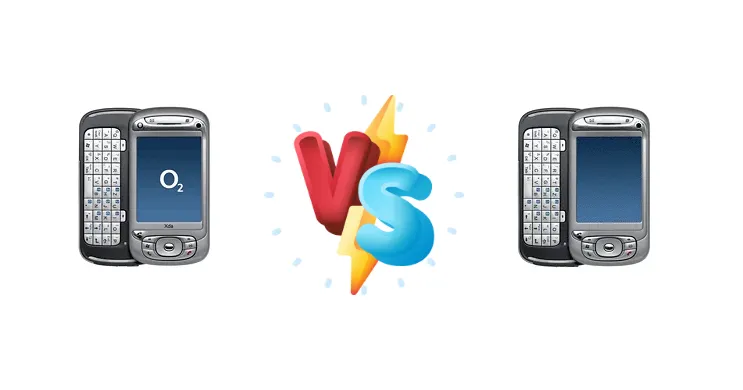
The O2 XDA Trion and Qtek 9600 represent a pivotal moment in early smartphone history, both built around the burgeoning Windows Mobile platform. These devices aimed to bridge the gap between PDAs and mobile phones, offering business users a powerful, pocketable computing experience. This comparison dissects their similarities and differences, focusing on what mattered most to the power users of the mid-2000s.
🏆 Quick Verdict
For the average user seeking a functional early Windows Mobile device, the Qtek 9600 offers a slightly more refined experience due to its branding and potential software optimizations. However, the O2 XDA Trion provides a comparable core experience and may be more readily available for collectors or those seeking specific software customizations.
| Network |
|---|
| 2G bands | GSM 850 / 900 / 1800 / 1900 | GSM 850 / 900 / 1800 / 1900 |
| 3G bands | UMTS 850 / 1900 / 2100 | UMTS 850 / 1900 / 2100 |
| Speed | Yes, 384 kbps | Yes, 384 kbps |
| Technology | GSM / UMTS | GSM / UMTS |
| Launch |
|---|
| Announced | 2006, May | 2006, June |
| Status | Discontinued | Discontinued |
| Body |
|---|
| Dimensions | 113 x 58 x 22 mm (4.45 x 2.28 x 0.87 in) | 113 x 58 x 22 mm (4.45 x 2.28 x 0.87 in) |
| Keyboard | QWERTY | QWERTY |
| SIM | Mini-SIM | Mini-SIM |
| Weight | 160 g (5.64 oz) | 176 g (6.21 oz) |
| Display |
|---|
| Resolution | 240 x 320 pixels, 4:3 ratio (~143 ppi density) | 240 x 320 pixels, 4:3 ratio (~143 ppi density) |
| Size | 2.8 inches, 42 x 57 mm, 24.3 cm2 (~37.0% screen-to-body ratio) | 2.8 inches, 42 x 57 mm, 24.3 cm2 (~37.0% screen-to-body ratio) |
| Type | TFT resistive touchscreen, 65K colors | TFT resistive touchscreen, 65K colors |
| | Handwriting recognition
| Handwriting recognition
|
| Platform |
|---|
| CPU | 400 MHz Samsung | 400 MHz Samsung |
| OS | Microsoft Windows Mobile 5.0 PocketPC | Microsoft Windows Mobile 5.0 PocketPC |
| Memory |
|---|
| Card slot | microSD (dedicated slot) | microSD (dedicated slot) |
| Internal | 64MB RAM, 128MB ROM | 64MB RAM, 128MB ROM |
| Main Camera |
|---|
| Features | LED flash | LED flash |
| Single | 2 MP | 2 MP |
| Video | Yes | Yes |
| Selfie camera |
|---|
| Single | QCIF videocall camera | QCIF videocall camera |
| Sound |
|---|
| 3.5mm jack | No | No |
| 35mm jack | No | No |
| Alert types | Vibration; Downloadable polyphonic, MP3 ringtones | Vibration; Downloadable polyphonic, MP3 ringtones |
| Loudspeaker | Yes | Yes |
| Comms |
|---|
| Bluetooth | 2.0 | 2.0 |
| Infrared port | Yes | Yes |
| Positioning | No | No |
| Radio | No | No |
| USB | Proprietary | 1.1 |
| WLAN | Wi-Fi 802.11b/g | Wi-Fi 802.11b/g |
| Features |
|---|
| Browser | WAP 2.0/xHTML, HTML (PocketIE) | WAP 2.0/xHTML, HTML (PocketIE) |
| | Pocket Office
Voice memo
MP3/AAC player | Pocket Office
Voice memo
MP3/AAC player |
| Battery |
|---|
| Stand-by | Up to 300 h | Up to 300 h |
| Talk time | Up to 5 h | Up to 5 h |
| Type | Removable Li-Ion 1350 mAh battery | Removable Li-Po 1350 mAh battery |
| Misc |
|---|
| Colors | Silver | Silver |
| Price | About 360 EUR | - |
O2 XDA Trion
- Strong enthusiast community for custom ROMs and modifications.
- Comparable performance to the Qtek 9600.
- Potential for lower cost due to brand recognition.
- Limited brand recognition compared to Qtek.
- Potential for software inconsistencies.
Qtek 9600
- Established brand reputation within the business market.
- Potentially better software support from Qtek.
- Slightly more refined user experience.
- Comparable performance to the O2 XDA Trion.
- May be more expensive due to brand prestige.
Display Comparison
Both the O2 XDA Trion and Qtek 9600 feature displays typical of the era – likely 2.8-3.2 inch resistive touchscreens with resolutions around 320x240. Given the lack of specific display specs, it's reasonable to assume similar brightness and color accuracy. The user experience will be heavily influenced by the resistive touchscreen technology, requiring more deliberate presses than modern capacitive displays. The smaller screen size is ideal for one-handed operation, but limits media consumption.
Camera Comparison
Camera specifications for both devices are limited in the provided data. It's likely both feature a basic VGA (0.3MP) camera, suitable for quick snapshots but lacking in image quality. The camera is primarily a convenience feature, not a strength of either device. Image processing will be rudimentary, and low-light performance will be poor. The absence of optical image stabilization (OIS) is expected.
Performance
Both devices are powered by a 400 MHz Samsung processor. This CPU, while modest by today’s standards, was a significant step up for mobile devices at the time. The performance will be largely identical for typical Windows Mobile tasks like email, contacts, and basic office applications. However, demanding applications or multitasking could lead to noticeable slowdowns. The RAM capacity, which is not specified, will be a key factor in multitasking performance; more RAM would benefit both devices.
Battery Life
Battery capacity is not specified for either device. Given the 400 MHz processor and resistive touchscreen, battery life would likely range from a half-day to a full day with moderate use. The lack of power-hungry features like large displays or 3G connectivity helps conserve battery. Charging times would be significant compared to modern smartphones, likely taking several hours to fully charge.
Buying Guide
Buy the O2 XDA Trion if you prioritize a device with a strong enthusiast community and potential for custom ROM development, appealing to those who enjoy tinkering. Buy the Qtek 9600 if you prefer a device with a more established brand reputation within the business-focused mobile market and potentially better software support from Qtek directly, prioritizing stability and ease of use.
Frequently Asked Questions
❓ Can either the O2 XDA Trion or Qtek 9600 run modern apps?
No. These devices run Windows Mobile, a legacy operating system incompatible with modern Android or iOS applications. While some limited emulation may be possible, the hardware is insufficient for running demanding modern software.
❓ What kind of connectivity do these devices offer?
Both devices likely offer GPRS/EDGE connectivity for data, allowing for basic internet access and email. Wi-Fi support may be present, but it's not guaranteed. Bluetooth is also a standard feature for connecting to headsets and other accessories.
❓ Is it possible to upgrade the operating system on either device?
Upgrading beyond the original Windows Mobile version is possible through custom ROMs developed by the enthusiast community, particularly for the O2 XDA Trion. However, this process is complex and carries the risk of bricking the device.