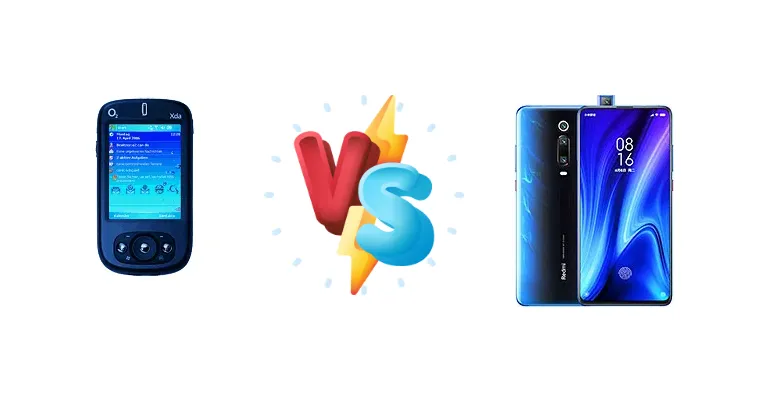
We're pitting two vastly different smartphones against each other: the O2 XDA Neo, a relic from the early Windows Mobile era, and the Xiaomi Redmi K20 Pro, a 2019 flagship that redefined the mid-range. This isn't about crowning a 'winner' in the traditional sense, but rather illustrating the monumental advancements in mobile technology over less than two decades.
🏆 Quick Verdict
For the vast majority of users in 2024, the Xiaomi Redmi K20 Pro is the unequivocally superior device. Its Snapdragon 855 chipset, vibrant display, and modern features offer a user experience the XDA Neo simply cannot match. The XDA Neo's value lies solely in its historical significance and collector's appeal.
| Network |
|---|
| 2G bands | GSM 850 / 900 / 1800 / 1900 | GSM 850 / 900 / 1800 / 1900 |
| 3G bands | - | HSDPA 850 / 900 / 1900 / 2100 |
| 4G bands | - | 1, 3, 5, 7, 8, 34, 38, 39, 40, 41 |
| EDGE | Class 10 | - |
| GPRS | Class 10 | - |
| Speed | - | HSPA, LTE |
| Technology | GSM | GSM / HSPA / LTE |
| Launch |
|---|
| Announced | 2006, February | 2019, May 28. Released 2019, June 01 |
| Status | Discontinued | Discontinued |
| Body |
|---|
| Build | - | Glass front (Gorilla Glass 5), glass back (Gorilla Glass 5), aluminum frame |
| Dimensions | 108.8 x 59.3 x 18.4 mm (4.28 x 2.33 x 0.72 in) | 156.7 x 74.3 x 8.8 mm (6.17 x 2.93 x 0.35 in) |
| SIM | Mini-SIM | Nano-SIM + Nano-SIM |
| Weight | 150 g (5.29 oz) | 191 g (6.74 oz) |
| Display |
|---|
| Protection | - | Corning Gorilla Glass 5 |
| Resolution | 240 x 320 pixels, 4:3 ratio (~143 ppi density) | 1080 x 2340 pixels, 19.5:9 ratio (~403 ppi density) |
| Size | 2.8 inches, 42 x 57 mm, 24.3 cm2 (~37.6% screen-to-body ratio) | 6.39 inches, 100.2 cm2 (~86.1% screen-to-body ratio) |
| Type | TFT resistive touchscreen, 65K colors | Super AMOLED, HDR10 |
| | Handwriting recognition | - |
| Platform |
|---|
| CPU | 200 MHz ARM926EJ-S | Octa-core (1x2.84 GHz Kryo 485 & 3x2.42 GHz Kryo 485 & 4x1.78 GHz Kryo 485) |
| Chipset | TI OMAP 850 | Qualcomm SM8150 Snapdragon 855 (7 nm) |
| GPU | - | Adreno 640 |
| OS | Microsoft Windows Mobile 5.0 PocketPC | Android 9.0 (Pie), upgradable to Android 10, MIUI 12 |
| Memory |
|---|
| Card slot | SD/MMC | No |
| Internal | 64MB RAM, 128MB ROM | 64GB 6GB RAM, 128GB 6GB RAM, 128GB 8GB RAM, 256GB 8GB RAM |
| | - | UFS 2.1 |
| Main Camera |
|---|
| Features | - | Laser AF, Dual-LED flash, HDR, panorama |
| Single | 2 MP | - |
| Triple | - | 48 MP, f/1.8, 26mm (wide), 1/2.0", 0.8µm, PDAF
8 MP, f/2.4, 53mm (telephoto), 1/4.0", 1.12µm, PDAF, 2x optical zoom
13 MP, f/2.4, 12mm (ultrawide), 1/3.1", 1.12µm |
| Video | CIF | 4K@30/60fps, 1080p@30/120/240fps, 1080p@960fps |
| Selfie camera |
|---|
| Features | - | HDR |
| Single | - | Motorized pop-up 20 MP, f/2.2, (wide), 1/3.4", 0.8µm |
| Video | - | 1080p@30fps |
| | No | - |
| Sound |
|---|
| 3.5mm jack | No | Yes |
| 35mm jack | No | Yes |
| Alert types | Vibration; Downloadable polyphonic ringtones | - |
| Loudspeaker | Yes | Yes |
| | - | 24-bit/192kHz audio
|
| Comms |
|---|
| Bluetooth | 2.0 | 5.0, A2DP, LE, aptX HD |
| Infrared port | Yes | - |
| NFC | - | Yes (China only) |
| Positioning | No | GPS (L1+L5), GLONASS (G1), BDS (B1), GALILEO (E1+E5a) |
| Radio | No | Yes |
| USB | miniUSB | USB Type-C 2.0, OTG |
| WLAN | Wi-Fi 802.11b/g | Wi-Fi 802.11 a/b/g/n/ac, dual-band, Wi-Fi Direct |
| Features |
|---|
| Browser | WAP 2.0/xHTML, HTML (PocketIE) | - |
| Sensors | - | Fingerprint (under display, optical), accelerometer, gyro, proximity, compass |
| | Pocket Office
Voice memo
MP3/AAC player | - |
| Battery |
|---|
| Charging | - | 27W wired, QC4 |
| Stand-by | Up to 200 h | - |
| Talk time | Up to 5 h | - |
| Type | Removable Li-Ion 1200 mAh battery | Li-Po 4000 mAh, non-removable |
| Misc |
|---|
| Colors | Stylish black | Carbon black, Flame red, Glacier blue, Summer Honey, Pearl White |
| Models | - | M1903F11I |
| Price | About 300 EUR | About 400 EUR |
| SAR | - | 1.03 W/kg (head) 0.72 W/kg (body) |
| Tests |
|---|
| Audio quality | - |
Noise -93.9dB / Crosstalk -94.2dB |
| Battery life | - | Endurance rating 103h |
| Camera | - |
Photo / Video |
| Display | - |
Contrast ratio: Infinite (nominal) |
| Loudspeaker | - |
Voice 71dB / Noise 75dB / Ring 84dB |
| Performance | - |
AnTuTu: 368846 (v7), 437823 (v8)
GeekBench: 10684 (v4.4), 2732 (v5.1)
GFXBench: 36fps (ES 3.1 onscreen) |
O2 XDA Neo
- Historical significance and collector's value
- Unique Windows Mobile experience
- Compact form factor (likely)
- Extremely slow performance
- Outdated display technology
- Limited app compatibility
- Poor camera quality
Xiaomi Redmi K20 Pro
- Powerful Snapdragon 855 processor
- Bright and vibrant display
- Fast charging and good battery life
- Modern features and software support
- May require software updates to maintain security
- Older model, may not receive future updates
- Larger form factor than the XDA Neo
Display Comparison
The Xiaomi Redmi K20 Pro boasts a significantly more advanced display. Its 643 nits of peak brightness, measured during testing, dwarfs what the XDA Neo could achieve. While the XDA Neo's display specifications are unavailable, it would have utilized older LCD technology with limited viewing angles and color reproduction. The K20 Pro's 'Infinite' contrast ratio (nominal) indicates a VA panel, offering deep blacks, a stark contrast to the XDA Neo's likely low contrast ratio. The K20 Pro's larger screen size and higher resolution also contribute to a far more immersive viewing experience.
Camera Comparison
Both devices offer 'Photo / Video' capabilities, but the implementation and quality differ drastically. The Redmi K20 Pro likely features a multi-camera system with a high-resolution main sensor (specifications not provided in context), offering features like optical image stabilization (OIS) and advanced image processing algorithms. The XDA Neo's camera, limited by its processor and sensor technology, would produce low-resolution images with limited dynamic range and detail. The K20 Pro's image processing capabilities would allow for features like HDR, portrait mode, and night mode, unavailable on the XDA Neo.
Performance
The performance disparity is immense. The O2 XDA Neo's TI OMAP 850 with a 200 MHz ARM926EJ-S CPU is a far cry from the Xiaomi Redmi K20 Pro's Qualcomm SM8150 Snapdragon 855. The Snapdragon 855 is an octa-core processor built on a 7nm process, featuring Kryo 485 cores clocked up to 2.84 GHz. This translates to orders of magnitude faster processing speeds, enabling smooth multitasking, demanding applications, and modern mobile gaming. The XDA Neo would struggle with even basic tasks by today's standards. The Snapdragon 855 also benefits from a significantly more powerful Adreno 640 GPU, capable of handling graphically intensive games and applications.
Battery Life
The Xiaomi Redmi K20 Pro's endurance rating of 103 hours, coupled with 27W wired charging and Quick Charge 4 (QC4) support, provides a modern battery experience. While the XDA Neo's battery capacity is unknown, its older technology and less efficient processor would result in significantly shorter battery life. The K20 Pro's fast charging capabilities allow for a quick top-up, minimizing downtime, a feature entirely absent in the XDA Neo.
Buying Guide
Buy the O2 XDA Neo if you're a mobile technology historian, collector of vintage devices, or someone interested in experiencing the dawn of smartphone computing. Buy the Xiaomi Redmi K20 Pro if you need a functional, capable smartphone for everyday tasks, gaming, photography, and benefit from modern connectivity and software features. The K20 Pro offers a compelling balance of performance and affordability even today.
Frequently Asked Questions
❓ Is the Xiaomi Redmi K20 Pro still a viable daily driver in 2024?
Yes, the Redmi K20 Pro remains surprisingly capable as a daily driver. While it won't compete with the latest flagships, its Snapdragon 855 processor can handle most everyday tasks, social media, and even some gaming. Battery life is still respectable, and the display is bright and clear. However, software updates may be limited, so security should be a consideration.
❓ Can I run modern apps on the O2 XDA Neo?
No, the O2 XDA Neo runs Windows Mobile, an operating system that is no longer supported. Modern Android or iOS apps are not compatible. While some enthusiasts may attempt to port apps, the limited processing power and memory of the XDA Neo would likely result in a poor user experience.
❓ What kind of games can the Xiaomi Redmi K20 Pro realistically play?
The Redmi K20 Pro can handle a wide range of mobile games, including popular titles like PUBG Mobile, Call of Duty Mobile, and Genshin Impact. While you may need to adjust graphics settings for optimal performance, the Snapdragon 855 is capable of delivering a smooth gaming experience.
❓ Is the O2 XDA Neo worth buying for its retro appeal?
If you're a collector of vintage technology or have a strong interest in the history of smartphones, the O2 XDA Neo can be a worthwhile purchase. However, be prepared for a very limited user experience and the challenges of maintaining a device from that era. It's more of a museum piece than a functional smartphone.