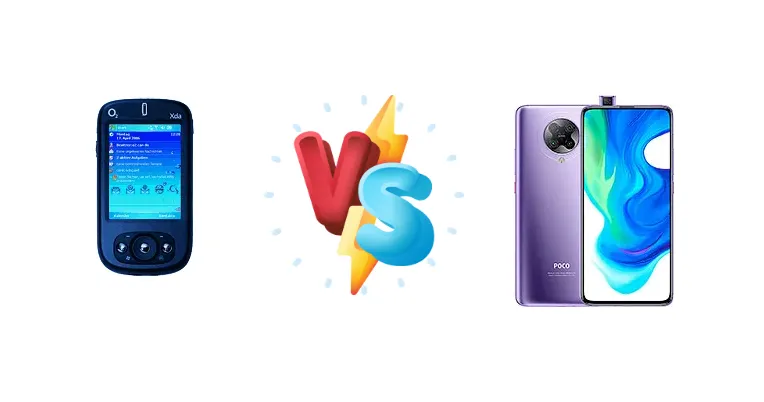
Comparing the O2 XDA Neo and the Xiaomi Poco F2 Pro is akin to contrasting a vintage car with a modern sports vehicle. The XDA Neo, powered by a 200 MHz TI OMAP 850, represents the early days of smartphone development, while the Poco F2 Pro, boasting a Snapdragon 865, embodies the cutting-edge performance of today's mobile landscape. This comparison isn't about finding a 'better' phone in the traditional sense, but understanding the immense progress made in mobile technology over the years.
🏆 Quick Verdict
For the vast majority of users, the Xiaomi Poco F2 Pro is the clear winner. Its Snapdragon 865 chipset delivers exponentially faster performance, its 854 nit display offers a vastly superior viewing experience, and its 30W fast charging is a game-changer compared to the XDA Neo's limited capabilities. The XDA Neo appeals only to collectors or those seeking a nostalgic experience.
| Network |
|---|
| 2G bands | GSM 850 / 900 / 1800 / 1900 | GSM 850 / 900 / 1800 / 1900 |
| 3G bands | - | HSDPA 850 / 900 / 1700(AWS) / 1900 / 2100 - International |
| 4G bands | - | 1, 2, 3, 4, 5, 7, 8, 20, 28, 38, 40, 41 - International |
| 5G bands | - | 77, 78 Sub6 |
| EDGE | Class 10 | - |
| GPRS | Class 10 | - |
| Speed | - | HSPA, LTE, 5G |
| Technology | GSM | GSM / HSPA / LTE / 5G |
| Launch |
|---|
| Announced | 2006, February | 2020, May 12 |
| Status | Discontinued | Available. Released 2020, May 19 |
| Body |
|---|
| Build | - | Glass front (Gorilla Glass 5), glass back (Gorilla Glass 5), aluminum frame |
| Dimensions | 108.8 x 59.3 x 18.4 mm (4.28 x 2.33 x 0.72 in) | 163.3 x 75.4 x 8.9 mm (6.43 x 2.97 x 0.35 in) |
| SIM | Mini-SIM | Nano-SIM + Nano-SIM |
| Weight | 150 g (5.29 oz) | 219 g (7.72 oz) |
| Display |
|---|
| Protection | - | Corning Gorilla Glass 5 |
| Resolution | 240 x 320 pixels, 4:3 ratio (~143 ppi density) | 1080 x 2400 pixels, 20:9 ratio (~395 ppi density) |
| Size | 2.8 inches, 42 x 57 mm, 24.3 cm2 (~37.6% screen-to-body ratio) | 6.67 inches, 107.4 cm2 (~87.2% screen-to-body ratio) |
| Type | TFT resistive touchscreen, 65K colors | Super AMOLED, HDR10+, 500 nits (typ) |
| | Handwriting recognition | - |
| Platform |
|---|
| CPU | 200 MHz ARM926EJ-S | Octa-core (1x2.84 GHz Cortex-A77 & 3x2.42 GHz Cortex-A77 & 4x1.80 GHz Cortex-A55) |
| Chipset | TI OMAP 850 | Qualcomm SM8250 Snapdragon 865 5G (7 nm+) |
| GPU | - | Adreno 650 |
| OS | Microsoft Windows Mobile 5.0 PocketPC | Android 10, upgradable to Android 12, MIUI 14 |
| Memory |
|---|
| Card slot | SD/MMC | No |
| Internal | 64MB RAM, 128MB ROM | 64GB 6GB RAM, 128GB 6GB RAM, 256GB 8GB RAM |
| | - | UFS 3.1
6GB RAM (LPDDR4X)
8GB RAM (LPDDR5) |
| Main Camera |
|---|
| Features | - | Dual-LED dual-tone flash, HDR, panorama |
| Quad | - | 64 MP, f/1.9, 26mm (wide), 1/1.72", 0.8µm, PDAF
5 MP, f/2.2, 50mm (telephoto macro), AF
13 MP, f/2.4, 123˚ (ultrawide), 1.12µm
Auxiliary lens |
| Single | 2 MP | - |
| Video | CIF | 8K@24/30fps, 4K@30/60fps, 1080p@30/60/120/240fps, 1080p@960fps; gyro-EIS |
| Selfie camera |
|---|
| Features | - | HDR |
| Single | - | Motorized pop-up 20 MP, f/2.2, (wide), 1/3.4", 0.8µm |
| Video | - | 1080p@30fps, 720p@120fps |
| | No | - |
| Sound |
|---|
| 3.5mm jack | No | Yes |
| 35mm jack | No | Yes |
| Alert types | Vibration; Downloadable polyphonic ringtones | - |
| Loudspeaker | Yes | Yes |
| | - | 24-bit/192kHz audio
|
| Comms |
|---|
| Bluetooth | 2.0 | 5.1, A2DP, LE, aptX HD, aptX Adaptive |
| Infrared port | Yes | Yes |
| NFC | - | Yes |
| Positioning | No | GPS (L1+L5), GLONASS (G1), BDS (B1), GALILEO (E1+E5a), QZSS (L1+L5) |
| Radio | No | No |
| USB | miniUSB | USB Type-C 2.0, OTG |
| WLAN | Wi-Fi 802.11b/g | Wi-Fi 802.11 a/b/g/n/ac/6, dual-band, Wi-Fi Direct |
| Features |
|---|
| Browser | WAP 2.0/xHTML, HTML (PocketIE) | - |
| Sensors | - | Fingerprint (under display, optical), accelerometer, gyro, proximity, compass, barometer |
| | Pocket Office
Voice memo
MP3/AAC player | - |
| Battery |
|---|
| Charging | - | 30W wired, PD3.0, QC4, 100% in 63 min |
| Stand-by | Up to 200 h | - |
| Talk time | Up to 5 h | - |
| Type | Removable Li-Ion 1200 mAh battery | Li-Po 4700 mAh |
| Misc |
|---|
| Colors | Stylish black | Neon Blue, Phantom White, Electric Purple, Cyber Gray |
| Models | - | M2004J11G |
| Price | About 300 EUR | About 150 EUR |
| SAR | - | 1.09 W/kg (head) 0.51 W/kg (body) |
| SAR EU | - | 0.79 W/kg (head) 1.03 W/kg (body) |
| Tests |
|---|
| Battery life | - |
Endurance rating 120h
|
| Camera | - |
Photo / Video |
| Display | - |
Contrast ratio: Infinite (nominal) |
| Loudspeaker | - |
-25.6 LUFS (Very good)
|
| Performance | - |
AnTuTu: 538221 (v8)
GeekBench: 3332 (v5.1)
GFXBench: 40fps (ES 3.1 onscreen) |
O2 XDA Neo
- Historical significance and collectibility
- Simplicity of early Windows Mobile OS
- Compact form factor (likely)
- Extremely slow performance
- Outdated display technology
- Limited app compatibility
- Poor camera quality
Xiaomi Poco F2 Pro
- Exceptional performance with Snapdragon 865
- Bright and vibrant display (854 nits)
- Fast 30W charging with PD3.0/QC4
- Long battery life (120h endurance)
- Modern Android operating system
- May be larger and heavier than the XDA Neo
- Software updates may be limited (depending on Xiaomi's support)
Display Comparison
The Poco F2 Pro’s display is a significant leap forward, achieving a measured peak brightness of 854 nits. This dramatically improves visibility in direct sunlight compared to the XDA Neo, which lacks detailed display specifications but would have offered significantly lower brightness levels typical of early smartphone screens. The Poco F2 Pro’s infinite (nominal) contrast ratio also provides richer, more vibrant colors. While the XDA Neo’s display served its purpose in its time, it cannot compete with the modern viewing experience offered by the Poco F2 Pro.
Camera Comparison
Both devices offer photo and video capabilities, but the specifics are vastly different. The Poco F2 Pro benefits from modern image signal processing (ISP) within the Snapdragon 865, enabling features like HDR, night mode, and improved image stabilization. While the XDA Neo’s camera was innovative for its time, its sensor size and image quality would be severely limited compared to the Poco F2 Pro. The lack of detailed camera specifications for the XDA Neo makes a precise comparison difficult, but it’s safe to assume the Poco F2 Pro offers a far superior photographic experience.
Performance
The difference in processing power is staggering. The O2 XDA Neo’s 200 MHz ARM926EJ-S CPU is dwarfed by the Xiaomi Poco F2 Pro’s Snapdragon 865, featuring an octa-core configuration with a prime Cortex-A77 core clocked at 2.84 GHz. The Snapdragon 865, built on a 7nm+ process, offers significantly improved performance per watt, enabling smoother multitasking, faster app loading times, and the ability to handle demanding games. The XDA Neo would struggle with even basic modern applications.
Battery Life
The Poco F2 Pro boasts an endurance rating of 120 hours, coupled with 30W wired charging, supporting PD3.0 and QC4 standards, achieving a full charge in just 63 minutes. The XDA Neo’s battery life and charging capabilities are unknown, but would be significantly inferior. The fast charging on the Poco F2 Pro is a crucial convenience feature, allowing users to quickly top up their battery when needed, a luxury unavailable on the older XDA Neo.
Buying Guide
Buy the O2 XDA Neo if you're a mobile history enthusiast, collector, or developer interested in exploring early Windows Mobile operating systems. Its value lies in its historical significance, not its practical usability. Buy the Xiaomi Poco F2 Pro if you prioritize performance, a vibrant display, fast charging, and a modern Android experience. It's a capable device for gaming, multimedia consumption, and everyday tasks.
Frequently Asked Questions
❓ Is the Poco F2 Pro still a good buy in [current year], considering newer Snapdragon chips are available?
Yes, the Snapdragon 865 remains a very capable chipset, offering excellent performance for most tasks, including gaming and demanding applications. While newer chips exist, the Poco F2 Pro provides a strong price-to-performance ratio, especially if found at a discounted price.
❓ Can I use modern apps like WhatsApp or Instagram on the O2 XDA Neo?
No, the O2 XDA Neo runs an outdated version of Windows Mobile and is not compatible with modern Android or iOS apps like WhatsApp or Instagram. Attempting to install them would likely result in errors or crashes.
❓ What kind of storage does the Poco F2 Pro use, and is it expandable?
The Poco F2 Pro utilizes UFS 3.1 storage, which is incredibly fast, leading to quicker app loading and file transfer speeds. It does *not* offer microSD card expansion, so you're limited to the internal storage option you choose at purchase.
❓ Is the XDA Neo useful for anything beyond collecting?
The XDA Neo can be useful for developers interested in reverse engineering or studying early smartphone operating systems. It also serves as a fascinating piece of mobile history for collectors and enthusiasts.