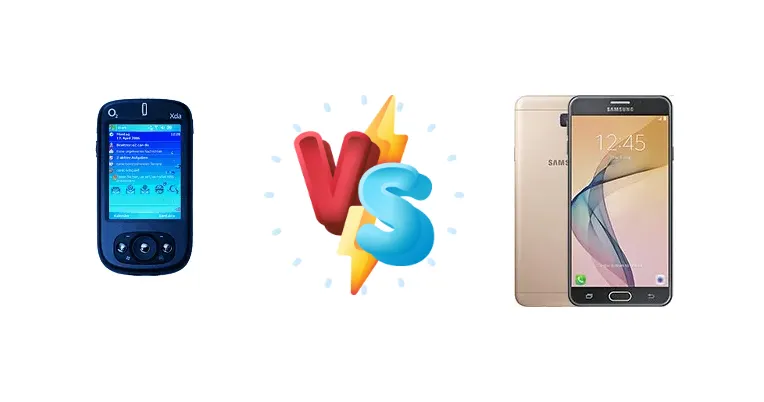
We're revisiting two devices separated by a significant technological leap: the O2 XDA Neo, a representative of early Windows Mobile smartphones, and the Samsung Galaxy J7 Prime, a mainstream Android device from 2016. This isn't about crowning a 'winner' in the traditional sense, but understanding how far mobile processing has come and where each phone fits within its historical context.
🏆 Quick Verdict
For the average user in 2024, the Samsung Galaxy J7 Prime is the unequivocally superior device. Its Exynos 7870 chipset delivers a vastly more responsive experience for modern apps and tasks, while the XDA Neo struggles even with basic functionality. The J7 Prime represents usable functionality; the XDA Neo is largely a collector's item.
| Network |
|---|
| 2G bands | GSM 850 / 900 / 1800 / 1900 | GSM 850 / 900 / 1800 / 1900 - SIM 1 & SIM 2 (dual-SIM model only) |
| 3G bands | - | HSDPA 850 / 900 / 1900 / 2100 |
| 4G bands | - | 1, 3, 5, 7, 8, 20, 38, 40 |
| EDGE | Class 10 | - |
| GPRS | Class 10 | - |
| Speed | - | HSPA 42.2/5.76 Mbps, LTE Cat4 150/50 Mbps |
| Technology | GSM | GSM / HSPA / LTE |
| Launch |
|---|
| Announced | 2006, February | 2016, September 01. Released 2016, November 30 |
| Status | Discontinued | Discontinued |
| Body |
|---|
| Build | - | Glass front (Gorilla Glass), aluminum/plastic back, aluminum frame |
| Dimensions | 108.8 x 59.3 x 18.4 mm (4.28 x 2.33 x 0.72 in) | 151.7 x 75 x 8 mm (5.97 x 2.95 x 0.31 in) |
| SIM | Mini-SIM | · Nano-SIM· Nano-SIM + Nano-SIM |
| Weight | 150 g (5.29 oz) | 167 g (5.89 oz) |
| Display |
|---|
| Protection | - | Corning Gorilla Glass (market dependent) |
| Resolution | 240 x 320 pixels, 4:3 ratio (~143 ppi density) | 1080 x 1920 pixels, 16:9 ratio (~401 ppi density) |
| Size | 2.8 inches, 42 x 57 mm, 24.3 cm2 (~37.6% screen-to-body ratio) | 5.5 inches, 83.4 cm2 (~73.3% screen-to-body ratio) |
| Type | TFT resistive touchscreen, 65K colors | PLS LCD |
| | Handwriting recognition | - |
| Platform |
|---|
| CPU | 200 MHz ARM926EJ-S | Octa-core 1.6 GHz Cortex-A53 |
| Chipset | TI OMAP 850 | Exynos 7870 Octa (14 nm) |
| GPU | - | Mali-T830 MP1 |
| OS | Microsoft Windows Mobile 5.0 PocketPC | Android 6.0.1 (Marshmallow), upgradable to Android 9.0 (Pie), One UI |
| Memory |
|---|
| Card slot | SD/MMC | microSDXC (dedicated slot) |
| Internal | 64MB RAM, 128MB ROM | 16GB 3GB RAM, 32GB 3GB RAM, 64GB 3GB RAM |
| | - | eMMC 5.1 |
| Main Camera |
|---|
| Features | - | LED flash, panorama, HDR |
| Single | 2 MP | 13 MP, f/1.9, 28mm (wide), AF |
| Video | CIF | 1080p@30fps |
| Selfie camera |
|---|
| Single | - | 8 MP, f/1.9 |
| Video | - | 1080p@30fps |
| | No | - |
| Sound |
|---|
| 3.5mm jack | No | Yes |
| 35mm jack | No | Yes |
| Alert types | Vibration; Downloadable polyphonic ringtones | - |
| Loudspeaker | Yes | Yes |
| Comms |
|---|
| Bluetooth | 2.0 | 4.1, A2DP, LE |
| Infrared port | Yes | - |
| NFC | - | No |
| Positioning | No | GPS, GLONASS, BDS |
| Radio | No | FM radio |
| USB | miniUSB | microUSB 2.0, OTG |
| WLAN | Wi-Fi 802.11b/g | Wi-Fi 802.11 b/g/n, Wi-Fi Direct |
| Features |
|---|
| Browser | WAP 2.0/xHTML, HTML (PocketIE) | - |
| Sensors | - | Fingerprint (front-mounted), accelerometer, proximity |
| | Pocket Office
Voice memo
MP3/AAC player | ANT+ |
| Battery |
|---|
| Music play | - | Up to 84 h |
| Stand-by | Up to 200 h | - |
| Talk time | Up to 5 h | Up to 21 h (3G) |
| Type | Removable Li-Ion 1200 mAh battery | Li-Ion 3300 mAh, non-removable |
| Misc |
|---|
| Colors | Stylish black | Black, Gold, Rose Gold |
| Models | - | SM-G610F, SM-G610Y, SM-G610M, SM-G610 |
| Price | About 300 EUR | About 210 EUR |
| SAR | - | 0.56 W/kg (head) 1.02 W/kg (body) |
| SAR EU | - | 0.40 W/kg (head) 1.40 W/kg (body) |
O2 XDA Neo
- Historical significance – a window into early smartphone technology.
- Compact size – significantly smaller than modern smartphones.
- Unique user experience – running Windows Mobile.
- Extremely slow performance – struggles with modern apps.
- Low-resolution display – poor viewing experience.
- Limited battery life – requires frequent charging.
Samsung Galaxy J7 Prime
- Significantly faster performance – capable of running modern apps.
- Larger, higher-resolution display – better viewing experience.
- Decent camera – capable of taking usable photos.
- Outdated software – may not receive security updates.
- Plastic build quality – feels less premium than modern phones.
- Relatively slow charging compared to current standards.
Display Comparison
The O2 XDA Neo's display specifications are largely unavailable, but based on devices of its era, it likely featured a small, low-resolution resistive touchscreen. In contrast, the Samsung Galaxy J7 Prime boasts a 5.5-inch PLS TFT LCD display. While not AMOLED, the J7 Prime's larger size and higher resolution (720 x 1280) provide a significantly more usable viewing experience. The J7 Prime's panel benefits from modern color calibration techniques, offering more accurate colors than the XDA Neo could achieve.
Camera Comparison
Comparing cameras is difficult due to the age difference. The O2 XDA Neo likely featured a very low-resolution camera, primarily for basic image capture. The Samsung Galaxy J7 Prime features a 13MP rear camera with an f/1.9 aperture. While not a flagship camera by 2016 standards, it's capable of producing usable photos in good lighting conditions. The J7 Prime also includes an 8MP front-facing camera, a feature absent on the XDA Neo. Image processing capabilities are vastly superior on the J7 Prime, offering features like HDR and scene detection.
Performance
The core difference lies in the chipsets. The O2 XDA Neo's TI OMAP 850, with its 200 MHz ARM926EJ-S CPU, represents a fundamentally different architectural approach. ARM9 is a RISC architecture from the early 2000s, optimized for low power but limited performance. The Samsung Galaxy J7 Prime's Exynos 7870, built on a 14nm process, features an octa-core Cortex-A53 CPU clocked at 1.6 GHz. Cortex-A53 is a modern ARMv8-A architecture, offering significantly higher instructions per clock (IPC) and overall processing power. The 14nm fabrication process also contributes to better thermal efficiency, allowing the J7 Prime to sustain performance for longer periods. The XDA Neo will struggle with even basic web browsing, while the J7 Prime can handle multitasking and some light gaming.
Battery Life
Battery capacity for the O2 XDA Neo is unknown, but given its age and hardware, it would have offered limited battery life. The Samsung Galaxy J7 Prime packs a 3300 mAh battery. While battery life is affected by usage, the J7 Prime can realistically last a full day with moderate use. The J7 Prime also supports faster charging than the XDA Neo, reducing downtime.
Buying Guide
Buy the O2 XDA Neo if you're a collector of early smartphones, interested in the history of mobile operating systems, or require a device for retro software experimentation. Buy the Samsung Galaxy J7 Prime if you need a functional, albeit basic, smartphone for calls, texts, and light app usage, particularly if you're on a very tight budget or prefer a larger screen.
Frequently Asked Questions
❓ Is the O2 XDA Neo capable of running modern Android apps?
No. The O2 XDA Neo runs Windows Mobile and its hardware is far too limited to run modern Android apps, even with custom ROMs. The ARM9 processor and limited RAM are significant bottlenecks.
❓ Does the Exynos 7870 in the Galaxy J7 Prime overheat during prolonged use?
The Exynos 7870 is a relatively efficient chip. While it can get warm during extended gaming or video recording, it's unlikely to overheat and cause performance throttling under normal usage conditions. The 14nm process helps manage thermal output.
❓ Can the Samsung Galaxy J7 Prime be upgraded to a newer version of Android?
Officially, the Samsung Galaxy J7 Prime shipped with Android 6.0 Marshmallow and received updates up to Android 7.0 Nougat. While custom ROMs may be available, they are not officially supported and may introduce instability.
❓ What kind of connectivity does the O2 XDA Neo offer compared to the J7 Prime?
The O2 XDA Neo primarily offered 2G and potentially early 3G connectivity, along with Bluetooth. The Samsung Galaxy J7 Prime supports 4G LTE, Wi-Fi 802.11 b/g/n, and Bluetooth 4.1, offering significantly faster data speeds and broader connectivity options.