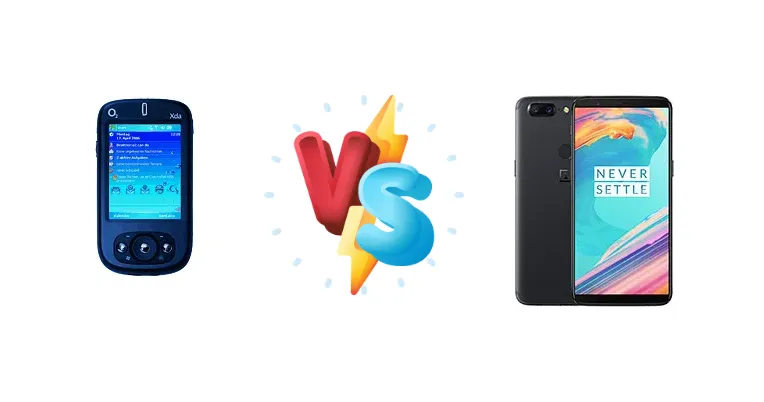
Comparing the O2 XDA Neo and the OnePlus 5T isn't about a head-to-head competition; it's a journey through twenty years of mobile technology. The XDA Neo, a landmark device from 2005, embodies the early days of Windows Mobile, while the 2017 OnePlus 5T represents the maturity of Android and the rise of powerful, affordable flagships. This comparison highlights the staggering advancements made in processing power, display technology, and overall user experience.
🏆 Quick Verdict
For the vast majority of users, the OnePlus 5T is the clear winner. Its Snapdragon 835 chipset, modern display, and significantly improved battery life offer a user experience the XDA Neo simply cannot match. However, the XDA Neo holds immense historical value as a pioneer of smartphone design.
| Network |
|---|
| 2G bands | GSM 850 / 900 / 1800 / 1900 | GSM 850 / 900 / 1800 / 1900 - SIM 1 & SIM 2 |
| 3G bands | - | HSDPA 850 / 900 / 1700(AWS) / 1900 / 2100 |
| 4G bands | - | 1, 2, 3, 4, 5, 7, 8, 12, 17, 18, 19, 20, 25, 26, 28, 29, 30, 34, 38, 39, 40, 41, 66 |
| EDGE | Class 10 | - |
| GPRS | Class 10 | - |
| Speed | - | HSPA 42.2/5.76 Mbps, LTE (3CA) Cat12 600/150 Mbps |
| Technology | GSM | GSM / CDMA / HSPA / LTE |
| | - | CDMA 800 & TD-SCDMA |
| Launch |
|---|
| Announced | 2006, February | 2017, November 16. Released 2017, November 21 |
| Status | Discontinued | Discontinued |
| Body |
|---|
| Build | - | Glass front (Gorilla Glass 5), aluminum back, aluminum frame |
| Dimensions | 108.8 x 59.3 x 18.4 mm (4.28 x 2.33 x 0.72 in) | 156.1 x 75 x 7.3 mm (6.15 x 2.95 x 0.29 in) |
| SIM | Mini-SIM | Nano-SIM + Nano-SIM |
| Weight | 150 g (5.29 oz) | 162 g (5.71 oz) |
| Display |
|---|
| Protection | - | Corning Gorilla Glass 5 |
| Resolution | 240 x 320 pixels, 4:3 ratio (~143 ppi density) | 1080 x 2160 pixels, 18:9 ratio (~401 ppi density) |
| Size | 2.8 inches, 42 x 57 mm, 24.3 cm2 (~37.6% screen-to-body ratio) | 6.01 inches, 93.7 cm2 (~80.0% screen-to-body ratio) |
| Type | TFT resistive touchscreen, 65K colors | Optic AMOLED |
| | Handwriting recognition | - |
| Platform |
|---|
| CPU | 200 MHz ARM926EJ-S | Octa-core (4x2.45 GHz Kryo & 4x1.9 GHz Kryo) |
| Chipset | TI OMAP 850 | Qualcomm MSM8998 Snapdragon 835 (10 nm) |
| GPU | - | Adreno 540 |
| OS | Microsoft Windows Mobile 5.0 PocketPC | Android 7.1.1 (Nougat), upgradable to Android 10, OxygenOS 10.0.0 |
| Memory |
|---|
| Card slot | SD/MMC | No |
| Internal | 64MB RAM, 128MB ROM | 64GB 6GB RAM, 128GB 8GB RAM |
| | - | UFS 2.1 |
| Main Camera |
|---|
| Dual | - | 16 MP, f/1.7, 27mm (wide), 1/2.8", 1.12µm, PDAF
20 MP, f/1.7, 27mm (wide), 1/2.8", 1.0µm, AF, PDAF |
| Features | - | Dual-LED flash, HDR, panorama |
| Single | 2 MP | - |
| Video | CIF | 4K@30fps, 1080p@30/60fps, 720p@30/120fps, Auto HDR |
| Selfie camera |
|---|
| Features | - | HDR |
| Single | - | 16 MP, f/2.0, 20mm (wide), 1/3.06", 1.0µm |
| Video | - | 1080p (gyro-EIS) |
| | No | - |
| Sound |
|---|
| 3.5mm jack | No | Yes |
| 35mm jack | No | Yes |
| Alert types | Vibration; Downloadable polyphonic ringtones | - |
| Loudspeaker | Yes | Yes |
| | - | Dirac HD sound |
| Comms |
|---|
| Bluetooth | 2.0 | 5.0, A2DP, LE, aptX HD |
| Infrared port | Yes | - |
| NFC | - | Yes |
| Positioning | No | GPS, GLONASS, BDS, GALILEO |
| Radio | No | No |
| USB | miniUSB | USB Type-C 2.0 |
| WLAN | Wi-Fi 802.11b/g | Wi-Fi 802.11 a/b/g/n/ac, dual-band, Wi-Fi Direct, DLNA |
| Features |
|---|
| Browser | WAP 2.0/xHTML, HTML (PocketIE) | - |
| Sensors | - | Fingerprint (rear-mounted), accelerometer, gyro, proximity, compass |
| | Pocket Office
Voice memo
MP3/AAC player | - |
| Battery |
|---|
| Charging | - | 20W wired |
| Stand-by | Up to 200 h | - |
| Talk time | Up to 5 h | - |
| Type | Removable Li-Ion 1200 mAh battery | Li-Po 3300 mAh, non-removable |
| Misc |
|---|
| Colors | Stylish black | Midnight Black, Lava Red, Sandstone White |
| Models | - | A5010 |
| Price | About 300 EUR | About 840 EUR |
| Tests |
|---|
| Audio quality | - |
Noise -94.0dB / Crosstalk -93.7dB |
| Battery life | - | Endurance rating 82h |
| Camera | - |
Photo / Video |
| Display | - |
Contrast ratio: Infinite (nominal), 4.789 (sunlight) |
| Loudspeaker | - |
Voice 68dB / Noise 73dB / Ring 69dB |
| Performance | - |
AnTuTu: 207072 (v7), 260352 (v8)
GeekBench: 6759 (v4.4), 1705 (v5.1)
GFXBench: 24fps (ES 3.1 onscreen) |
O2 XDA Neo
- Historical significance as an early smartphone
- Represents a pivotal moment in mobile technology
- Unique collector's item
- Extremely slow processing speed
- Outdated display technology
- Limited functionality by modern standards
OnePlus 5T
- Powerful Snapdragon 835 processor
- Excellent battery life and fast charging
- Modern display with high contrast
- No longer receives software updates
- Battery has degraded with age
- May not support the latest apps
Display Comparison
The contrast between the displays is stark. The OnePlus 5T boasts an 'Infinite' (nominal) contrast ratio and 4.789 sunlight contrast, indicating a vibrant and readable screen even outdoors. The XDA Neo, lacking detailed display specifications, would have utilized a much older LCD technology with significantly lower brightness and contrast. The 5T’s display is likely a significantly larger size and higher resolution, offering a far superior viewing experience for media consumption and general use. The XDA Neo’s display was constrained by the technology of the time, prioritizing functionality over visual fidelity.
Camera Comparison
Both devices offer photo and video capabilities, but the quality and features are worlds apart. The OnePlus 5T likely features a more advanced image sensor, potentially with optical image stabilization (OIS), and sophisticated image processing algorithms. The XDA Neo’s camera, limited by its era, would have produced low-resolution images with limited dynamic range and poor low-light performance. The 5T’s camera would allow for detailed photos and videos, while the XDA Neo’s camera was primarily for basic documentation.
Performance
The performance gap is immense. The O2 XDA Neo’s 200 MHz ARM926EJ-S processor is dwarfed by the OnePlus 5T’s Qualcomm MSM8998 Snapdragon 835, an octa-core CPU clocked up to 2.45 GHz. The Snapdragon 835, built on a 10nm process, delivers exponentially more processing power and efficiency. This translates to responsive multitasking, smooth gaming, and faster app loading times on the 5T. The XDA Neo would struggle with even basic modern applications. The 5T’s GPU is also vastly superior, enabling graphics-intensive tasks that were impossible on the XDA Neo.
Battery Life
The OnePlus 5T’s endurance rating of 82 hours, coupled with 20W wired charging, demonstrates a significant advantage in battery life and convenience. While the XDA Neo’s battery capacity is unknown, its less efficient processor and older battery technology would result in significantly shorter runtimes. The 5T’s fast charging capability allows for quick top-ups, minimizing downtime, a feature unavailable on the XDA Neo.
Buying Guide
Buy the O2 XDA Neo if you're a collector of vintage technology, a historian interested in the evolution of mobile devices, or someone seeking a nostalgic experience with early Windows Mobile. Buy the OnePlus 5T if you need a functional, powerful smartphone for everyday tasks, gaming, photography, and reliable performance. The 5T offers a modern experience, while the XDA Neo is a museum piece.
Frequently Asked Questions
❓ Can the O2 XDA Neo run any modern apps?
No. The O2 XDA Neo runs Windows Mobile, an operating system that is no longer supported. Modern apps are designed for Android or iOS and are incompatible with the XDA Neo’s architecture and software.
❓ Is the OnePlus 5T still a viable daily driver in 2024?
While the OnePlus 5T is capable of basic tasks, its age means the battery has likely degraded, and software updates have ceased. Performance will be noticeably slower than modern phones, and some apps may not function correctly. It's best suited for light use or as a backup device.
❓ What was the significance of the O2 XDA Neo at the time of its release?
The O2 XDA Neo was a groundbreaking device that combined mobile phone functionality with PDA features like email, calendar, and contact management. It represented a significant step towards the modern smartphone and popularized the use of Windows Mobile as a mobile operating system.
❓ How does the Snapdragon 835 in the OnePlus 5T compare to processors found in similarly priced modern phones?
The Snapdragon 835, while powerful for its time, is significantly less performant than processors found in similarly priced modern phones. Current mid-range chips offer substantially improved CPU and GPU performance, along with enhanced power efficiency.