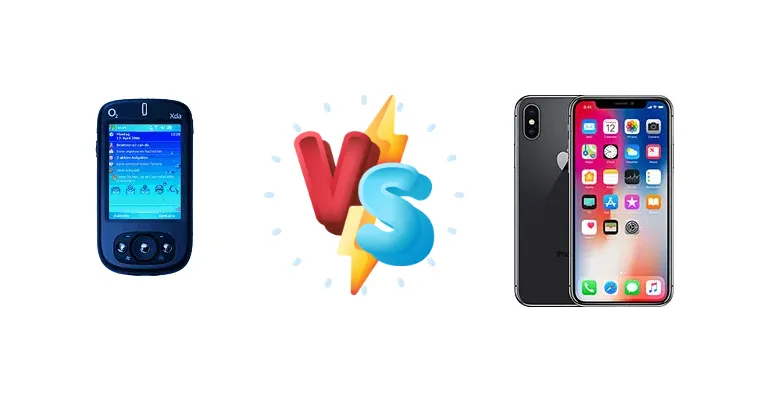
Comparing the O2 XDA Neo and the Apple iPhone X is akin to examining two vastly different eras of mobile computing. The XDA Neo, representing the mature stages of Windows Mobile, offers a glimpse into the pre-smartphone world, while the iPhone X embodies the modern smartphone paradigm. This comparison isn't about declaring a 'winner' in the traditional sense, but rather understanding the monumental shift in technology that occurred between these two devices.
🏆 Quick Verdict
For the average user in 2024, the Apple iPhone X is the clear choice. Its A11 Bionic chip delivers exponentially faster performance, a vastly superior user experience, and a more modern feature set. While the XDA Neo holds historical significance, its 200MHz processor and Windows Mobile OS are simply too dated for contemporary use.
| Network |
|---|
| 2G bands | GSM 850 / 900 / 1800 / 1900 | GSM 850 / 900 / 1800 / 1900 |
| 3G bands | - | HSDPA 850 / 900 / 1700(AWS) / 1900 / 2100 |
| 4G bands | - | 1, 2, 3, 4, 5, 7, 8, 12, 13, 17, 18, 19, 20, 25, 26, 28, 29, 30, 34, 38, 39, 40, 41, 66 |
| EDGE | Class 10 | - |
| GPRS | Class 10 | - |
| Speed | - | HSPA 42.2/5.76 Mbps, LTE (3CA) Cat12 600/150 Mbps, EV-DO Rev.A 3.1 Mbps |
| Technology | GSM | GSM / HSPA / LTE |
| Launch |
|---|
| Announced | 2006, February | 2017, September 12. Released 2017, November 03 |
| Status | Discontinued | Discontinued |
| Body |
|---|
| Build | - | Glass front (Corning-made glass), glass back (Corning-made glass), stainless steel frame |
| Dimensions | 108.8 x 59.3 x 18.4 mm (4.28 x 2.33 x 0.72 in) | 143.6 x 70.9 x 7.7 mm (5.65 x 2.79 x 0.30 in) |
| SIM | Mini-SIM | Nano-SIM |
| Weight | 150 g (5.29 oz) | 174 g (6.14 oz) |
| | - | IP67 dust/water resistant (up to 1m for 30 mins)
Apple Pay (Visa, MasterCard, AMEX certified) |
| Display |
|---|
| Protection | - | Scratch-resistant glass |
| Resolution | 240 x 320 pixels, 4:3 ratio (~143 ppi density) | 1125 x 2436 pixels, 19.5:9 ratio (~458 ppi density) |
| Size | 2.8 inches, 42 x 57 mm, 24.3 cm2 (~37.6% screen-to-body ratio) | 5.8 inches, 84.4 cm2 (~82.9% screen-to-body ratio) |
| Type | TFT resistive touchscreen, 65K colors | Super Retina OLED, HDR10, Dolby Vision, 625 nits (HBM) |
| | Handwriting recognition | 3D Touch |
| Platform |
|---|
| CPU | 200 MHz ARM926EJ-S | Hexa-core 2.39 GHz (2x Monsoon + 4x Mistral) |
| Chipset | TI OMAP 850 | Apple A11 Bionic (10 nm) |
| GPU | - | Apple GPU (three-core graphics) |
| OS | Microsoft Windows Mobile 5.0 PocketPC | iOS 11.1.1, up to iOS 16.7.12 |
| Memory |
|---|
| Card slot | SD/MMC | No |
| Internal | 64MB RAM, 128MB ROM | 64GB 3GB RAM, 256GB 3GB RAM |
| | - | NVMe |
| Main Camera |
|---|
| Dual | - | 12 MP, f/1.8, 28mm (wide), 1/3.0", 1.22µm, dual pixel PDAF, OIS
12 MP, f/2.4, 52mm (telephoto), 1/3.4", 1.0µm, PDAF, OIS, 2x optical zoom |
| Features | - | Quad-LED dual-tone flash, HDR (photo/panorama), panorama, HDR |
| Single | 2 MP | - |
| Video | CIF | 4K@24/30/60fps, 1080p@30/60/120/240fps |
| Selfie camera |
|---|
| Features | - | HDR |
| Single | - | 7 MP, f/2.2, 32mm (standard)
SL 3D, (depth/biometrics sensor) |
| Video | - | 1080p@30fps |
| | No | - |
| Sound |
|---|
| 3.5mm jack | No | No |
| 35mm jack | No | No |
| Alert types | Vibration; Downloadable polyphonic ringtones | - |
| Loudspeaker | Yes | Yes, with stereo speakers |
| Comms |
|---|
| Bluetooth | 2.0 | 5.0, A2DP, LE |
| Infrared port | Yes | - |
| NFC | - | Yes |
| Positioning | No | GPS, GLONASS, GALILEO, QZSS |
| Radio | No | No |
| USB | miniUSB | Lightning, USB 2.0 |
| WLAN | Wi-Fi 802.11b/g | Wi-Fi 802.11 a/b/g/n/ac, dual-band, hotspot |
| Features |
|---|
| Browser | WAP 2.0/xHTML, HTML (PocketIE) | - |
| Sensors | - | Face ID, accelerometer, gyro, proximity, compass, barometer |
| | Pocket Office
Voice memo
MP3/AAC player | - |
| Battery |
|---|
| Charging | - | 15W wired, PD2.0, 50% in 30 min
Wireless (Qi) |
| Stand-by | Up to 200 h | - |
| Talk time | Up to 5 h | Up to 21 h (3G) |
| Type | Removable Li-Ion 1200 mAh battery | Li-Ion 2716 mAh, non-removable (10.35 Wh) |
| Misc |
|---|
| Colors | Stylish black | Space Gray, Silver |
| Models | - | A1865, A1901, A1902, A1903, iPhone10,3, iPhone10,6 |
| Price | About 300 EUR | About 100 EUR |
| SAR | - | 1.09 W/kg (head) 1.17 W/kg (body) |
| Tests |
|---|
| Audio quality | - |
Noise -93.7dB / Crosstalk -82.8dB |
| Battery life | - | Endurance rating 74h |
| Camera | - |
Photo / Video |
| Display | - |
Contrast ratio: Infinity (nominal), 5.013 (sunlight) |
| Loudspeaker | - |
Voice 68dB / Noise 74dB / Ring 76dB |
| Performance | - |
AnTuTu: 233100 (v7)
GeekBench: 10215 (v4.4)
GFXBench: 28fps (ES 3.1 onscreen) |
O2 XDA Neo
- Historical significance – a relic of early smartphone development.
- Windows Mobile OS – appeals to niche users with legacy software needs.
- Potentially expandable storage (via microSD, common in the era).
- Extremely slow processor – 200MHz ARM9 is inadequate for modern tasks.
- Outdated operating system – Windows Mobile lacks modern app support.
- Poor display quality – likely low resolution and limited brightness.
Apple iPhone X
- Powerful A11 Bionic chip – delivers excellent performance.
- High-quality OLED display – offers vibrant colors and excellent contrast.
- Modern iOS operating system – provides access to a vast app ecosystem.
- Battery is aging – endurance rating is based on a new battery.
- No longer receiving software updates.
- Relatively small storage capacity compared to modern phones.
Display Comparison
The iPhone X boasts a significantly more advanced display. While both devices share an 'Infinity' contrast ratio (nominal), the iPhone X's 5.013 sunlight contrast ratio indicates superior outdoor visibility. The XDA Neo's display technology and resolution are not specified, but given its era, it likely utilizes a resistive touchscreen with lower brightness and color accuracy compared to the iPhone X's capacitive, high-resolution OLED panel. The iPhone X's display is designed for media consumption and visual clarity, while the XDA Neo's is primarily functional.
Camera Comparison
Both devices feature photo and video capabilities, but the specifics are limited for the XDA Neo. The iPhone X's camera system, while not cutting-edge by today's standards, benefits from Apple's image processing algorithms and likely features a larger sensor and wider aperture than the XDA Neo. The iPhone X's camera is designed for capturing high-quality photos and videos in various lighting conditions, while the XDA Neo's camera is likely limited in resolution and image quality.
Performance
The performance disparity is immense. The O2 XDA Neo's 200 MHz ARM926EJ-S CPU is dwarfed by the Apple A11 Bionic's hexa-core architecture running at 2.39 GHz. The A11 Bionic, built on a 10nm process, features two high-performance 'Monsoon' cores and four efficiency 'Mistral' cores, enabling it to handle complex tasks with ease. The XDA Neo would struggle with even basic web browsing, while the iPhone X can run demanding apps and games. The A11 Bionic's GPU is also orders of magnitude more powerful, offering a smooth and responsive user experience.
Battery Life
The iPhone X's endurance rating of 74 hours suggests a relatively efficient power management system, despite its more powerful components. It supports 15W wired charging with PD2.0 and Qi wireless charging, offering convenient charging options. The XDA Neo's battery capacity and charging capabilities are unknown, but given its age and processor, it likely has a smaller battery and slower charging speeds. The iPhone X's faster charging and wireless capabilities provide a more convenient user experience.
Buying Guide
Buy the O2 XDA Neo if you're a collector of vintage technology, a mobile history enthusiast, or require a device for specific legacy applications compatible only with Windows Mobile. Buy the Apple iPhone X if you prioritize performance, a modern operating system, a high-quality display, and access to a vast ecosystem of apps and services. The iPhone X remains a usable device for basic tasks, while the XDA Neo is primarily a museum piece.
Frequently Asked Questions
❓ Can the O2 XDA Neo run modern apps like WhatsApp or Facebook?
No. The O2 XDA Neo runs Windows Mobile, an operating system that is no longer supported and lacks compatibility with modern applications. Attempts to install modern apps would be unsuccessful due to architectural differences and lack of available software.
❓ Is the iPhone X still secure in 2024, given it no longer receives security updates?
The iPhone X's lack of security updates poses a risk. While iOS is generally secure, the absence of patches leaves it vulnerable to newly discovered exploits. It's advisable to avoid using the iPhone X for sensitive tasks like online banking or storing personal information.
❓ What kind of connectivity does the O2 XDA Neo offer?
The O2 XDA Neo likely supports 2G and 3G cellular connectivity, along with Wi-Fi (802.11b/g). It lacks support for 4G LTE and modern Wi-Fi standards like 802.11ac or Wi-Fi 6.
❓ Could I use the iPhone X as a daily driver in 2024?
While technically possible for basic tasks like calls, texts, and light web browsing, the iPhone X is not ideal as a daily driver. Its aging battery, lack of software updates, and slower performance compared to modern smartphones will likely lead to a frustrating user experience.