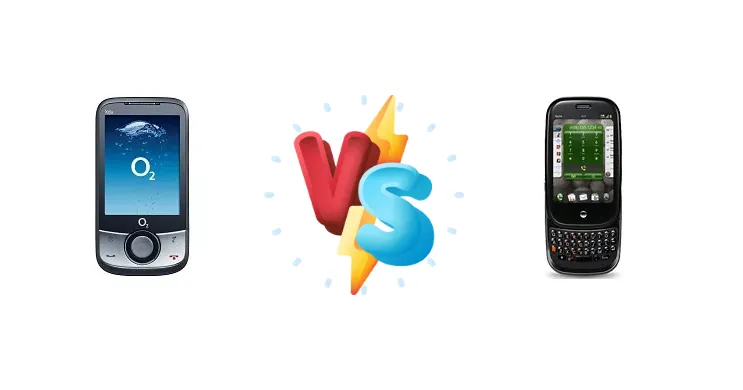
The O2 XDA Guide and Palm Pre represent pivotal moments in early smartphone history. The XDA Guide, running Windows Mobile, aimed for business productivity, while the Palm Pre, with its innovative webOS, targeted a more consumer-focused experience. This comparison dissects their core hardware to determine which device holds up better under scrutiny, given their respective eras.
🏆 Quick Verdict
For the average user seeking a functional, albeit dated, smartphone experience, the Palm Pre emerges as the slightly better choice. Its 600 MHz Cortex-A8 processor offers a noticeable performance advantage over the XDA Guide’s 528 MHz ARM 11, and the inclusion of wireless charging adds a modern convenience absent in the O2 device.
| Network |
|---|
| 2G bands | GSM 850 / 900 / 1800 / 1900 | GSM 850 / 900 / 1800 / 1900 |
| 3G bands | HSDPA 2100 | HSDPA 850 / 1900 / 2100 |
| Speed | HSPA | HSPA 3.6/0.384 Mbps |
| Technology | GSM / HSPA | GSM / HSPA |
| Launch |
|---|
| Announced | 2008, December. Released 2009, February | 2009, Februray. Released 2009, October |
| Status | Discontinued | Discontinued |
| Body |
|---|
| Dimensions | 102 x 53.5 x 14.5 mm (4.02 x 2.11 x 0.57 in) | 100.5 x 59.5 x 16.9 mm (3.96 x 2.34 x 0.67 in) |
| Keyboard | - | QWERTY |
| SIM | Mini-SIM | Mini-SIM |
| Weight | 102 g (3.60 oz) | 133 g (4.69 oz) |
| Display |
|---|
| Resolution | 240 x 320 pixels, 4:3 ratio (~143 ppi density) | 320 x 480 pixels, 3:2 ratio (~186 ppi density) |
| Size | 2.8 inches, 24.3 cm2 (~44.5% screen-to-body ratio) | 3.1 inches, 28.6 cm2 (~47.9% screen-to-body ratio) |
| Type | TFT resistive touchscreen, 65K colors | TFT |
| | TouchFLO finger swipe navigation
Handwriting recognition
5-way navigation | - |
| Platform |
|---|
| CPU | 528 MHz ARM 11 | 600 MHz Cortex-A8 |
| Chipset | Qualcomm MSM7225 Snapdragon S1 | - |
| GPU | No | PowerVR SGX |
| OS | Microsoft Windows Mobile 6.1 Professional | Palm webOS |
| Memory |
|---|
| Card slot | microSD (dedicated slot), 1 GB included | No |
| Internal | 256MB RAM, 512MB ROM | 8GB 256MB RAM |
| Main Camera |
|---|
| Features | - | LED flash |
| Single | 3.15 MP | 3.15 MP |
| Video | CIF | No |
| Sound |
|---|
| 3.5mm jack | No | Yes |
| 35mm jack | No | Yes |
| Loudspeaker | Yes | Yes |
| Comms |
|---|
| Bluetooth | 2.0, A2DP | 2.1, A2DP (headset support only) |
| Positioning | GPS, A-GPS; TomTom NAVIGATOR 7 | GPS |
| Radio | No | No |
| USB | miniUSB | microUSB |
| WLAN | Wi-Fi 802.11 b/g | Wi-Fi 802.11 b/g |
| Features |
|---|
| Browser | WAP 2.0/xHTML, HTML | WAP 2.0 / HTML |
| Sensors | - | Accelerometer |
| | HTC Footprints
Pocket Office
Voice memo
MP3/AAC player
3GP/MP4/WMV/AVI player
Predictive text input | - |
| Battery |
|---|
| Charging | - | Wireless |
| Stand-by | Up to 400 h | Up to 300 h |
| Talk time | Up to 6 h 30 min | Up to 5 h |
| Type | Removable Li-Ion 1110 mAh battery | Removable Li-Ion 1150 mAh battery |
| Misc |
|---|
| Colors | Grey | Black |
| Price | - | About 180 EUR |
| SAR | - | 0.92 W/kg (head) 0.94 W/kg (body) |
| Tests |
|---|
| Audio quality | - |
Noise -95.7dB / Crosstalk -53.9dB |
| Camera | - |
Photo |
| Loudspeaker | - |
Voice 71dB / Noise 68dB / Ring 80dB |
O2 XDA Guide
- Windows Mobile compatibility for legacy apps
- Potentially more robust build quality for business use
- Traditional smartphone form factor
- Slower ARM 11 processor
- Lack of wireless charging
- Outdated Windows Mobile operating system
Palm Pre
- Faster Cortex-A8 processor
- Innovative webOS operating system
- Wireless charging capability
- webOS app ecosystem was limited
- Potentially less durable build quality
- Reliance on a proprietary connector for wired charging
Display Comparison
Display specifications are unavailable for both devices. However, given the XDA Guide’s focus on business, it likely featured a smaller, more utilitarian display prioritizing readability over immersive viewing. The Palm Pre, targeting consumers, likely had a larger, more vibrant display. The absence of details prevents a precise comparison of brightness nits, panel technology, or color accuracy, but the Pre’s marketing suggests a more visually appealing experience.
Camera Comparison
Both devices feature a 'Photo' camera, but lack specific details regarding resolution or sensor size. Given the era, image quality would be limited on both. The Palm Pre likely benefited from webOS’s image processing capabilities, potentially offering slightly better results. Without further specifications, a detailed camera comparison is impossible, but the Pre’s software advantage is a reasonable assumption.
Performance
The Palm Pre’s 600 MHz Cortex-A8 CPU represents a significant architectural leap over the O2 XDA Guide’s 528 MHz ARM 11. The Cortex-A8 utilizes a more efficient instruction set and generally delivers superior performance per clock cycle. While both devices would feel slow by modern standards, the Pre would handle multitasking and web browsing with noticeably less lag. The Qualcomm MSM7225 Snapdragon S1 in the XDA Guide, while introducing a more integrated platform, couldn’t overcome the architectural disadvantage of the older ARM 11 core.
Battery Life
Battery capacity and charging wattage are unspecified for both devices. However, the Palm Pre’s inclusion of wireless charging provides a significant convenience factor. While wireless charging was slower than wired charging at the time, it offered a hassle-free top-up option. The XDA Guide, lacking wireless charging, would rely solely on a wired connection, potentially making it less convenient for users on the go.
Buying Guide
Buy the O2 XDA Guide if you specifically need a Windows Mobile device for legacy application compatibility or require a more traditional smartphone form factor with a focus on business-oriented features. Buy the Palm Pre if you prioritize a smoother user experience, a more modern operating system (webOS), and the convenience of wireless charging, even if it means adapting to a different application ecosystem.
Frequently Asked Questions
❓ Is the Palm Pre’s webOS still functional today?
While official support for webOS on the Palm Pre has long ended, a dedicated community has maintained and updated the operating system through open-source projects like webOS Nation. Functionality is limited, but enthusiasts can still experience a modified version of webOS on the device.
❓ Can I install Android on the O2 XDA Guide?
Installing Android on the O2 XDA Guide is technically possible, but requires significant technical expertise and often involves unstable custom ROMs. The ARM 11 processor and limited RAM present significant challenges, resulting in a suboptimal Android experience.
❓ Which device is better for running older Windows Mobile applications?
The O2 XDA Guide is the clear choice for running older Windows Mobile applications. It natively supports the Windows Mobile operating system and its associated software, ensuring compatibility and optimal performance.
❓ How does the Qualcomm Snapdragon S1 in the XDA Guide compare to other processors of its time?
The Snapdragon S1 was a relatively early attempt at integrating multiple components onto a single chip. While it offered improvements in power efficiency compared to discrete solutions, its ARM 11 core was less powerful than competing Cortex-A8 processors found in devices like the Palm Pre.