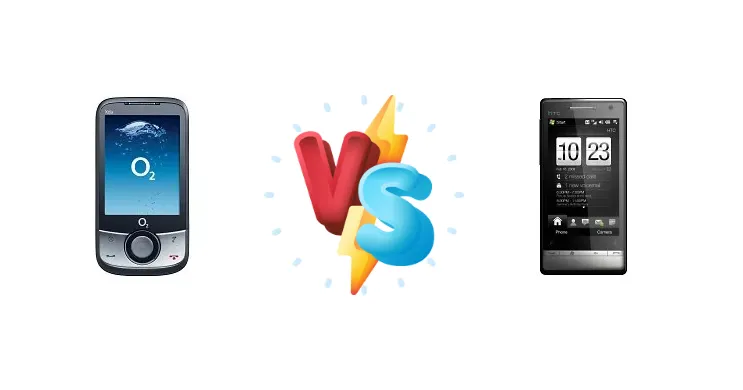
Released in the late 2000s, the O2 XDA Guide and HTC Touch Diamond2 represent a pivotal moment in smartphone evolution. Both devices ran Windows Mobile and targeted business users, but subtle hardware differences, particularly in their Qualcomm chipsets, dictated the user experience. This comparison dissects those differences to determine which device offered the better overall package.
🏆 Quick Verdict
For the average user seeking a functional Windows Mobile device, the HTC Touch Diamond2 edges out the O2 XDA Guide. While both utilize a 528MHz ARM 11 processor, the MSM7200A chipset in the Diamond2 likely benefits from slightly optimized power management and potentially a more refined modem, leading to a smoother overall experience.
| Network |
|---|
| 2G bands | GSM 850 / 900 / 1800 / 1900 | GSM 850 / 900 / 1800 / 1900 |
| 3G bands | HSDPA 2100 | HSDPA 900 / 2100 |
| Speed | HSPA | HSPA 7.2/2 Mbps |
| Technology | GSM / HSPA | GSM / HSPA |
| Launch |
|---|
| Announced | 2008, December. Released 2009, February | 2009, February. Released 2009, April |
| Status | Discontinued | Discontinued |
| Body |
|---|
| Dimensions | 102 x 53.5 x 14.5 mm (4.02 x 2.11 x 0.57 in) | 107.9 x 53.1 x 13.7 mm (4.25 x 2.09 x 0.54 in) |
| SIM | Mini-SIM | Mini-SIM |
| Weight | 102 g (3.60 oz) | 117.5 g (4.13 oz) |
| Display |
|---|
| Resolution | 240 x 320 pixels, 4:3 ratio (~143 ppi density) | 480 x 800 pixels, 5:3 ratio (~292 ppi density) |
| Size | 2.8 inches, 24.3 cm2 (~44.5% screen-to-body ratio) | 3.2 inches, 29.1 cm2 (~50.9% screen-to-body ratio) |
| Type | TFT resistive touchscreen, 65K colors | TFT resistive touchscreen, 65K colors |
| | TouchFLO finger swipe navigation
Handwriting recognition
5-way navigation | TouchFLO 3D finger swipe navigation
Touch-sensitive zoom bar
Handwriting recognition |
| Platform |
|---|
| CPU | 528 MHz ARM 11 | 528 MHz ARM 11 |
| Chipset | Qualcomm MSM7225 Snapdragon S1 | Qualcomm MSM7200A |
| GPU | No | Adreno 130 |
| OS | Microsoft Windows Mobile 6.1 Professional | Microsoft Windows Mobile 6.1 Professional, upgradable to Windows Mobile 6.5 |
| Memory |
|---|
| Card slot | microSD (dedicated slot), 1 GB included | microSD (dedicated slot) |
| Internal | 256MB RAM, 512MB ROM | 288MB RAM, 512MB ROM |
| Main Camera |
|---|
| Single | 3.15 MP | 5 MP, AF |
| Video | CIF | 480p@15fps |
| Selfie camera |
|---|
| Single | - | VGA videocall camera |
| | No | - |
| Sound |
|---|
| 3.5mm jack | No | No |
| 35mm jack | No | No |
| Loudspeaker | Yes | Yes |
| Comms |
|---|
| Bluetooth | 2.0, A2DP | 2.0, A2DP |
| Positioning | GPS, A-GPS; TomTom NAVIGATOR 7 | GPS, A-GPS |
| Radio | No | Stereo FM radio, RDS |
| USB | miniUSB | miniUSB |
| WLAN | Wi-Fi 802.11 b/g | Wi-Fi 802.11 b/g |
| Features |
|---|
| Browser | WAP 2.0/xHTML, HTML | HTML |
| Sensors | - | Accelerometer |
| | HTC Footprints
Pocket Office
Voice memo
MP3/AAC player
3GP/MP4/WMV/AVI player
Predictive text input | Pocket Office
Voice memo
MP3 player |
| Battery |
|---|
| Stand-by | Up to 400 h | Up to 500 h |
| Talk time | Up to 6 h 30 min | Up to 5 h |
| Type | Removable Li-Ion 1110 mAh battery | Removable Li-Ion 1100 mAh battery |
| Misc |
|---|
| Colors | Grey | Black |
| Price | - | About 150 EUR |
| SAR | - | 0.78 W/kg (head) 1.46 W/kg (body) |
| Tests |
|---|
| Audio quality | - |
Noise -86.9dB / Crosstalk -86dB |
| Loudspeaker | - |
Voice 69dB / Noise 66dB / Ring 76dB
|
O2 XDA Guide
- Potentially more repairable due to simpler design.
- May benefit from later modem revisions in the MSM7225.
- Focus on practicality and core functionality.
- Less polished user interface compared to the Diamond2.
- Likely less refined overall hardware experience.
- MSM7225 may not offer significant performance gains.
HTC Touch Diamond2
- More visually appealing and 'premium' design.
- Potentially better power management with the MSM7200A.
- Refined user interface and software experience.
- Potentially more difficult to repair.
- MSM7200A is an earlier chipset revision.
- Relies heavily on Windows Mobile's limitations.
Display Comparison
Both devices featured small touchscreen displays typical of the era. Specific display resolutions and panel technologies are difficult to ascertain without further testing, but both likely utilized resistive touchscreens. The Diamond2’s marketing emphasized its visual appeal, suggesting potentially better color calibration or brightness, though this is speculative given the limited data. Bezels were substantial on both, a common characteristic of early touchscreen phones.
Camera Comparison
Camera performance on both devices was limited by the technology of the time. Details regarding sensor size and aperture are unavailable. Both likely featured basic CMOS sensors capable of capturing low-resolution images suitable for basic documentation. Image processing capabilities were rudimentary, and image quality would be significantly lower than modern smartphones. Focusing on camera quality as a deciding factor between these two is not advisable.
Performance
The core of both devices is a 528 MHz ARM 11 processor. However, the O2 XDA Guide utilizes the Qualcomm MSM7225 Snapdragon S1, while the HTC Touch Diamond2 employs the MSM7200A. While both are based on the same ARM architecture, the MSM7200A is a slightly earlier iteration. The S1 in the XDA Guide *could* offer marginal improvements in modem performance due to being a later revision, but the CPU performance is expected to be nearly identical. Neither chipset is capable of handling modern demanding applications; performance is limited to Windows Mobile’s native applications and basic web browsing. RAM capacity, a critical factor in Windows Mobile responsiveness, is not specified and would be a key differentiator if known.
Battery Life
Battery capacity details are unavailable for either device. Given their similar chipsets and screen sizes, battery life would likely be comparable, offering a day of moderate use. Charging times would have been significant, likely several hours via USB. The MSM7200A *might* have slightly better power management, potentially extending battery life marginally, but this is difficult to confirm without empirical testing.
Buying Guide
Buy the O2 XDA Guide if you prioritize a more straightforward, potentially more repairable device with a focus on basic productivity. Its design leans towards practicality. Buy the HTC Touch Diamond2 if you prefer a more polished user interface, a slightly more refined hardware experience, and a device that feels more 'premium' despite the similar underlying hardware. The Diamond2’s focus was on a more consumer-friendly experience.
Frequently Asked Questions
❓ Is the Qualcomm MSM7225 in the O2 XDA Guide noticeably faster than the MSM7200A in the HTC Touch Diamond2?
While the MSM7225 is a later revision, the core ARM 11 processor running at 528 MHz is identical in both devices. Any performance difference would be minimal and likely unnoticeable in real-world usage. The primary bottleneck is the processor itself, not the chipset revision.
❓ Which device is better for running older Windows Mobile applications?
Both devices should perform similarly when running older Windows Mobile applications. The key factor will be the amount of available RAM, which is currently unknown for both models. If one device has significantly more RAM, it will likely offer a smoother experience.
❓ Are either of these phones capable of running modern apps?
No. These devices run Windows Mobile, an operating system that is no longer supported and incompatible with modern applications. Attempting to run modern apps would be impossible.