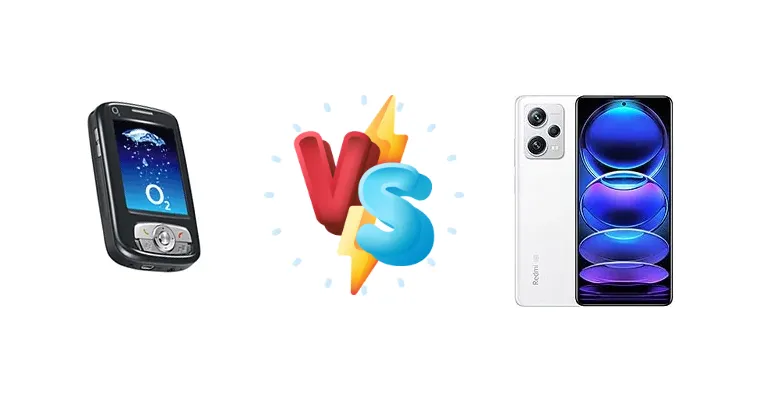
Comparing the O2 XDA Atom and the Xiaomi Redmi Note 12 Pro+ is akin to contrasting the dawn of smartphone technology with its current iteration. The XDA Atom, representing an earlier era, offers a glimpse into the past, while the Redmi Note 12 Pro+ showcases the advancements in processing power, display technology, and camera capabilities of modern mid-range devices. This comparison isn't about declaring a 'winner' in the traditional sense, but rather understanding the vast gulf in technology between these two devices.
🏆 Quick Verdict
For the vast majority of users, the Xiaomi Redmi Note 12 Pro+ is the clear choice. Its modern chipset, rapid 120W charging, and significantly more advanced camera system offer a user experience the O2 XDA Atom simply cannot match. The Atom serves primarily as a historical artifact or a niche device for enthusiasts.
| Network |
|---|
| 2G bands | GSM 900 / 1800 / 1900 | GSM 850 / 900 / 1800 / 1900 - SIM 1 & SIM 2 |
| 3G bands | - | HSDPA 800 / 850 / 900 / 1900 / 2100 |
| 4G bands | - | 1, 3, 5, 8, 19, 34, 38, 39, 40, 41 - International, China |
| 5G bands | - | 1, 3, 5, 8, 28, 38, 40, 41, 77, 78 SA/NSA - International |
| EDGE | Class 10 | - |
| GPRS | Class 10 | - |
| Speed | - | HSPA, LTE-A (CA), 5G |
| Technology | GSM | GSM / CDMA / HSPA / EVDO / LTE / 5G |
| | - | 1, 3, 5, 8, 28, 38, 41, 77, 78 SA/NSA - China |
| Launch |
|---|
| Announced | 2005, November | 2022, October 27 |
| Status | Discontinued | Available. Released 2022, November 01 |
| Body |
|---|
| Build | - | Glass front (Gorilla Glass 5), glass back |
| Dimensions | 102 x 58 x 18.5 mm (4.02 x 2.28 x 0.73 in) | 162.9 x 76 x 8.9 mm (6.41 x 2.99 x 0.35 in) |
| SIM | Mini-SIM | Dual SIM (Nano-SIM, dual stand-by) |
| Weight | 140 g (4.94 oz) | 208.4 g (7.34 oz) |
| | - | IP53, dust and splash resistant |
| Display |
|---|
| Protection | - | Corning Gorilla Glass 5 |
| Resolution | 240 x 320 pixels, 4:3 ratio (~148 ppi density) | 1080 x 2400 pixels, 20:9 ratio (~395 ppi density) |
| Size | 2.7 inches, 22.6 cm2 (~38.2% screen-to-body ratio) | 6.67 inches, 107.4 cm2 (~86.8% screen-to-body ratio) |
| Type | TFT resistive touchscreen, 256K colors (65K effective) | OLED, 1B colors, 120Hz, Dolby Vision, HDR10+, 500 nits (typ), 900 nits (HBM) |
| | Handwriting recognition | - |
| Platform |
|---|
| CPU | Intel PXA272 416 MHz | Octa-core (2x2.6 GHz Cortex-A78 & 6x2.0 GHz Cortex-A55) |
| Chipset | - | Mediatek MT6877V Dimensity 1080 (6 nm) |
| GPU | - | Mali-G68 MC4 |
| OS | Microsoft Windows Mobile 5.0 PocketPC | Android 12, MIUI 13 |
| Memory |
|---|
| Card slot | miniSD | No |
| Internal | 64MB RAM, 128MB ROM | 256GB 8GB RAM, 256GB 12GB RAM |
| | - | UFS 2.2 |
| Main Camera |
|---|
| Features | LED flash | Dual-LED dual-tone flash, HDR, panorama |
| Single | 2 MP | - |
| Triple | - | 200 MP, f/1.7, 24mm (wide), 1/1.4", 0.56µm, PDAF, OIS
8 MP, f/2.2, 120˚ (ultrawide), 1/4", 1.12µm
2 MP, f/2.4, (macro) |
| Video | Yes | 4K@30fps, 1080p@30/60/120fps, 720p@960fps |
| Selfie camera |
|---|
| Features | - | HDR |
| Single | - | 16 MP, f/2.5, (wide), 1/3.06", 1.0µm |
| Video | - | 1080p@30/60fps |
| | No | - |
| Sound |
|---|
| 3.5mm jack | No | Yes |
| 35mm jack | No | - |
| Alert types | Vibration; Downloadable polyphonic, MP3, AAC ringtones | - |
| Loudspeaker | Yes, with stereo speakers | Yes, with stereo speakers |
| | - | 24-bit/192kHz audio |
| Comms |
|---|
| Bluetooth | 1.2 | 5.2, A2DP, LE |
| Infrared port | Yes | Yes |
| NFC | - | Yes (market/region dependent) |
| Positioning | No | GPS (L1), GLONASS (G1), BDS (B1I+B1c), GALILEO (E1), QZSS (L1) |
| Radio | FM radio | No |
| USB | miniUSB | USB Type-C 2.0, OTG |
| WLAN | Wi-Fi 802.11b | Wi-Fi 802.11 a/b/g/n/ac/6, dual-band, Wi-Fi Direct |
| Features |
|---|
| Browser | WAP 2.0/xHTML, HTML (PocketIE) | - |
| Sensors | - | Fingerprint (side-mounted), accelerometer, proximity, gyro, compass |
| | Pocket Office
MP3/AAC/AAC+/WMA/OGG/AMR player
WMV/MP4 player
| - |
| Battery |
|---|
| Charging | - | 120W wired, PD3.0, 100% in 19 min (advertised) |
| Stand-by | Up to 150 h | - |
| Talk time | Up to 5 h 30 min | - |
| Type | Removable Li-Po 1530 mAh battery | Li-Po 5000 mAh, non-removable |
| Misc |
|---|
| Colors | Silver | Arctic White, Iceberg Blue, Obsidian Black, Trend edition |
| Models | - | 22101316UCP, 22101316UG |
| Price | About 260 EUR | $ 348.00 / £ 439.00 / € 399.00 / ₹ 29,949 |
| Tests |
|---|
| Battery life | - |
Endurance rating 88h
|
| Camera | - |
Photo / Video |
| Display | - |
Contrast ratio: Infinite (nominal) |
| Loudspeaker | - |
-26.7 LUFS (Good)
|
| Performance | - |
AnTuTu: 498710 (v9)
GeekBench: 2208 (v5.1), 2372 (v6)
GFXBench: 22fps (ES 3.1 onscreen) |
O2 XDA Atom
- Historical significance and collectibility
- Unique software environment for enthusiasts
- Compact form factor (likely)
- Extremely limited processing power
- Outdated display technology
- Poor camera performance
- Slow charging
Xiaomi Redmi Note 12 Pro+
- Fast 120W charging
- High-performance Dimensity 1080 chipset
- Modern camera system (likely 200MP)
- Long battery life (88h endurance)
- May lack the charm of a retro device
- Potential for software bloat (Xiaomi)
- Larger form factor compared to the XDA Atom
Display Comparison
The Redmi Note 12 Pro+ boasts a modern display with an 'Infinite' (nominal) contrast ratio, suggesting a high-quality panel likely utilizing AMOLED technology. This contrasts sharply with the XDA Atom, which, given its age, would have employed an older LCD technology with significantly lower contrast and color accuracy. While specific nit brightness isn't provided for either, the Redmi Note 12 Pro+ likely offers a much brighter and more vibrant viewing experience, especially outdoors. The absence of information on refresh rate for the XDA Atom implies a standard 60Hz panel, while the Redmi Note 12 Pro+ likely supports a higher refresh rate for smoother scrolling and animations.
Camera Comparison
The Redmi Note 12 Pro+ is equipped for modern mobile photography, though specific sensor details beyond 'Photo / Video' are missing. However, the presence of a 200MP camera (based on market positioning) suggests a high-resolution main sensor capable of capturing detailed images. The XDA Atom's camera, by comparison, would have been limited in resolution and image quality. The Redmi Note 12 Pro+ likely includes features like Optical Image Stabilization (OIS) and advanced image processing algorithms, absent in the older device. The XDA Atom's camera would be suitable for basic snapshots, while the Redmi Note 12 Pro+ aims for a more versatile and high-quality photographic experience.
Performance
The performance disparity is immense. The O2 XDA Atom's Intel PXA272 at 416 MHz is a relic of the past, designed for basic smartphone functions. The Xiaomi Redmi Note 12 Pro+'s Mediatek Dimensity 1080 (6 nm) is an octa-core processor built on a modern 6nm process, offering significantly higher clock speeds (up to 2.6 GHz) and a vastly superior architecture (Cortex-A78 and A55 cores). This translates to a dramatically faster and more responsive user experience on the Redmi Note 12 Pro+, capable of handling demanding tasks like gaming and video editing with ease. The 6nm process also contributes to better thermal efficiency, reducing throttling under sustained load.
Battery Life
The Redmi Note 12 Pro+ features a standout 120W wired charging capability, promising a full charge in just 19 minutes. This is a game-changer for convenience. The XDA Atom, relying on older charging technology, would take considerably longer to charge. While the Redmi Note 12 Pro+'s battery capacity isn't specified, its endurance rating of 88 hours suggests a well-optimized battery life. The combination of fast charging and efficient power management makes the Redmi Note 12 Pro+ a far more practical device for users who rely heavily on their smartphones throughout the day.
Buying Guide
Buy the O2 XDA Atom if you are a collector of vintage technology, a developer interested in retro platforms, or require a device for specific legacy applications. Its historical significance and unique software environment are its primary draws. Buy the Xiaomi Redmi Note 12 Pro+ if you prioritize performance, camera quality, fast charging, and a modern Android experience. It's ideal for everyday use, gaming, photography, and staying connected.
Frequently Asked Questions
❓ Is the O2 XDA Atom capable of running modern apps like WhatsApp or Facebook?
No. The O2 XDA Atom runs on an outdated operating system (likely Windows Mobile) and lacks the processing power and software compatibility to run modern Android or iOS applications. Attempting to do so would likely result in crashes or complete unresponsiveness.
❓ How does the Dimensity 1080 in the Redmi Note 12 Pro+ handle graphically intensive games like Genshin Impact?
The Dimensity 1080 is capable of running Genshin Impact, but performance will depend on the graphics settings. Expect to play at medium settings for a smooth experience. While not a flagship-level chipset, it provides a solid gaming experience for most mobile titles.
❓ Does the 120W charging of the Redmi Note 12 Pro+ affect the long-term battery health?
While extremely fast charging can theoretically contribute to faster battery degradation over time, Xiaomi incorporates technologies to mitigate this effect. The Redmi Note 12 Pro+ utilizes intelligent charging algorithms that slow down the charging rate as the battery approaches full capacity, minimizing heat and stress on the battery cells.