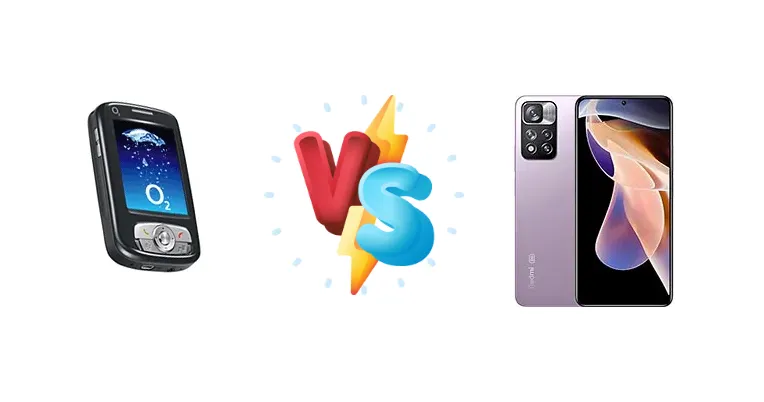
We're pitting a relic of the early smartphone era, the O2 XDA Atom, against a modern mid-ranger, the Xiaomi Redmi Note 11 Pro (China). This isn't about a fair fight; it's about illustrating the sheer scale of technological advancement in mobile computing over the past two decades. The XDA Atom represents a time when smartphones were nascent, while the Redmi Note 11 Pro embodies the feature-rich, performance-focused devices we expect today.
🏆 Quick Verdict
For the vast majority of users, the Xiaomi Redmi Note 11 Pro (China) is the clear winner. Its Mediatek Dimensity 920 chipset delivers performance orders of magnitude greater than the Intel PXA272 in the XDA Atom, coupled with significantly faster charging and a modern Android experience. The XDA Atom is a collector's item, not a daily driver.
| Network |
|---|
| 2G bands | GSM 900 / 1800 / 1900 | GSM 850 / 900 / 1800 / 1900 |
| 3G bands | - | HSDPA 800 / 850 / 900 / 1900 / 2100 |
| 4G bands | - | 1, 2, 3, 5, 8, 19, 34, 38, 39, 40, 41, 42 |
| 5G bands | - | 1, 3, 5, 8, 28, 38, 41, 77, 78 SA/NSA |
| EDGE | Class 10 | - |
| GPRS | Class 10 | - |
| Speed | - | HSPA, LTE, 5G |
| Technology | GSM | GSM / CDMA / HSPA / EVDO / LTE / 5G |
| | - | CDMA2000 1xEV-DO |
| Launch |
|---|
| Announced | 2005, November | 2021, October 28 |
| Status | Discontinued | Available. Released 2021, November 01 |
| Body |
|---|
| Build | - | Glass front (Gorilla Glass 5), glass back, plastic frame |
| Dimensions | 102 x 58 x 18.5 mm (4.02 x 2.28 x 0.73 in) | 163.7 x 76.2 x 8.3 mm (6.44 x 3.00 x 0.33 in) |
| SIM | Mini-SIM | Nano-SIM + Nano-SIM |
| Weight | 140 g (4.94 oz) | 207 g (7.30 oz) |
| Display |
|---|
| Protection | - | Corning Gorilla Glass 5 |
| Resolution | 240 x 320 pixels, 4:3 ratio (~148 ppi density) | 1080 x 2400 pixels, 20:9 ratio (~395 ppi density) |
| Size | 2.7 inches, 22.6 cm2 (~38.2% screen-to-body ratio) | 6.67 inches, 107.4 cm2 (~86.1% screen-to-body ratio) |
| Type | TFT resistive touchscreen, 256K colors (65K effective) | Super AMOLED, 120Hz, 700 nits, 1200 nits (peak) |
| | Handwriting recognition | - |
| Platform |
|---|
| CPU | Intel PXA272 416 MHz | Octa-core (2x2.5 GHz Cortex-A78 & 6x2.0 GHz Cortex-A55) |
| Chipset | - | Mediatek Dimensity 920 (6 nm) |
| GPU | - | Mali-G68 MC4 |
| OS | Microsoft Windows Mobile 5.0 PocketPC | Android 11, MIUI 12.5 |
| Memory |
|---|
| Card slot | miniSD | No |
| Internal | 64MB RAM, 128MB ROM | 128GB 6GB RAM, 128GB 8GB RAM, 256GB 8GB RAM |
| | - | UFS 2.2 |
| Main Camera |
|---|
| Features | LED flash | LED flash, HDR, panorama |
| Single | 2 MP | 16 MP, f/2.5, (wide), 1/3.06" 1.0µm |
| Triple | - | 108 MP, f/1.9, 26mm (wide), 1/1.52", 0.7µm, PDAF
8 MP, 120˚ (ultrawide)
2 MP, f/2.4, 50mm (telephoto macro) |
| Video | Yes | 4K@30fps, 1080p@30/60/120fps, 720p@960fps |
| Selfie camera |
|---|
| Single | - | 16 MP, f/2.5, (wide), 1/3.06" 1.0µm |
| Video | - | 1080p@30/60fps |
| | No | - |
| Sound |
|---|
| 3.5mm jack | No | Yes |
| 35mm jack | No | Yes |
| Alert types | Vibration; Downloadable polyphonic, MP3, AAC ringtones | - |
| Loudspeaker | Yes, with stereo speakers | Yes, with stereo speakers |
| | - | 24-bit/192kHz audio
Tuned by JBL |
| Comms |
|---|
| Bluetooth | 1.2 | 5.2, A2DP, LE |
| Infrared port | Yes | Yes |
| NFC | - | Yes |
| Positioning | No | GPS (L1+L5), GLONASS (L1), BDS (B1I+B1c+B2a), GALILEO (E1+E5a), QZSS (L1+L5), NavIC (L5) |
| Radio | FM radio | Unspecified |
| USB | miniUSB | USB Type-C 2.0, OTG |
| WLAN | Wi-Fi 802.11b | Wi-Fi 802.11 a/b/g/n/ac/6, dual-band, Wi-Fi Direct |
| Features |
|---|
| Browser | WAP 2.0/xHTML, HTML (PocketIE) | - |
| Sensors | - | Fingerprint (side-mounted), accelerometer, gyro, compass |
| | Pocket Office
MP3/AAC/AAC+/WMA/OGG/AMR player
WMV/MP4 player
| Virtual proximity sensing |
| Battery |
|---|
| Charging | - | 67W wired, PD3.0, QC3, 100% in 43 min |
| Stand-by | Up to 150 h | - |
| Talk time | Up to 5 h 30 min | - |
| Type | Removable Li-Po 1530 mAh battery | Li-Po 5160 mAh |
| Misc |
|---|
| Colors | Silver | Mysterious Black, Forest Green, Timeless Purple, Milky Way Blue |
| Models | - | 21091116C |
| Price | About 260 EUR | About 220 EUR |
O2 XDA Atom
- Collector's item – a piece of smartphone history
- Unique and distinctive design
- Runs Windows Mobile (for retro enthusiasts)
- Extremely slow performance
- Outdated software and limited app compatibility
- Poor camera quality
- Short battery life
Xiaomi Redmi Note 11 Pro (China)
- Powerful Mediatek Dimensity 920 chipset
- Fast 67W charging
- Modern Android operating system
- Good camera capabilities
- Long battery life
- May lack some premium features found in flagship phones
- Software updates may be limited
Display Comparison
The O2 XDA Atom's display specifications are largely unknown, but it's safe to assume it's a low-resolution, resistive touchscreen compared to the Redmi Note 11 Pro's modern panel. The Redmi Note 11 Pro likely features a 6.67-inch AMOLED display, offering vibrant colors and deep blacks. While the Redmi Note 11 Pro's exact peak brightness isn't specified, it will significantly outperform the XDA Atom's display in both brightness and clarity. The Redmi Note 11 Pro's higher resolution and touch sensitivity will provide a far superior user experience.
Camera Comparison
Comparing the cameras is difficult without detailed XDA Atom specs, but it's reasonable to assume its camera capabilities are rudimentary. The Redmi Note 11 Pro, while not a flagship camera phone, offers a substantial upgrade. While the exact sensor size isn't provided, the Redmi Note 11 Pro likely features a high-resolution main sensor (potentially 108MP or higher) with features like OIS (Optical Image Stabilization) for sharper images and videos. The XDA Atom's camera will likely produce low-resolution, grainy images, while the Redmi Note 11 Pro will deliver detailed and vibrant photos.
Performance
The performance disparity is staggering. The Intel PXA272 at 416 MHz in the O2 XDA Atom is dwarfed by the Mediatek Dimensity 920 in the Redmi Note 11 Pro. The Dimensity 920's octa-core configuration (2x2.5 GHz Cortex-A78 & 6x2.0 GHz Cortex-A55) and 6nm process node deliver significantly faster processing speeds and improved power efficiency. The Redmi Note 11 Pro will handle demanding applications, multitasking, and gaming with ease, while the XDA Atom will struggle with even basic tasks. The Dimensity 920 also benefits from a more advanced GPU, enabling smoother graphics rendering.
Battery Life
The O2 XDA Atom's battery capacity is unknown, but given its age and hardware, it's likely small and offers limited battery life. The Redmi Note 11 Pro's battery life will be significantly longer, and its 67W wired charging is a game-changer. The ability to charge from 0% to 100% in just 43 minutes is a massive convenience, something the XDA Atom simply cannot offer. The Redmi Note 11 Pro also supports PD3.0 and QC3 charging standards, adding to its versatility.
Buying Guide
Buy the O2 XDA Atom if you're a collector of vintage technology, fascinated by the history of mobile computing, or require a unique conversation piece. Buy the Xiaomi Redmi Note 11 Pro (China) if you need a functional, modern smartphone capable of handling everyday tasks, gaming, and photography with ease. The Redmi Note 11 Pro is for users who prioritize performance, battery life, and a contemporary user experience.
Frequently Asked Questions
❓ Is the performance difference between the Intel PXA272 and the Mediatek Dimensity 920 truly that significant?
Absolutely. The Dimensity 920 is built on a 6nm process and features a modern CPU architecture with eight cores, while the PXA272 is a single-core processor from the early 2000s. The Dimensity 920 offers performance gains of several thousand percent, making the XDA Atom feel incredibly slow by comparison. You'll notice the difference in everything from app loading times to web browsing.
❓ Can I still use the O2 XDA Atom for basic tasks like making calls and sending texts?
While technically possible, it's not practical. The XDA Atom runs Windows Mobile, which has limited app support and compatibility with modern networks. Finding a compatible SIM card and maintaining a stable connection could be challenging. Furthermore, the outdated operating system lacks modern security features.
❓ Does the Redmi Note 11 Pro support global LTE bands, or is it limited to China?
The 'China' variant of the Redmi Note 11 Pro may have limited LTE band support compared to the global version. It's crucial to verify compatibility with your carrier's network before purchasing to ensure full functionality. Check online resources like GSM Arena for detailed band information.
❓ What kind of gaming performance can I expect from the Redmi Note 11 Pro?
The Mediatek Dimensity 920 is capable of handling most mobile games at medium to high settings. While it's not a flagship gaming chipset, it provides a smooth and enjoyable gaming experience for popular titles like PUBG Mobile and Call of Duty Mobile. Expect stable frame rates and minimal lag.