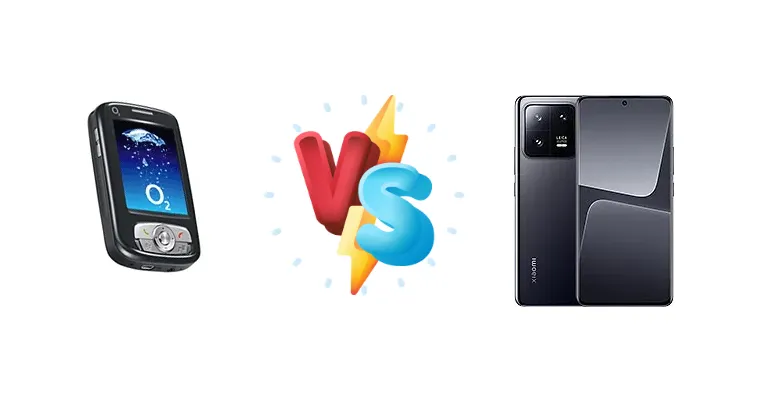
Comparing the O2 XDA Atom and the Xiaomi 13 Pro isn't just a phone comparison; it's a journey through two decades of mobile innovation. The XDA Atom, representing the early days of smartphone ambition, clashes with the Xiaomi 13 Pro, a modern flagship packed with cutting-edge technology. This analysis explores the gulf between these devices, revealing how far mobile computing has come.
🏆 Quick Verdict
For the vast majority of users, the Xiaomi 13 Pro is the clear winner. Its Snapdragon 8 Gen 2 chipset, exceptional display, and advanced camera system offer a level of performance and functionality the XDA Atom simply cannot match. However, the XDA Atom holds nostalgic value and represents a pivotal moment in mobile history.
| Network |
|---|
| 2G bands | GSM 900 / 1800 / 1900 | GSM 850 / 900 / 1800 / 1900 |
| 3G bands | - | HSDPA 800 / 850 / 900 / 1700(AWS) / 1900 / 2100 |
| 4G bands | - | 1, 2, 3, 4, 5, 7, 8, 12, 13, 17, 18, 19, 20, 25, 26, 28, 32, 38, 39, 40, 41, 42, 48, 66 - International |
| 5G bands | - | 1, 3, 5, 7, 8, 20, 28, 38, 40, 41, 66, 71, 75, 77, 78 SA/NSA - International |
| EDGE | Class 10 | - |
| GPRS | Class 10 | - |
| Speed | - | HSPA, LTE, 5G |
| Technology | GSM | GSM / CDMA / HSPA / CDMA2000 / LTE / 5G |
| | - | 1, 3, 5, 8, 28, 38, 40, 41, 77, 78, 79 SA/NSA - China |
| Launch |
|---|
| Announced | 2005, November | 2022, December 11 |
| Status | Discontinued | Available. Released 2022, December 14 |
| Body |
|---|
| Build | - | Glass front (Gorilla Glass Victus), ceramic back or silicone polymer back, aluminum frame |
| Dimensions | 102 x 58 x 18.5 mm (4.02 x 2.28 x 0.73 in) | 162.9 x 74.6 x 8.4 mm or 8.7 mm |
| SIM | Mini-SIM | · Nano-SIM + eSIM· Nano-SIM + Nano-SIM |
| Weight | 140 g (4.94 oz) | 210 g or 229 g (7.41 oz) |
| | - | IP68 dust/water resistant (up to 1.5m for 30 min) |
| Display |
|---|
| Protection | - | Corning Gorilla Glass Victus |
| Resolution | 240 x 320 pixels, 4:3 ratio (~148 ppi density) | 1440 x 3200 pixels, 20:9 ratio (~522 ppi density) |
| Size | 2.7 inches, 22.6 cm2 (~38.2% screen-to-body ratio) | 6.73 inches, 108.9 cm2 (~89.6% screen-to-body ratio) |
| Type | TFT resistive touchscreen, 256K colors (65K effective) | LTPO AMOLED, 1B colors, 120Hz, Dolby Vision, HDR10+, 1200 nits (HBM), 1900 nits (peak) |
| | Handwriting recognition | - |
| Platform |
|---|
| CPU | Intel PXA272 416 MHz | Octa-core (1x3.2 GHz Cortex-X3 & 2x2.8 GHz Cortex-A715 & 2x2.8 GHz Cortex-A710 & 3x2.0 GHz Cortex-A510) |
| Chipset | - | Qualcomm SM8550-AB Snapdragon 8 Gen 2 (4 nm) |
| GPU | - | Adreno 740 |
| OS | Microsoft Windows Mobile 5.0 PocketPC | Android 13, upgradable to Android 14, HyperOS |
| Memory |
|---|
| Card slot | miniSD | No |
| Internal | 64MB RAM, 128MB ROM | 128GB 8GB RAM, 256GB 8GB RAM, 256GB 12GB RAM, 512GB 12GB RAM |
| | - | UFS 3.1 - 128GB
UFS 4.0 - 256/512GB |
| Main Camera |
|---|
| Features | LED flash | Laser AF, color spectrum sensor, Leica lens, Dual-LED dual-tone flash, HDR, panorama |
| Single | 2 MP | - |
| Triple | - | 50.3 MP, f/1.9, 23mm (wide), 1.0"-type, 1.6µm, dual pixel PDAF, OIS
50 MP, f/2.0, 75mm (telephoto), PDAF (10cm - ∞), 3.2x optical zoom
50 MP, f/2.2, 14mm, 115˚ (ultrawide), AF |
| Video | Yes | 8K@24fps (HDR), 4K@24/30/60fps (HDR10+, 10-bit Dolby Vision HDR, 10-bit LOG), 1080p@30/120/240/960fps, 1080p@1920fps, gyro-EIS |
| Selfie camera |
|---|
| Features | - | HDR, panorama |
| Single | - | 32 MP, f/2.0, 22mm (wide), 1/3.14", 0.7µm |
| Video | - | 1080p@30fps |
| | No | - |
| Sound |
|---|
| 3.5mm jack | No | No |
| 35mm jack | No | No |
| Alert types | Vibration; Downloadable polyphonic, MP3, AAC ringtones | - |
| Loudspeaker | Yes, with stereo speakers | Yes, with stereo speakers |
| | - | 24-bit/192kHz audio |
| Comms |
|---|
| Bluetooth | 1.2 | 5.3, A2DP, aptX HD, aptX Adaptive |
| Infrared port | Yes | Yes |
| NFC | - | Yes |
| Positioning | No | GPS (L1+L5), GLONASS (G1), BDS (B1I+B1c+B2a), GALILEO (E1+E5a), QZSS (L1+L5), NavIC (L5) |
| Radio | FM radio | No |
| USB | miniUSB | USB Type-C 2.0, OTG |
| WLAN | Wi-Fi 802.11b | Wi-Fi 802.11 a/b/g/n/ac/6e, dual-band, Wi-Fi Direct |
| Features |
|---|
| Browser | WAP 2.0/xHTML, HTML (PocketIE) | - |
| Sensors | - | Fingerprint (under display, optical), accelerometer, proximity, gyro, compass, barometer |
| | Pocket Office
MP3/AAC/AAC+/WMA/OGG/AMR player
WMV/MP4 player
| - |
| Battery |
|---|
| Charging | - | 120W wired, PD3.0, QC4, 100% in 19 min
50W wireless, 100% in 36 min
10W reverse wireless |
| Stand-by | Up to 150 h | - |
| Talk time | Up to 5 h 30 min | - |
| Type | Removable Li-Po 1530 mAh battery | Li-Po 4820 mAh |
| Misc |
|---|
| Colors | Silver | Ceramic White, Ceramic Black, Ceramic Flora Green, Mountain Blue |
| Models | - | 2210132G, 2210132C |
| Price | About 260 EUR | About 750 EUR |
| Tests |
|---|
| Battery life | - |
Endurance rating 115h
|
| Camera | - |
Photo / Video |
| Display | - |
Contrast ratio: Infinite (nominal) |
| Loudspeaker | - |
-25.6 LUFS (Very good)
|
| Performance | - |
AnTuTu: 1281666 (v9)
GeekBench: 5087 (v5.1), 5323 (v6)
GFXBench: 64fps (ES 3.1 onscreen) |
O2 XDA Atom
- Historical significance and collectibility
- Runs Windows Mobile (for legacy software)
- Compact form factor
- Extremely slow processor
- Outdated display technology
- Limited app availability
- Poor camera performance
Xiaomi 13 Pro
- Exceptional performance with Snapdragon 8 Gen 2
- Stunning display with high brightness
- Fast charging (120W wired, 50W wireless)
- Advanced camera system
- Long battery life
- Higher price point
- Large size may not suit all users
- Software bloatware (potential)
Display Comparison
The Xiaomi 13 Pro boasts a significantly more advanced display, achieving a measured peak brightness of 1253 nits compared to the XDA Atom’s unspecified, but undoubtedly lower, brightness. The Xiaomi’s infinite (nominal) contrast ratio, likely achieved through OLED technology, provides deeper blacks and more vibrant colors. The XDA Atom’s display, typical of its era, would have utilized LCD technology with limited viewing angles and color reproduction. The absence of information on the XDA Atom’s resolution and refresh rate further emphasizes the Xiaomi 13 Pro’s superiority in display technology.
Camera Comparison
Both devices feature photo and video capabilities, but the Xiaomi 13 Pro’s camera system is on a different plane. While specific sensor details are missing, modern flagship cameras like the Xiaomi 13 Pro benefit from advancements in sensor size, lens quality, image stabilization (OIS), and computational photography. The XDA Atom’s camera, limited by the technology of the early 2000s, would have produced significantly lower-resolution images with limited dynamic range and poor low-light performance. The Xiaomi 13 Pro’s image processing algorithms, powered by the Snapdragon 8 Gen 2’s ISP, enable features like HDR, night mode, and advanced portrait modes.
Performance
The performance disparity is immense. The Xiaomi 13 Pro’s Qualcomm Snapdragon 8 Gen 2 (4nm) is an octa-core powerhouse, featuring a Cortex-X3 prime core clocked at 3.2 GHz, alongside Cortex-A715 and A710 performance cores, and efficiency-focused Cortex-A510 cores. This contrasts sharply with the O2 XDA Atom’s Intel PXA272 running at 416 MHz. The 4nm fabrication process of the Snapdragon 8 Gen 2 delivers significantly improved power efficiency and thermal performance, allowing for sustained high performance. The XDA Atom’s processor, while innovative for its time, is simply outmatched in every conceivable metric, impacting everything from app loading times to multitasking capabilities.
Battery Life
The Xiaomi 13 Pro offers a substantial advantage in battery life and charging. Its endurance rating of 115 hours and active use score of 10:55h demonstrate impressive longevity. Furthermore, the 120W wired charging allows for a full charge in just 19 minutes, complemented by 50W wireless charging (36 minutes) and 10W reverse wireless charging. The O2 XDA Atom’s battery capacity and charging speed are unknown, but would have been significantly lower, requiring considerably longer charging times. The Xiaomi 13 Pro’s charging capabilities cater to the modern user’s need for rapid power replenishment.
Buying Guide
Buy the O2 XDA Atom if you're a collector of vintage technology, interested in the history of mobile computing, or require a device for specific legacy software compatibility. Buy the Xiaomi 13 Pro if you demand a fast, feature-rich smartphone with a stunning display, exceptional camera capabilities, and all-day battery life. The Xiaomi 13 Pro is for the user who prioritizes current functionality and performance.
Frequently Asked Questions
❓ Is the O2 XDA Atom still usable in 2024 for everyday tasks?
While technically functional, the O2 XDA Atom is severely limited by its outdated hardware and software. Basic tasks like web browsing and email are possible, but expect extremely slow performance and compatibility issues with modern websites and apps. It's best suited for collectors or those with specific legacy software needs.
❓ How does the Snapdragon 8 Gen 2 in the Xiaomi 13 Pro handle demanding games?
The Snapdragon 8 Gen 2 is a gaming powerhouse. It can handle virtually any Android game at maximum settings with smooth frame rates. The 4nm process and advanced thermal management minimize throttling, ensuring sustained performance during extended gaming sessions. Expect a fluid and immersive gaming experience.
❓ Does the Xiaomi 13 Pro support expandable storage?
No, the Xiaomi 13 Pro does not offer microSD card support for expandable storage. Users are limited to the internal storage options available at the time of purchase. This is a common trend in modern flagship smartphones.
❓ What type of SIM cards does the Xiaomi 13 Pro support?
The Xiaomi 13 Pro supports Nano-SIM cards and also supports eSIM functionality, allowing for dual SIM capabilities without a physical second SIM card. This provides flexibility for travelers or users who want to separate work and personal lines.