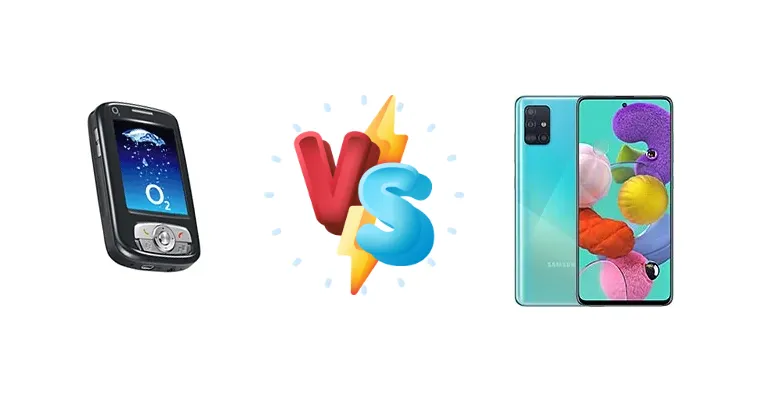
Comparing the O2 XDA Atom and the Samsung Galaxy A51 is a study in contrasts – a relic of early smartphone technology against a mainstream mid-ranger from 2020. This isn't about crowning a 'better' phone in a vacuum, but understanding where each device stands in today's landscape, particularly for users seeking a basic, affordable mobile experience or exploring vintage tech.
🏆 Quick Verdict
For the vast majority of users, the Samsung Galaxy A51 is the clear winner. Its significantly more powerful Exynos 9611 chipset, bright 636 nit display, and 86-hour endurance rating offer a modern smartphone experience the XDA Atom simply cannot match. However, the XDA Atom holds niche appeal for collectors or those seeking a minimalist, distraction-free device.
| Network |
|---|
| 2G bands | GSM 900 / 1800 / 1900 | GSM 850 / 900 / 1800 / 1900 |
| 3G bands | - | HSDPA 850 / 900 / 1900 / 2100 |
| 4G bands | - | 1, 2, 3, 4, 5, 7, 8, 12, 13, 17, 20, 26, 28, 38, 40, 41, 66 |
| EDGE | Class 10 | - |
| GPRS | Class 10 | - |
| Speed | - | HSPA, LTE |
| Technology | GSM | GSM / HSPA / LTE |
| | - | 2, 4, 5, 12, 13, 25, 26, 41, 66, 71 - SM-A515U |
| Launch |
|---|
| Announced | 2005, November | 2019, December 12. Released 2019, December 16 |
| Status | Discontinued | Discontinued |
| Body |
|---|
| Build | - | Glass front (Gorilla Glass 3), plastic back, plastic frame |
| Dimensions | 102 x 58 x 18.5 mm (4.02 x 2.28 x 0.73 in) | 158.5 x 73.6 x 7.9 mm (6.24 x 2.90 x 0.31 in) |
| SIM | Mini-SIM | · Nano-SIM· Nano-SIM + Nano-SIM |
| Weight | 140 g (4.94 oz) | 172 g (6.07 oz) |
| Display |
|---|
| Protection | - | Corning Gorilla Glass 3 |
| Resolution | 240 x 320 pixels, 4:3 ratio (~148 ppi density) | 1080 x 2400 pixels, 20:9 ratio (~405 ppi density) |
| Size | 2.7 inches, 22.6 cm2 (~38.2% screen-to-body ratio) | 6.5 inches, 102.0 cm2 (~87.4% screen-to-body ratio) |
| Type | TFT resistive touchscreen, 256K colors (65K effective) | Super AMOLED |
| | Handwriting recognition | - |
| Platform |
|---|
| CPU | Intel PXA272 416 MHz | Octa-core (4x2.3 GHz Cortex-A73 & 4x1.7 GHz Cortex-A53) |
| Chipset | - | Exynos 9611 (10 nm) |
| GPU | - | Mali-G72 MP3 |
| OS | Microsoft Windows Mobile 5.0 PocketPC | Android 10, upgradable to Android 13, One UI 5 |
| Memory |
|---|
| Card slot | miniSD | microSDXC (dedicated slot) |
| Internal | 64MB RAM, 128MB ROM | 64GB 4GB RAM, 64GB 6GB RAM, 128GB 4GB RAM, 128GB 6GB RAM, 128GB 8GB RAM, 256GB 6GB RAM, 256GB 8GB RAM |
| | - | UFS 2.0 |
| Main Camera |
|---|
| Features | LED flash | LED flash, panorama, HDR |
| Quad | - | 48 MP, f/2.0, 26mm (wide), 1/2.0", 0.8µm, PDAF
12 MP, f/2.2, 123˚ (ultrawide)
5 MP (macro)
Auxiliary lens |
| Single | 2 MP | - |
| Video | Yes | 4K@30fps, 1080p@30/120fps; gyro-EIS |
| Selfie camera |
|---|
| Features | - | HDR |
| Single | - | 32 MP, f/2.2, 26mm (wide), 1/2.8", 0.8µm |
| Video | - | 4K@30fps, 1080p@30fps |
| | No | - |
| Sound |
|---|
| 3.5mm jack | No | Yes |
| 35mm jack | No | Yes |
| Alert types | Vibration; Downloadable polyphonic, MP3, AAC ringtones | - |
| Loudspeaker | Yes, with stereo speakers | Yes |
| Comms |
|---|
| Bluetooth | 1.2 | 5.0, A2DP, LE |
| Infrared port | Yes | - |
| NFC | - | Yes |
| Positioning | No | GPS, GLONASS, GALILEO, BDS |
| Radio | FM radio | FM radio |
| USB | miniUSB | USB Type-C 2.0, OTG |
| WLAN | Wi-Fi 802.11b | Wi-Fi 802.11 a/b/g/n/ac, dual-band, Wi-Fi Direct |
| Features |
|---|
| Browser | WAP 2.0/xHTML, HTML (PocketIE) | - |
| Sensors | - | Fingerprint (under display, optical), accelerometer, gyro, compass |
| | Pocket Office
MP3/AAC/AAC+/WMA/OGG/AMR player
WMV/MP4 player
| Virtual proximity sensing
ANT+ |
| Battery |
|---|
| Charging | - | 15W wired |
| Stand-by | Up to 150 h | - |
| Talk time | Up to 5 h 30 min | - |
| Type | Removable Li-Po 1530 mAh battery | Li-Po 4000 mAh, non-removable |
| Misc |
|---|
| Colors | Silver | Prism Crush Black, Prism Crush White, Prism Crush Blue, Prism Crush Pink |
| Models | - | SM-A515F, SM-A515F/DSN, SM-A515F/DS, SM-A515F/DST, SM-A515F/DSM, SM-A515F/N, SM-A515U, SM-A515U1, SM-A515W, SM-A515X, SM-S515DL |
| Price | About 260 EUR | About 100 EUR |
| SAR | - | 0.80 W/kg (head) 0.67 W/kg (body) |
| SAR EU | - | 0.37 W/kg (head) 1.59 W/kg (body) |
| Pricing |
|---|
| 128GB 4GB RAM | - | $ 299.99 |
| 128GB 6GB RAM | - | $ 674.99 |
| 64GB 4GB RAM | - | $ 211.50 |
| RENEWED | - | £ 179.00 |
| Tests |
|---|
| Audio quality | - |
Noise -93.1dB / Crosstalk -87.3dB |
| Battery life | - |
Endurance rating 86h
|
| Camera | - |
Photo / Video |
| Display | - |
Contrast ratio: Infinite (nominal) |
| Loudspeaker | - |
-28.6 LUFS (Average)
|
| Performance | - |
AnTuTu: 113051 (v7), 175363 (v8)
GeekBench: 5401 (v4.4), 1294 (v5.1)
GFXBench: 5.6fps (ES 3.1 onscreen) |
O2 XDA Atom
- Extremely lightweight and compact
- Collector's item/novelty factor
- Simple, distraction-free interface
- Severely outdated performance
- Poor display quality
- Limited battery life
- Incompatible with modern apps
Samsung Galaxy A51
- Bright and vibrant display
- Powerful Exynos 9611 processor
- Long battery life (86h endurance)
- Modern smartphone features
- 15W charging is relatively slow
- Software support is ending
- Price varies significantly by configuration
Display Comparison
The Samsung Galaxy A51 boasts a significantly more advanced display, achieving a measured peak brightness of 636 nits. This is crucial for outdoor visibility, something the XDA Atom, lacking detailed display specifications, would struggle with. While the A51’s contrast ratio is listed as 'Infinite (nominal)', this indicates a typical AMOLED panel, offering deep blacks and vibrant colors. The XDA Atom’s display, by 2002 standards, would have been a small, low-resolution LCD, severely limiting its usability in bright conditions and offering a far less immersive viewing experience.
Camera Comparison
Both devices offer photo and video capabilities, but the comparison ends there. The Galaxy A51, while not a camera champion, benefits from modern image processing and likely a multi-lens setup (details not provided in the context data). The XDA Atom’s camera would have been a low-resolution sensor, suitable for basic snapshots but lacking the dynamic range, detail, and low-light performance of the A51. The A51’s camera system, even with its limitations, allows for social media sharing and casual photography, while the XDA Atom’s output would be largely unusable by today’s standards.
Performance
The performance gap is immense. The Intel PXA272 at 416 MHz in the XDA Atom is dwarfed by the Samsung Galaxy A51’s Exynos 9611. The Exynos 9611, built on a 10nm process, features an octa-core configuration (4x2.3 GHz Cortex-A73 & 4x1.7 GHz Cortex-A53) designed for efficient multitasking and moderate gaming. The XDA Atom’s processor was adequate for its time, handling basic PIM functions and calls, but would be overwhelmed by modern apps and web browsing. The A51’s 4GB or 6GB of RAM (depending on the configuration) further enhances its multitasking capabilities, a feature entirely absent in the XDA Atom’s limited memory.
Battery Life
The Samsung Galaxy A51’s 86-hour endurance rating is a significant advantage. This suggests efficient power management and a reasonably sized battery. While the exact mAh capacity isn’t specified, 86 hours indicates all-day usability for typical users. The XDA Atom, with its older battery technology and limited capacity, would offer significantly shorter battery life, likely requiring daily charging even with minimal use. The A51’s 15W wired charging is also a modern convenience the XDA Atom lacks.
Buying Guide
Buy the O2 XDA Atom if you need a truly basic, lightweight device for calls and texts, and are fascinated by early smartphone history. It's a collector's item or a 'dumbphone' alternative. Buy the Samsung Galaxy A51 if you prefer a functional, modern smartphone with a decent camera, reliable battery life, and access to contemporary apps – even if it's no longer the latest model.
Frequently Asked Questions
❓ Does the Exynos 9611 in the Galaxy A51 overheat during prolonged use, like gaming?
The Exynos 9611 is known to exhibit some thermal throttling under sustained heavy load, such as extended gaming sessions. While it won't shut down, performance may decrease slightly to manage heat. This is typical for mid-range chipsets and isn't a deal-breaker for casual gaming.
❓ Is the 2MP macro camera on the Galaxy A51 actually useful for taking detailed close-up photos?
The 2MP macro camera on the Galaxy A51 is largely a marketing feature. Its low resolution results in images lacking detail and sharpness. It's usable for casual close-ups in good lighting, but don't expect professional-quality results. The main sensor is far more capable.
❓ Can the Galaxy A51 still run popular games like PUBG Mobile at acceptable frame rates?
The Galaxy A51 can run PUBG Mobile, but performance will vary depending on the graphics settings. Expect to play at medium settings for a smoother experience. High settings may result in frame drops and lag. It won't deliver the same performance as flagship devices, but it's playable.
❓ What kind of connectivity does the O2 XDA Atom offer compared to the Galaxy A51?
The O2 XDA Atom is limited to 2G connectivity and older data standards. The Galaxy A51 supports 4G LTE, offering significantly faster data speeds and broader network compatibility. The XDA Atom also lacks modern connectivity features like Wi-Fi 6 or Bluetooth 5.0.