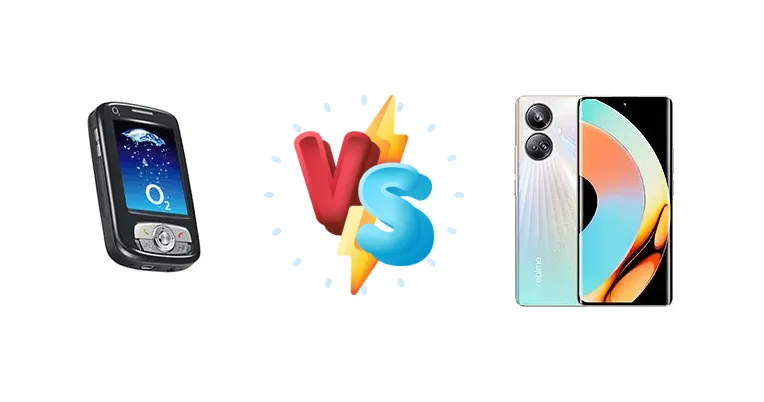
The O2 XDA Atom represents a bygone era of Windows Mobile, while the Realme 10 Pro+ embodies modern Android smartphone capabilities. This comparison isn't about a direct contest of specs; it's about understanding the vast technological gulf between these devices and identifying who each phone serves best in today's market.
🏆 Quick Verdict
For the vast majority of users, the Realme 10 Pro+ is the clear winner. Its modern chipset, fast charging, and significantly improved display offer a user experience the O2 XDA Atom simply cannot match. However, the Atom holds niche appeal for collectors and those seeking a retro experience.
| Network |
|---|
| 2G bands | GSM 900 / 1800 / 1900 | GSM 850 / 900 / 1800 / 1900 - SIM 1 & SIM 2 |
| 3G bands | - | HSDPA 850 / 900 / 1700(AWS) / 1900 / 2100 |
| 4G bands | - | 1, 3, 5, 7, 8, 19, 28, 34, 38, 39, 40, 41 |
| 5G bands | - | 1, 3, 5, 8, 28, 40, 41, 77, 78 SA/NSA |
| EDGE | Class 10 | - |
| GPRS | Class 10 | - |
| Speed | - | HSPA, LTE-A, 5G |
| Technology | GSM | GSM / CDMA / HSPA / CDMA2000 / LTE / 5G |
| | - | CDMA2000 1x |
| Launch |
|---|
| Announced | 2005, November | 2022, November 17 |
| Status | Discontinued | Available. Released 2022, November 24 |
| Body |
|---|
| Build | - | Glass front, plastic frame, plastic back |
| Dimensions | 102 x 58 x 18.5 mm (4.02 x 2.28 x 0.73 in) | 161.5 x 73.9 x 7.8 mm or 8 mm |
| SIM | Mini-SIM | Dual SIM (Nano-SIM, dual stand-by) |
| Weight | 140 g (4.94 oz) | 173 g / 175 g (6.10 oz) |
| Display |
|---|
| Resolution | 240 x 320 pixels, 4:3 ratio (~148 ppi density) | 1080 x 2412 pixels, 20:9 ratio (~394 ppi density) |
| Size | 2.7 inches, 22.6 cm2 (~38.2% screen-to-body ratio) | 6.7 inches, 108.0 cm2 (~90.5% screen-to-body ratio) |
| Type | TFT resistive touchscreen, 256K colors (65K effective) | AMOLED, 1B colors, HDR10+, 120Hz, 800 nits |
| | Handwriting recognition | - |
| Platform |
|---|
| CPU | Intel PXA272 416 MHz | Octa-core (2x2.6 GHz Cortex-A78 & 6x2.0 GHz Cortex-A55) |
| Chipset | - | Mediatek MT6877V Dimensity 1080 (6 nm) |
| GPU | - | Mali-G68 MC4 |
| OS | Microsoft Windows Mobile 5.0 PocketPC | Android 13, Realme UI 4.0 |
| Memory |
|---|
| Card slot | miniSD | No |
| Internal | 64MB RAM, 128MB ROM | 128GB 6GB RAM, 128GB 8GB RAM, 256GB 8GB RAM, 256GB 12GB RAM |
| Main Camera |
|---|
| Features | LED flash | LED flash, HDR, panorama |
| Single | 2 MP | 16 MP, f/2.5, 25mm (wide) |
| Triple | - | 108 MP, f/1.8, 24mm (wide), 1/1.67", 0.64µm, PDAF
8 MP, f/2.2, 16mm, 112˚ (ultrawide)
2 MP, f/2.4, (macro) |
| Video | Yes | 4K@30fps, 1080p@30/60/120/480fps, 720p@960fps, gyro-EIS |
| Selfie camera |
|---|
| Features | - | Panorama |
| Single | - | 16 MP, f/2.5, 25mm (wide) |
| Video | - | 1080p@30fps |
| | No | - |
| Sound |
|---|
| 3.5mm jack | No | No |
| 35mm jack | No | - |
| Alert types | Vibration; Downloadable polyphonic, MP3, AAC ringtones | - |
| Loudspeaker | Yes, with stereo speakers | Yes, with stereo speakers |
| | - | 24-bit/192kHz audio |
| Comms |
|---|
| Bluetooth | 1.2 | 5.2, A2DP, LE, aptX HD |
| Infrared port | Yes | - |
| NFC | - | Yes (market/region dependent) |
| Positioning | No | GPS (L1+L5), GALILEO, GLONASS, BDS, QZSS |
| Radio | FM radio | No |
| USB | miniUSB | USB Type-C 2.0 |
| WLAN | Wi-Fi 802.11b | Wi-Fi 802.11 a/b/g/n/ac/6, dual-band |
| Features |
|---|
| Browser | WAP 2.0/xHTML, HTML (PocketIE) | - |
| Sensors | - | Fingerprint (under display, optical), accelerometer, gyro, proximity, compass |
| | Pocket Office
MP3/AAC/AAC+/WMA/OGG/AMR player
WMV/MP4 player
| - |
| Battery |
|---|
| Charging | - | 67W wired, PD3.0, 50% in 17 min (advertised) |
| Stand-by | Up to 150 h | - |
| Talk time | Up to 5 h 30 min | - |
| Type | Removable Li-Po 1530 mAh battery | Li-Po 5000 mAh, non-removable |
| Misc |
|---|
| Colors | Silver | Dark Matter Black, Nebula Blue, Hyperspace |
| Models | - | RMX3687, RMX3686 |
| Price | About 260 EUR | $ 269.00 / ₹ 22,999 |
| Tests |
|---|
| Battery life | - |
Endurance rating 149h
|
| Camera | - |
Photo / Video |
| Display | - |
Contrast ratio: Infinite (nominal) |
| Loudspeaker | - |
-25.4 LUFS (Very good)
|
| Performance | - |
AnTuTu: 522376 (v9)
GeekBench: 2371 (v5.1)
GFXBench: 23fps (ES 3.1 onscreen) |
O2 XDA Atom
- Nostalgic appeal for retro tech enthusiasts
- Unique Windows Mobile experience
- Compact form factor (likely)
- Extremely outdated processor
- Poor performance with modern apps
- Low-resolution display
- Limited battery life
Realme 10 Pro+
- Powerful MediaTek Dimensity 1080 chipset
- Fast 67W charging
- Long battery life (149h endurance)
- Modern Android operating system
- High-quality display (likely AMOLED)
- May lack expandable storage
- Software bloatware (typical of Realme)
Display Comparison
The Realme 10 Pro+ boasts a modern display with an 'Infinite' (nominal) contrast ratio, suggesting a high-quality AMOLED panel. This contrasts sharply with the likely smaller, lower-resolution LCD found on the O2 XDA Atom. While specific nit brightness isn't provided for the Realme, modern AMOLEDs typically offer significantly higher brightness and better outdoor visibility. The Atom's display, limited by its age, will likely struggle in direct sunlight. The Realme's display technology also benefits from features like higher refresh rates (likely 120Hz, though not specified) for smoother scrolling, a feature absent on the Atom.
Camera Comparison
The Realme 10 Pro+ features a camera system designed for modern photography, though specific sensor details are missing. The Atom's camera, while functional for its time, will be limited in resolution and image quality. The Realme likely includes features like image stabilization (OIS) and advanced image processing algorithms, resulting in sharper, more vibrant photos and videos. The Atom's camera will likely be limited to basic photo and video capture with minimal editing capabilities. The Realme's camera system is geared towards social media sharing and everyday photography, while the Atom's is a relic of a simpler time.
Performance
The performance disparity is immense. The O2 XDA Atom's Intel PXA272 at 416 MHz is dwarfed by the Realme 10 Pro+'s MediaTek Dimensity 1080 (6 nm) with its octa-core configuration (2x2.6 GHz Cortex-A78 & 6x2.0 GHz Cortex-A55). The Dimensity 1080's 6nm process node provides superior power efficiency and thermal management compared to the Atom's older architecture. This translates to significantly faster app loading times, smoother multitasking, and the ability to handle demanding applications and games on the Realme. The Atom will struggle with even basic modern tasks.
Battery Life
The Realme 10 Pro+ offers a substantial advantage in battery life and charging. Its 67W wired charging, with a claimed 50% charge in 17 minutes (using PD3.0), is light years ahead of the Atom's charging capabilities. The Atom's battery life, while potentially adequate for its limited functionality, will be significantly shorter than the Realme's 149-hour endurance rating. The Realme's fast charging allows for quick top-ups, minimizing downtime, while the Atom will require significantly longer charging times.
Buying Guide
Buy the O2 XDA Atom if you're a collector of vintage technology, enjoy the Windows Mobile operating system, or require a device for specific legacy applications. Buy the Realme 10 Pro+ if you prioritize performance, battery life, a vibrant display, and modern smartphone features like fast charging and a capable camera system. The Realme is for daily use; the Atom is for enthusiasts.
Frequently Asked Questions
❓ Is the O2 XDA Atom compatible with modern mobile networks (4G/5G)?
No. The O2 XDA Atom predates 4G and 5G technology. It is limited to 2G and 3G connectivity, which may be unavailable or unreliable in many regions. It's primarily a device for historical use, not modern communication.
❓ Can I install Android on the O2 XDA Atom?
While technically possible through custom ROM development, installing Android on the O2 XDA Atom is extremely challenging and requires significant technical expertise. The hardware is not optimized for Android, and performance would likely be very poor. It's not a practical upgrade path.
❓ Does the Realme 10 Pro+ support expandable storage via microSD card?
Based on typical Realme 10 series configurations, the 10 Pro+ likely *does not* support microSD card expansion. Users should carefully consider their storage needs when purchasing, as internal storage is the only option.
❓ What type of charger does the Realme 10 Pro+ include in the box?
The Realme 10 Pro+ includes a 67W SuperVOOC charger in the box, allowing you to take full advantage of its fast charging capabilities. This is a proprietary charging standard, so using a different charger may result in slower charging speeds.