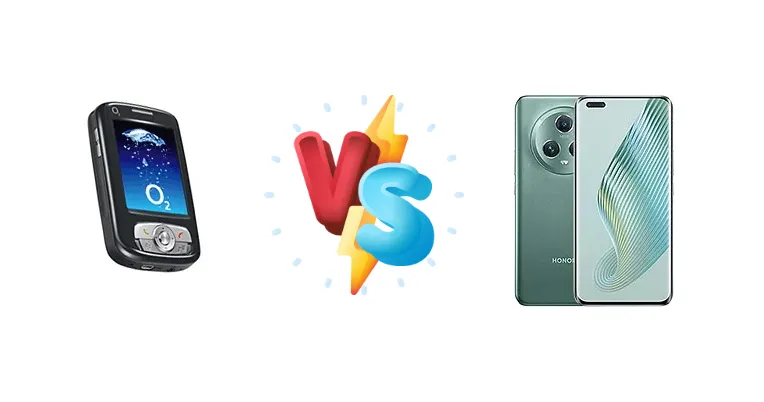
Comparing the O2 XDA Atom and the Honor Magic5 Pro isn't just a phone comparison; it's a look at two decades of mobile innovation. The XDA Atom, representing the early Windows Mobile era, showcases the foundational steps of smartphone development, while the Magic5 Pro embodies the pinnacle of modern Android technology. This comparison will highlight the dramatic shifts in processing power, display technology, and overall user experience.
🏆 Quick Verdict
For the vast majority of users, the Honor Magic5 Pro is the clear winner. Its Snapdragon 8 Gen 2 chipset, exceptional battery life (12:06h active use), and bright 1227 nit display offer a performance and feature set unimaginable on the O2 XDA Atom. The Atom serves primarily as a historical artifact.
| Network |
|---|
| 2G bands | GSM 900 / 1800 / 1900 | GSM 850 / 900 / 1800 / 1900 |
| 3G bands | - | HSDPA 800 / 850 / 900 / 1700(AWS) / 1900 / 2100 |
| 4G bands | - | 1, 2, 3, 4, 5, 7, 8, 12, 17, 18, 19, 20, 26, 28, 34, 38, 39, 40, 41 - China |
| 5G bands | - | 1, 3, 5, 8, 28, 38, 41, 77, 78, 79 SA/NSA - China |
| EDGE | Class 10 | - |
| GPRS | Class 10 | - |
| Speed | - | HSPA, LTE, 5G |
| Technology | GSM | GSM / CDMA / HSPA / EVDO / LTE / 5G |
| | - | CDMA2000 1xEV-DO |
| Launch |
|---|
| Announced | 2005, November | 2023, February 27 |
| Status | Discontinued | Available. Released 2023, March 31 |
| Body |
|---|
| Build | - | Glass front, glass back or eco leather back |
| Dimensions | 102 x 58 x 18.5 mm (4.02 x 2.28 x 0.73 in) | 162.9 x 76.7 x 8.8 mm (6.41 x 3.02 x 0.35 in) |
| SIM | Mini-SIM | · Nano-SIM + eSIM· Nano-SIM + Nano-SIM + eSIM (max 2 at a time) |
| Weight | 140 g (4.94 oz) | 219 g (7.72 oz) |
| | - | IP68 dust/water resistant (up to 1.5m for 30 min) |
| Display |
|---|
| Resolution | 240 x 320 pixels, 4:3 ratio (~148 ppi density) | 1312 x 2848 pixels, 19.5:9 ratio (~460 ppi density) |
| Size | 2.7 inches, 22.6 cm2 (~38.2% screen-to-body ratio) | 6.81 inches, 113.7 cm2 (~91.0% screen-to-body ratio) |
| Type | TFT resistive touchscreen, 256K colors (65K effective) | LTPO OLED, 1B colors, 120Hz, HDR10+, 1800 nits (peak) |
| | Handwriting recognition | - |
| Platform |
|---|
| CPU | Intel PXA272 416 MHz | Octa-core (1x3.2 GHz Cortex-X3 & 2x2.8 GHz Cortex-A715 & 2x2.8 GHz Cortex-A710 & 3x2.0 GHz Cortex-A510) |
| Chipset | - | Qualcomm SM8550-AB Snapdragon 8 Gen 2 (4 nm) |
| GPU | - | Adreno 740 |
| OS | Microsoft Windows Mobile 5.0 PocketPC | Android 13, upgradable to Android 14, MagicOS 8 |
| Memory |
|---|
| Card slot | miniSD | No |
| Internal | 64MB RAM, 128MB ROM | 256GB 8GB RAM, 256GB 12GB RAM, 512GB 12GB RAM, 512GB 16GB RAM |
| | - | UFS 4.0 |
| Main Camera |
|---|
| Features | LED flash | Laser AF, color spectrum sensor, LED flash, HDR, panorama |
| Single | 2 MP | 12 MP, f/2.4, 100˚ (ultrawide), 1.22µm
TOF 3D, (depth/biometrics sensor) |
| Triple | - | 50 MP, f/1.6, 23mm (wide), 1/1.12" 1.4µm, multi-directional PDAF, OIS
50 MP, f/3.0, 90mm (periscope telephoto), PDAF, OIS, 3.5x optical zoom
50 MP, f/2.0, 13mm, 122˚ (ultrawide), 1/2.76", AF
TOF 3D (depth) |
| Video | Yes | 4K@30/60fps, 1080p@30/60fps, gyro-EIS, HDR10, 10-bit video |
| Selfie camera |
|---|
| Features | - | HDR |
| Single | - | 12 MP, f/2.4, 100˚ (ultrawide), 1.22µm
TOF 3D, (depth/biometrics sensor) |
| Video | - | 4K@30fps, 1080p@30/60fps |
| | No | - |
| Sound |
|---|
| 3.5mm jack | No | No |
| 35mm jack | No | No |
| Alert types | Vibration; Downloadable polyphonic, MP3, AAC ringtones | - |
| Loudspeaker | Yes, with stereo speakers | Yes, with stereo speakers |
| | - | 24-bit audio stereo recording |
| Comms |
|---|
| Bluetooth | 1.2 | 5.2, A2DP, LE, aptX HD |
| Infrared port | Yes | Yes |
| NFC | - | Yes |
| Positioning | No | GPS (L1+L5), GLONASS (L1), BDS (B1I+B1c+B2a), GALILEO (E1+E5a) |
| Radio | FM radio | No |
| USB | miniUSB | USB Type-C 3.1, DisplayPort 1.2, OTG |
| WLAN | Wi-Fi 802.11b | Wi-Fi 802.11 a/b/g/n/ac/6, dual-band, Wi-Fi Direct |
| Features |
|---|
| Browser | WAP 2.0/xHTML, HTML (PocketIE) | - |
| Sensors | - | Fingerprint (under display, optical), Face ID, accelerometer, gyro, proximity, compass |
| | Pocket Office
MP3/AAC/AAC+/WMA/OGG/AMR player
WMV/MP4 player
| - |
| Battery |
|---|
| Charging | - | 66W wired
50W wireless
Reverse wireless
5W reverse wired |
| Stand-by | Up to 150 h | - |
| Talk time | Up to 5 h 30 min | - |
| Type | Removable Li-Po 1530 mAh battery | Market-dependent versions:· Li-Po 5100 mAh (Global)· Si/C Li-Ion 5450 mAh (China only) |
| Misc |
|---|
| Colors | Silver | Black, Meadow Green, Blue, Purple, Orange |
| Models | - | PGT-AN10, PGT-N19 |
| Price | About 260 EUR | £ 799.99 / € 407.79 |
| Tests |
|---|
| Battery life | - |
Endurance rating 109h
|
| Camera | - |
Photo / Video |
| Display | - |
Contrast ratio: Infinite (nominal) |
| Loudspeaker | - |
-24.6 LUFS (Very good)
|
| Performance | - |
GeekBench: 4378 (v5.1), 5096 (v6) |
O2 XDA Atom
- Historical significance – a piece of mobile history.
- Compact size – potentially more pocketable than modern phones.
- Simple operating system – for those who prefer a less complex interface.
- Extremely slow processor.
- Low-resolution display.
- Limited battery life.
- Outdated software and app compatibility.
Honor Magic5 Pro
- Exceptional performance with Snapdragon 8 Gen 2.
- Long battery life and fast charging.
- Bright and vibrant display.
- Advanced camera system.
- Modern features like wireless charging and reverse wireless charging.
- Larger size and weight.
- Higher price point.
- Complex software with potential bloatware.
Display Comparison
The Honor Magic5 Pro’s display is a world apart. Its measured peak brightness of 1227 nits dwarfs anything the XDA Atom could achieve, offering excellent visibility even in direct sunlight. While the XDA Atom’s display specs are unavailable, it would have utilized older LCD technology with significantly lower contrast and color accuracy. The Magic5 Pro’s infinite (nominal) contrast ratio, likely achieved through OLED technology, delivers deep blacks and vibrant colors. The XDA Atom’s smaller screen size and lower resolution would be noticeably less immersive for modern content consumption.
Camera Comparison
Both devices feature photo and video capabilities, but the comparison ends there. The Honor Magic5 Pro benefits from modern image sensor technology, advanced image processing algorithms, and likely optical image stabilization (OIS). While specific sensor details are missing, the Magic5 Pro’s camera system is designed for high-resolution photos and videos in various lighting conditions. The XDA Atom’s camera, by comparison, would have offered limited resolution and image quality, suitable only for basic snapshots. The lack of advanced features like HDR and night mode would further limit its capabilities.
Performance
The performance gap is astronomical. The O2 XDA Atom’s 416 MHz Intel PXA272 processor is dwarfed by the Honor Magic5 Pro’s Qualcomm Snapdragon 8 Gen 2. The Snapdragon 8 Gen 2, built on a 4nm process, features an octa-core architecture (1x3.2 GHz Cortex-X3, 2x2.8 GHz Cortex-A715, 2x2.8 GHz Cortex-A710, 3x2.0 GHz Cortex-A510) delivering significantly higher processing speeds and efficiency. This translates to instant app launches, smooth multitasking, and the ability to handle demanding games and applications – tasks the XDA Atom would struggle with immensely. The 4nm node also contributes to better thermal management, preventing throttling during sustained workloads.
Battery Life
Battery life is another area where the Magic5 Pro excels. Its active use score of 12:06h and endurance rating of 109h demonstrate exceptional longevity. The 66W wired charging and 50W wireless charging capabilities allow for rapid replenishment. The XDA Atom’s battery capacity and charging speed are unknown, but would have been significantly lower, requiring frequent charging and offering limited talk time. The Magic5 Pro also offers reverse wireless charging at 5W, a feature unavailable on the XDA Atom.
Buying Guide
Buy the O2 XDA Atom if you're a collector of vintage technology, interested in the history of mobile computing, or require a device for specific legacy software. Buy the Honor Magic5 Pro if you demand a modern smartphone experience with cutting-edge performance, a stunning display, long battery life, and advanced camera capabilities. The Magic5 Pro is for anyone who uses a smartphone daily for communication, entertainment, and productivity.
Frequently Asked Questions
❓ Can the Honor Magic5 Pro handle demanding mobile games like Genshin Impact at high settings?
Yes, the Snapdragon 8 Gen 2 chipset in the Honor Magic5 Pro is more than capable of running Genshin Impact and other graphically intensive games at high settings with smooth frame rates. The advanced thermal management system helps prevent throttling during extended gaming sessions.
❓ Is the O2 XDA Atom compatible with modern mobile networks like 5G?
No, the O2 XDA Atom predates 3G and is not compatible with modern mobile networks like 4G or 5G. It relies on older 2G/GSM technology, which is being phased out in many regions.
❓ What type of storage does the Honor Magic5 Pro use, and is it expandable?
The Honor Magic5 Pro utilizes UFS 4.0 storage, which is significantly faster than the storage used in the O2 XDA Atom. Unfortunately, the Magic5 Pro does not offer expandable storage via microSD card.
❓ Could I use the O2 XDA Atom as a daily driver in 2024?
While technically possible, using the O2 XDA Atom as a daily driver in 2024 would be extremely frustrating. Its limited functionality, slow performance, and lack of app compatibility make it impractical for modern smartphone use.