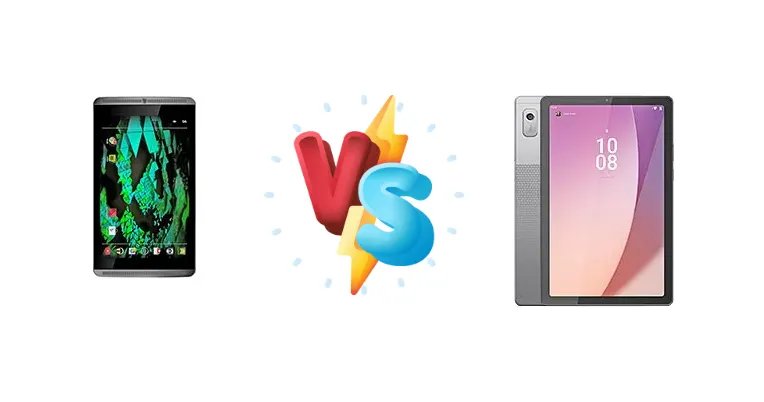
The Nvidia Shield, once a flagship Android tablet, now faces competition from newer, more affordable options like the Lenovo Tab M9. While the Shield boasts a dedicated gaming heritage, the Tab M9 leverages a modern chipset for everyday tasks. This comparison dissects the strengths and weaknesses of each, determining which tablet delivers the best experience in 2024.
🏆 Quick Verdict
For dedicated gamers and those heavily invested in the Nvidia ecosystem, the Shield remains a compelling choice despite its age. However, the Lenovo Tab M9 offers a significantly more modern experience for general use, boasting a more efficient processor and a lower price point, making it the better option for the average user.
| Network |
|---|
| 2G bands | N/A | GSM 850 / 900 / 1800 / 1900 |
| 3G bands | - | HSDPA 850 / 900 / 1700(AWS) / 1900 / 2100 |
| 4G bands | - | 1, 2, 3, 4, 5, 7, 8, 18, 19, 20, 26, 28, 38, 40, 41, 66 |
| EDGE | No | - |
| GPRS | No | - |
| Speed | - | HSPA, LTE - cellular model only |
| Technology | No cellular connectivity | GSM / HSPA / LTE |
| Launch |
|---|
| Announced | 2014, July. Released 2014, July | 2022, December 20 |
| Status | Discontinued | Available. Released 2023, March 14 |
| Body |
|---|
| Dimensions | 221 x 126 x 9.2 mm (8.70 x 4.96 x 0.36 in) | 215.4 x 136.8 x 8 mm (8.48 x 5.39 x 0.31 in) |
| SIM | No | Nano-SIM (cellular model only) |
| Weight | 390 g (13.76 oz) | 344 g (12.13 oz) |
| | Stylus | - |
| Display |
|---|
| Resolution | 1920 x 1200 pixels, 16:10 ratio (~283 ppi density) | 800 x 1340 pixels, 5:3 ratio (~173 ppi density) |
| Size | 8.0 inches, 185.6 cm2 (~66.6% screen-to-body ratio) | 9.0 inches, 230.0 cm2 (~78.1% screen-to-body ratio) |
| Type | IPS LCD | IPS LCD, 400 nits (typ) |
| Platform |
|---|
| CPU | Quad-core 2.2 GHz Cortex-A15 | Octa-core (2x2.0 GHz Cortex-A75 & 6x1.8 GHz Cortex-A55) |
| Chipset | Nvidia Tegra K1 | Mediatek MT6769V/CU Helio G80 (12 nm) |
| GPU | ULP GeForce Kepler (192 cores) | Mali-G52 MC2 |
| OS | Android 4.4.2 (KitKat), upgradable to 7.0 (Nougat) | Android 12 |
| Memory |
|---|
| Card slot | microSDXC (dedicated slot) | microSDXC (dedicated slot) |
| Internal | 16GB 2GB RAM | 32GB 3GB RAM, 64GB 4GB RAM, 128GB 4GB RAM |
| | - | eMMC 5.1 |
| Main Camera |
|---|
| Features | HDR | - |
| Single | 5 MP, AF | 8 MP, AF |
| Video | Yes | 1080p |
| Selfie camera |
|---|
| Features | HDR | - |
| Single | 5 MP | 2 MP |
| Video | - | 720p |
| Sound |
|---|
| 3.5mm jack | Yes | Yes |
| 35mm jack | Yes | Yes |
| Loudspeaker | Yes, with stereo speakers | Yes, with dual speakers |
| | Dual bass reflex port | - |
| Comms |
|---|
| Bluetooth | 4.0, A2DP, LE | 5.1, A2DP, LE |
| NFC | No | No |
| Positioning | GPS | GPS, GLONASS, GALILEO - cellular model only |
| Radio | No | Unspecified |
| USB | microUSB 2.0 | USB Type-C 2.0 |
| WLAN | Wi-Fi 802.11 a/b/g/n, dual-band | Wi-Fi 802.11 a/b/g/n/ac, dual-band, Wi-Fi Direct |
| Features |
|---|
| Sensors | Accelerometer, gyro, compass | Accelerometer, proximity |
| | HDMI port | - |
| Battery |
|---|
| Charging | - | 10W wired |
| Type | Li-Ion 5400 mAh, non-removable (19.75 Wh) | Li-Po 5100 mAh |
| Misc |
|---|
| Colors | Black | Arctic Grey, Frost Blue |
| Models | - | TB310FU |
| Price | About 230 EUR | About 180 EUR |
Nvidia Shield
- Dedicated Nvidia gaming heritage
- Access to Nvidia's streaming services (GeForce Now)
- Potentially higher display quality (based on original positioning)
- Aging Tegra K1 chipset
- Likely shorter battery life
- Outdated software support
Lenovo Tab M9
- Modern and efficient Helio G80 chipset
- Better multi-tasking performance
- More affordable price point
- Basic camera system
- Slow 10W charging
- Lower build quality compared to the Shield's original premium materials
Display Comparison
Display specifications are not provided for either device. However, given the Shield's original positioning, it likely features a higher-quality panel with better color accuracy than the Tab M9, which targets the budget segment. The Tab M9's display is likely an IPS LCD, while the Shield may have utilized an IPS or even a higher-end panel at launch. Bezels are expected to be significantly larger on the Shield due to its age. Without specific data, it's difficult to assess peak brightness or HDR support, but the Shield likely has an advantage in overall visual quality.
Camera Comparison
Camera details are absent for both devices. Given their respective market segments, it's safe to assume neither will excel in photography. The Shield's camera was likely adequate for basic snapshots at its launch, but will appear dated today. The Tab M9 likely features a basic camera setup focused on video calls and casual photography. Without specific sensor sizes or apertures, a meaningful comparison is impossible, but the Tab M9 likely benefits from more modern image processing algorithms.
Performance
The core difference lies in the chipsets. The Nvidia Shield's Tegra K1, with its quad-core 2.2 GHz Cortex-A15 CPU, is showing its age. While it was powerful for its time, it's significantly outmatched by the Lenovo Tab M9's MediaTek Helio G80. The Helio G80's octa-core configuration (2x2.0 GHz Cortex-A75 & 6x1.8 GHz Cortex-A55) provides superior multi-core performance and efficiency. The Cortex-A75 cores offer a substantial architectural improvement over the A15, resulting in faster application loading and smoother multitasking. The 12nm process node of the Helio G80 also contributes to better thermal management compared to the likely larger node process of the Tegra K1. This translates to sustained performance under load, crucial for gaming. The Shield's GPU, while capable, will struggle with modern titles compared to the Helio G80's integrated GPU.
Battery Life
Battery capacity is not specified for either device. However, the Helio G80's superior efficiency gives the Tab M9 an advantage in battery life. The 10W wired charging on the Tab M9 is slow by modern standards, but the lower power draw of the Helio G80 means it won't require rapid charging to achieve a full charge. The Shield, with its older chipset, will likely consume more power, potentially resulting in shorter battery life and longer charging times. Without specific mAh figures, it's difficult to provide precise estimates, but the Tab M9 is expected to offer better endurance.
Buying Guide
Buy the Nvidia Shield if you prioritize a dedicated gaming experience, rely on Nvidia's streaming services (GeForce Now), and appreciate a device with a strong legacy in the Android gaming community. Buy the Lenovo Tab M9 if you need a versatile tablet for everyday tasks like browsing, video streaming, and light gaming, and value affordability and a more modern processor architecture.
Frequently Asked Questions
❓ Will the Nvidia Shield still be able to play modern Android games?
While the Shield can run many Android games, newer, more demanding titles may experience performance issues or require significant graphical settings reductions. The Tegra K1's GPU is simply not as powerful as the integrated graphics in the Helio G80, especially when considering optimizations for newer games.
❓ Is the 10W charging on the Lenovo Tab M9 a significant drawback?
10W charging is relatively slow compared to modern standards. However, the Helio G80's power efficiency means the Tab M9 doesn't require fast charging to achieve a full charge in a reasonable timeframe. Expect a full charge to take several hours.
❓ Does the Nvidia Shield still receive software updates?
Software support for the Nvidia Shield is limited. While it still runs Android, it may not receive the latest Android versions or security patches, potentially leaving it vulnerable to security risks.
❓ Is the Lenovo Tab M9 a good choice for streaming video?
Yes, the Lenovo Tab M9 is well-suited for streaming video thanks to its efficient processor and adequate display. It supports popular streaming services like Netflix and YouTube, providing a smooth and enjoyable viewing experience.