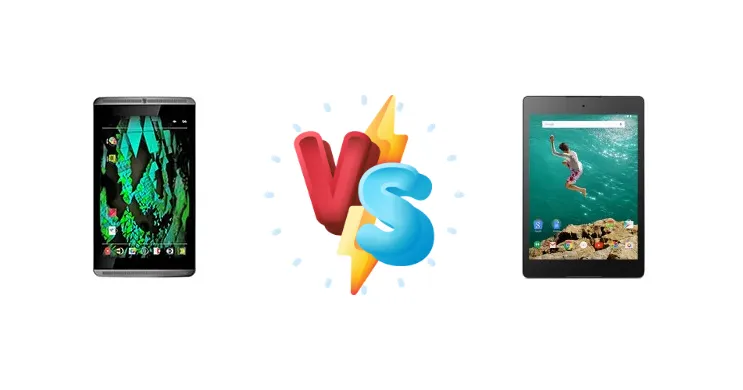
Both the Nvidia Shield and HTC Nexus 9 represent interesting points in Android tablet history, both leveraging Nvidia's Tegra K1 chipset. However, their approaches diverge significantly. The Shield was positioned as a dedicated gaming and media hub, while the Nexus 9 aimed for a premium, Google-first tablet experience. This comparison dissects their differences to determine which tablet holds up better today.
🏆 Quick Verdict
For the average user seeking a versatile tablet, the Nvidia Shield emerges as the stronger choice. While the Nexus 9 offered a cleaner software experience, the Shield’s more robust CPU configuration and gaming-focused design provide a more compelling and enduring experience, especially given their current age and software support.
| Network |
|---|
| 2G bands | N/A | GSM 850 / 900 / 1800 / 1900 |
| 3G bands | - | HSDPA 850 / 900 / 1700 / 1900 / 2100 |
| 4G bands | - | 1, 2, 3, 4, 5, 7, 8, 20 |
| EDGE | No | No |
| GPRS | No | Class 12 |
| Speed | - | HSPA 42.2/5.76 Mbps, LTE Cat4 150/50 Mbps - cellular model only |
| Technology | No cellular connectivity | GSM / HSPA / LTE |
| | - | 2, 3, 5, 6, 13 - T-Mobile |
| Launch |
|---|
| Announced | 2014, July. Released 2014, July | 2014, October. Released 2014, November |
| Status | Discontinued | Discontinued |
| Body |
|---|
| Build | - | Glass front, plastic back, plastic frame |
| Dimensions | 221 x 126 x 9.2 mm (8.70 x 4.96 x 0.36 in) | 228.2 x 153.7 x 8 mm (8.98 x 6.05 x 0.31 in) |
| SIM | No | Nano-SIM (cellular model only) |
| Weight | 390 g (13.76 oz) | 425 g (Wi-Fi) / 436 g (3G/LTE) (14.99 oz) |
| | Stylus | - |
| Display |
|---|
| Protection | - | Corning Gorilla Glass 3 |
| Resolution | 1920 x 1200 pixels, 16:10 ratio (~283 ppi density) | 1536 x 2048 pixels, 4:3 ratio (~281 ppi density) |
| Size | 8.0 inches, 185.6 cm2 (~66.6% screen-to-body ratio) | 8.9 inches, 257.7 cm2 (~73.5% screen-to-body ratio) |
| Type | IPS LCD | IPS LCD |
| Platform |
|---|
| CPU | Quad-core 2.2 GHz Cortex-A15 | Dual-core 2.3 GHz Denver |
| Chipset | Nvidia Tegra K1 | Nvidia Tegra K1 |
| GPU | ULP GeForce Kepler (192 cores) | Kepler DX1 |
| OS | Android 4.4.2 (KitKat), upgradable to 7.0 (Nougat) | Android 5.0 (Lollipop), upgradable to 7.1.1 (Nougat) |
| Memory |
|---|
| Call records | - | Yes |
| Card slot | microSDXC (dedicated slot) | No |
| Internal | 16GB 2GB RAM | 16GB (Wi-Fi)/ 32GB (LTE), 2GB RAM |
| Phonebook | - | 500 entries |
| Main Camera |
|---|
| Features | HDR | LED flash |
| Quad | - | 48 MP, f/1.7, (wide), 1/2.0", 0.8µm, PDAF
8 MP, f/2.2, 118˚ (ultrawide), 1/4.0", 1.12µm
5 MP, f/2.2, (macro)
2 MP, f/2.2, (depth) |
| Single | 5 MP, AF | 8 MP, AF |
| Video | Yes | 1080p@30fps, stereo sound rec. |
| Selfie camera |
|---|
| Features | HDR | - |
| Single | 5 MP | 1.6 MP |
| Video | - | 720p |
| Sound |
|---|
| 3.5mm jack | Yes | Yes |
| 35mm jack | Yes | Yes |
| Loudspeaker | Yes, with stereo speakers | Yes, with stereo speakers |
| | Dual bass reflex port | - |
| Comms |
|---|
| Bluetooth | 4.0, A2DP, LE | 4.1, A2DP, aptX |
| NFC | No | Yes |
| Positioning | GPS | GPS, GLONASS - cellular model only |
| Radio | No | No |
| USB | microUSB 2.0 | microUSB 2.0 |
| WLAN | Wi-Fi 802.11 a/b/g/n, dual-band | Wi-Fi 802.11 a/b/g/n/ac, dual-band, Wi-Fi Direct, DLNA, hotspot |
| Features |
|---|
| Browser | - | WAP 2.0/xHTML |
| Games | - | Downloadable |
| Java | - | No |
| Messaging | - | SMS, MMS |
| Sensors | Accelerometer, gyro, compass | Accelerometer, gyro, compass |
| | HDMI port | - |
| Battery |
|---|
| Charging | - | 10W wired |
| Stand-by | - | Up to 720 h (3G) |
| Talk time | - | Up to 9 h 30 min (multimedia) (3G) |
| Type | Li-Ion 5400 mAh, non-removable (19.75 Wh) | Li-Po 6700 mAh, non-removable |
| Misc |
|---|
| Colors | Black | Indigo Black, Lunar White, Sand |
| Models | - | XT2073-2 |
| Price | About 230 EUR | About 300 EUR |
| Tests |
|---|
| Camera | - |
Photo / Video |
| Performance | - |
Basemark OS II 2.0: 1540Basemark X: 28244 |
Nvidia Shield
- More powerful multi-core CPU performance with Cortex-A15.
- Likely larger battery capacity for extended gaming.
- Designed for gaming and media consumption.
- Potentially less refined camera system.
- Software updates may be limited due to age.
HTC Nexus 9
- Stock Android experience (at launch).
- Potentially sharper display with higher pixel density.
- Lighter and more portable design.
- Dual-core Denver CPU may struggle with multitasking.
- Slower 10W charging.
- Denver CPU architecture faced software optimization issues.
Display Comparison
Display specifications are absent from the provided data, but considering their release timelines, both likely featured 8-9 inch LCD panels. The Nexus 9, being a flagship, likely boasted a higher pixel density. However, the Shield’s focus on media consumption suggests Nvidia may have prioritized color accuracy and brightness. Without specific nit ratings, it’s difficult to definitively declare a winner, but the Nexus 9’s potential for a sharper image is a key differentiator.
Camera Comparison
Both devices feature photo and video capabilities, but the provided data offers no specifics on sensor size, aperture, or image processing. Given the Nexus 9’s flagship positioning, it likely had a more refined camera system with better image quality in optimal conditions. However, the Shield’s focus wasn’t on photography, so its camera likely served as a secondary feature. Without detailed specifications, a definitive camera comparison is impossible.
Performance
Both devices utilize the Nvidia Tegra K1, but crucially, they differ in CPU architecture. The Nvidia Shield employs a quad-core 2.2 GHz Cortex-A15 CPU, a proven and well-understood architecture. The Nexus 9, however, features a dual-core 2.3 GHz Denver CPU. While the Denver cores aimed for higher single-core performance, the Cortex-A15’s quad-core configuration provides superior multi-threaded performance, benefiting demanding games and multitasking. This means the Shield is likely to handle background tasks and complex applications more smoothly. The Denver architecture also faced software optimization challenges, potentially leading to inconsistent performance in the Nexus 9.
Battery Life
Battery capacity data is missing. However, the Nexus 9’s 10W wired charging suggests a slower charging speed compared to what would be expected from a gaming-focused device like the Shield. The Shield likely prioritized a larger battery and potentially faster charging to support extended gaming sessions. While a larger battery doesn’t guarantee longer runtime, the combination of a more efficient CPU (due to more cores handling load) and potentially larger capacity gives the Shield an edge in sustained usage.
Buying Guide
Buy the Nvidia Shield if you prioritize gaming, streaming, and a more powerful processor for demanding tasks. Its dedicated gaming features and robust CPU make it ideal for enthusiasts. Buy the HTC Nexus 9 if you value a stock Android experience, a lighter form factor, and a tablet primarily for media consumption and basic productivity – understanding that software updates have likely ceased.
Frequently Asked Questions
❓ Does the Nvidia Shield's Tegra K1 still hold up for modern Android games?
While not on par with current flagship processors, the Tegra K1 in the Shield remains capable of running many Android games at playable settings. The quad-core Cortex-A15 CPU provides sufficient processing power, and Nvidia’s GPU drivers were well-optimized for gaming. However, demanding titles may require reduced graphics settings.
❓ Was the HTC Nexus 9's Denver CPU a significant improvement over the Cortex-A15?
The Denver CPU aimed for higher single-core performance, but it didn't consistently outperform the Cortex-A15 in real-world scenarios. Software optimization proved challenging, and the dual-core configuration limited its multi-threaded capabilities. The Cortex-A15 in the Shield generally offered a more stable and reliable experience.
❓ Which tablet is better for streaming video content?
The Nvidia Shield is better suited for streaming due to its gaming-focused design and likely more robust power delivery. This allows for sustained performance during long streaming sessions without overheating or throttling. While the Nexus 9 can stream, it may experience performance limitations.