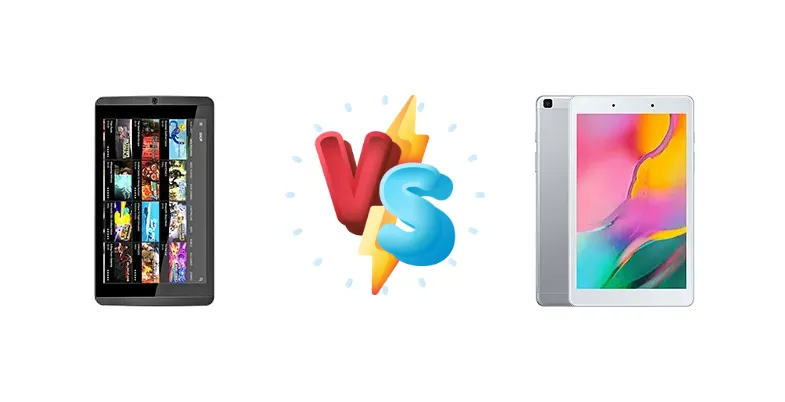
The Nvidia Shield K1, released in 2015, represented a high-water mark for Android gaming tablets, leveraging Nvidia's Tegra K1 processor. The Samsung Galaxy Tab A 8.0 (2019) targets a more mainstream, budget-conscious audience with Qualcomm's Snapdragon 429. This comparison dissects the architectural differences and real-world implications of these two tablets, determining which one remains relevant today.
🏆 Quick Verdict
For users prioritizing raw performance and gaming capabilities, the Nvidia Shield K1 remains the superior choice despite its age. Its Tegra K1 chipset offers a significant performance advantage over the Snapdragon 429 in the Tab A 8.0. However, the Tab A 8.0 excels in battery efficiency and modern software support, making it a better all-rounder for basic tasks.
| Network |
|---|
| 2G bands | N/A | GSM 850 / 900 / 1800 / 1900 |
| 3G bands | - | HSDPA 850 / 900 / 1700(AWS) / 1900 / 2100 |
| 4G bands | - | 1, 2, 3, 4, 5, 7, 8, 12, 17, 20, 28, 38, 40, 41 |
| EDGE | No | - |
| GPRS | No | - |
| Speed | - | HSPA 42.2/5.76 Mbps, LTE Cat4 150/50 Mbps - cellular model only |
| Technology | No cellular connectivity | GSM / HSPA / LTE |
| Launch |
|---|
| Announced | 2015, November. Released 2015, November | 2019, July 05. Released 2019, July |
| Status | Discontinued | Discontinued |
| Body |
|---|
| Build | - | Glass front, aluminum back, plastic frame |
| Dimensions | 221 x 126 x 9.2 mm (8.70 x 4.96 x 0.36 in) | 210 x 124.4 x 8 mm (8.27 x 4.90 x 0.31 in) |
| SIM | No | Nano-SIM (cellular model only) |
| Weight | 356 g (12.56 oz) | 345g (Wi-Fi), 347g (LTE) (12.24 oz) |
| | Stylus | - |
| Display |
|---|
| Resolution | 1920 x 1200 pixels, 16:10 ratio (~283 ppi density) | 800 x 1280 pixels, 16:10 ratio (~189 ppi density) |
| Size | 8.0 inches, 185.6 cm2 (~66.6% screen-to-body ratio) | 8.0 inches, 185.6 cm2 (~71.0% screen-to-body ratio) |
| Type | IPS LCD | TFT LCD |
| Platform |
|---|
| CPU | Quad-core 2.2 GHz Cortex-A15 | Quad-core 2.0 GHz Cortex-A53 |
| Chipset | Nvidia Tegra K1 | Qualcomm SDM429 Snapdragon 429 (12 nm) |
| GPU | ULP GeForce Kepler (192 cores) | Adreno 504 |
| OS | Android 5.0 (Lollipop), upgradable to 7.0 (Nougat) | Android 9.0 (Pie), upgradable to Android 11 |
| Memory |
|---|
| Card slot | microSDXC (dedicated slot) | microSDXC (dedicated slot) |
| Internal | 16GB 2GB RAM | 32GB 2GB RAM, 32GB 3GB RAM, 64GB 2GB RAM |
| | - | eMMC 5.1 |
| Main Camera |
|---|
| Features | HDR | - |
| Single | 5 MP, AF | 8 MP, AF |
| Video | Yes | 1080p@30fps |
| Selfie camera |
|---|
| Features | HDR | - |
| Single | 5 MP | 2 MP |
| Sound |
|---|
| 3.5mm jack | Yes | Yes |
| 35mm jack | Yes | Yes |
| Loudspeaker | Yes, with stereo speakers | Yes, with dual speakers |
| | Dual bass reflex port | - |
| Comms |
|---|
| Bluetooth | 4.0, A2DP, LE | 4.2, A2DP, LE |
| NFC | No | No |
| Positioning | GPS, GLONASS | GPS, GLONASS, GALILEO, BDS - cellular model only |
| Radio | No | No |
| USB | microUSB 2.0 | microUSB 2.0 |
| WLAN | Wi-Fi 802.11 a/b/g/n, dual-band | Wi-Fi 802.11 a/b/g/n, dual-band, Wi-Fi Direct |
| Features |
|---|
| Sensors | Accelerometer, gyro, compass | Accelerometer |
| | HDMI port | - |
| Battery |
|---|
| Type | Li-Ion 5200 mAh, non-removable (19.75 Wh) | Li-Po 5100 mAh, non-removable |
| Misc |
|---|
| Colors | Black | Carbon Black, Silver Gray |
| Models | - | SM-T290, SM-T295 |
| Price | About 200 EUR | About 130 EUR |
| SAR EU | - | 0.75 W/kg (head) 1.19 W/kg (body) |
Nvidia Shield K1
- Significantly more powerful GPU for gaming and emulation.
- Stronger CPU architecture (Cortex-A15) for single-threaded tasks.
- Potential for custom ROMs and advanced configurations.
- Older chipset and potentially limited software updates.
- Likely shorter battery life due to power-hungry processor.
- Display technology is showing its age.
Samsung Galaxy Tab A 8.0 (2019)
- More modern Android version and potential for future updates.
- Better battery life due to efficient Snapdragon 429.
- Lower price point and wider availability.
- Significantly weaker performance compared to the Tegra K1.
- Limited gaming capabilities for demanding titles.
- Basic camera performance.
Display Comparison
Neither device boasts a particularly impressive display by modern standards. Specifics regarding panel type (IPS vs TFT) and resolution are missing for both, but the Tab A 8.0's 8-inch screen likely offers a slightly higher pixel density given its smaller size. The Shield K1's display, while adequate, is showing its age. Both are likely to have similar color accuracy, leaning towards the standard sRGB color space. The lack of information on brightness levels makes a direct comparison difficult, but the Tab A 8.0's newer manufacturing process *could* translate to slightly better efficiency.
Camera Comparison
Camera performance is not a strength for either device. Both tablets likely feature basic camera sensors suitable for casual snapshots. Details regarding sensor size and aperture are unavailable, but given their market segments, expectations should be tempered. The Tab A 8.0 likely has a more modern image signal processor (ISP) within the Snapdragon 429, potentially resulting in slightly better image quality in good lighting conditions. Any 2MP or lower resolution cameras on either device are largely irrelevant for practical photography.
Performance
The core difference lies in the chipsets. The Nvidia Shield K1’s Tegra K1, with its quad-core 2.2 GHz Cortex-A15 CPU, utilizes a more powerful, albeit older, CPU architecture. The Cortex-A15 is known for its strong single-core performance, beneficial for many applications. Conversely, the Samsung Galaxy Tab A 8.0 (2019) features the Qualcomm Snapdragon 429 with a quad-core 2.0 GHz Cortex-A53 CPU. The A53 prioritizes power efficiency over raw speed. The Tegra K1’s GPU is significantly more capable, offering a substantial advantage in graphics-intensive tasks. The Snapdragon 429’s Adreno 504 GPU is sufficient for basic gaming and video playback, but will struggle with demanding titles. The 12nm process node of the Snapdragon 429 provides better power efficiency than the Tegra K1’s older manufacturing process, leading to longer battery life under similar workloads.
Battery Life
Battery capacity specifics are missing for both devices. However, the Snapdragon 429’s superior power efficiency, stemming from its Cortex-A53 cores and 12nm process, will likely translate to longer battery life for the Tab A 8.0. The Tegra K1, while powerful, is a more power-hungry chip. Charging wattage is also unknown for both, but the Tab A 8.0 likely supports a more modern charging standard, potentially offering faster charging times.
Buying Guide
Buy the Nvidia Shield K1 if you need a tablet primarily for gaming, streaming, or emulation, and are comfortable with potentially limited software updates. Its Tegra K1 processor provides a level of graphical horsepower unmatched by the Tab A 8.0. Buy the Samsung Galaxy Tab A 8.0 (2019) if you prefer a lightweight, affordable tablet for everyday tasks like browsing, video playback, and light productivity, and value longer battery life and a more current Android experience.
Frequently Asked Questions
❓ Is the Nvidia Shield K1 still a good choice for playing older Android games and emulators?
Absolutely. The Tegra K1's GPU remains remarkably capable for emulating consoles up to the PlayStation 2 and GameCube, and handles many older Android titles with ease. Its performance significantly surpasses the Snapdragon 429 in these scenarios.
❓ Will the Samsung Galaxy Tab A 8.0 (2019) be able to run modern, graphically demanding games like Genshin Impact or Call of Duty Mobile?
While it *can* run them, expect significant compromises in graphics settings and frame rates. The Snapdragon 429 is simply not powerful enough to deliver a smooth experience on high settings. You'll likely need to play at the lowest possible settings to achieve playable frame rates.
❓ What is the likelihood of receiving further software updates for the Nvidia Shield K1?
The Nvidia Shield K1 is nearing the end of its software support lifecycle. While the community has a strong presence for custom ROM development, official updates from Nvidia are unlikely. The Tab A 8.0, being a more recent device, has a higher probability of receiving at least one more major Android update.