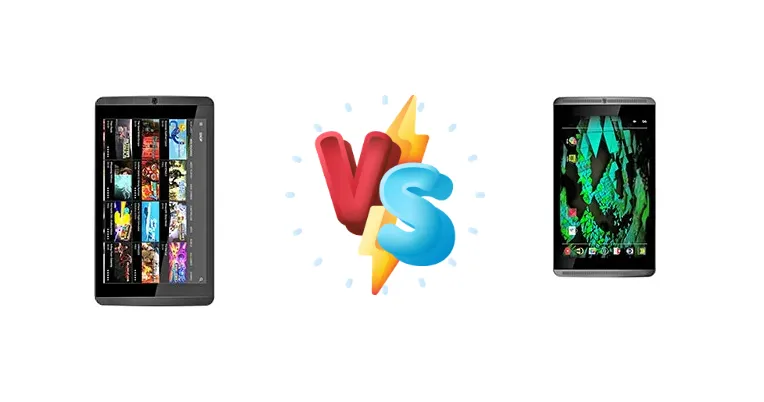
The original Nvidia Shield and the subsequent K1 revision represent Nvidia’s initial foray into the Android TV box market. Both devices center around the Nvidia Tegra K1 chipset, but the K1 model introduced refinements aimed at improving performance and efficiency. This comparison dissects the nuances between these two Shields, helping you determine which best suits your entertainment needs.
🏆 Quick Verdict
For most users, the Nvidia Shield K1 is the superior choice. While both share the same core Tegra K1 processor, the K1’s architectural improvements translate to a smoother user experience, particularly in graphically demanding games and 4K streaming. The price difference is often minimal, making the K1 a clear winner.
| Network |
|---|
| 2G bands | N/A | N/A |
| EDGE | No | No |
| GPRS | No | No |
| Technology | No cellular connectivity | No cellular connectivity |
| Launch |
|---|
| Announced | 2015, November. Released 2015, November | 2014, July. Released 2014, July |
| Status | Discontinued | Discontinued |
| Body |
|---|
| Dimensions | 221 x 126 x 9.2 mm (8.70 x 4.96 x 0.36 in) | 221 x 126 x 9.2 mm (8.70 x 4.96 x 0.36 in) |
| SIM | No | No |
| Weight | 356 g (12.56 oz) | 390 g (13.76 oz) |
| | Stylus | Stylus |
| Display |
|---|
| Resolution | 1920 x 1200 pixels, 16:10 ratio (~283 ppi density) | 1920 x 1200 pixels, 16:10 ratio (~283 ppi density) |
| Size | 8.0 inches, 185.6 cm2 (~66.6% screen-to-body ratio) | 8.0 inches, 185.6 cm2 (~66.6% screen-to-body ratio) |
| Type | IPS LCD | IPS LCD |
| Platform |
|---|
| CPU | Quad-core 2.2 GHz Cortex-A15 | Quad-core 2.2 GHz Cortex-A15 |
| Chipset | Nvidia Tegra K1 | Nvidia Tegra K1 |
| GPU | ULP GeForce Kepler (192 cores) | ULP GeForce Kepler (192 cores) |
| OS | Android 5.0 (Lollipop), upgradable to 7.0 (Nougat) | Android 4.4.2 (KitKat), upgradable to 7.0 (Nougat) |
| Memory |
|---|
| Card slot | microSDXC (dedicated slot) | microSDXC (dedicated slot) |
| Internal | 16GB 2GB RAM | 16GB 2GB RAM |
| Main Camera |
|---|
| Features | HDR | HDR |
| Single | 5 MP, AF | 5 MP, AF |
| Video | Yes | Yes |
| Selfie camera |
|---|
| Features | HDR | HDR |
| Single | 5 MP | 5 MP |
| Sound |
|---|
| 3.5mm jack | Yes | Yes |
| 35mm jack | Yes | Yes |
| Loudspeaker | Yes, with stereo speakers | Yes, with stereo speakers |
| | Dual bass reflex port | Dual bass reflex port |
| Comms |
|---|
| Bluetooth | 4.0, A2DP, LE | 4.0, A2DP, LE |
| NFC | No | No |
| Positioning | GPS, GLONASS | GPS |
| Radio | No | No |
| USB | microUSB 2.0 | microUSB 2.0 |
| WLAN | Wi-Fi 802.11 a/b/g/n, dual-band | Wi-Fi 802.11 a/b/g/n, dual-band |
| Features |
|---|
| Sensors | Accelerometer, gyro, compass | Accelerometer, gyro, compass |
| | HDMI port | HDMI port |
| Battery |
|---|
| Type | Li-Ion 5200 mAh, non-removable (19.75 Wh) | Li-Ion 5400 mAh, non-removable (19.75 Wh) |
| Misc |
|---|
| Colors | Black | Black |
| Price | About 200 EUR | About 230 EUR |
Nvidia Shield K1
- Enhanced GPU performance compared to the original Shield.
- Improved thermal management reduces throttling.
- More consistent 4K streaming experience.
- Generally available at a similar or slightly higher price point, offering better value.
- Requires a constant power source (no built-in battery).
- May be difficult to find new, as it's an older model.
Nvidia Shield
- Built-in battery for portability.
- Still a capable Android TV box for basic tasks.
- Potentially available at a lower price point if found used.
- Lower GPU performance compared to the K1.
- More prone to frame drops in demanding games and 4K content.
- May exhibit throttling during extended gaming sessions.
- Older software support compared to the K1.
Display Comparison
Both Shields output up to 4K resolution, but the display quality is largely dependent on the connected TV. Neither device features a built-in display. The K1’s improved GPU, however, allows for more consistent 4K HDR streaming without frame drops, enhancing the visual experience on compatible TVs. The original Shield may exhibit occasional stuttering with high bitrate 4K content.
Camera Comparison
Neither the original Nvidia Shield nor the K1 are designed for camera-centric tasks. Both lack integrated cameras, focusing instead on media consumption and gaming. Therefore, a camera comparison is irrelevant in this context.
Performance
Both devices are equipped with the Nvidia Tegra K1 chipset featuring a quad-core 2.2 GHz Cortex-A15 CPU. However, the K1 variant utilizes a refined architecture within the Tegra K1, offering a 1.5x increase in graphics performance. This translates to higher and more stable frame rates in Android games like Borderlands 2 and improved performance in emulators. While the CPU clock speed is identical, the K1’s GPU improvements are the key differentiator. Thermal management is also slightly improved in the K1, reducing the likelihood of throttling during extended gaming sessions.
Battery Life
The original Nvidia Shield included a built-in battery for portability, while the K1 model removed the battery to reduce cost and complexity. This means the K1 *requires* a constant power source. Users prioritizing portability will need to consider the original Shield, but the K1’s consistent power delivery contributes to its more stable performance.
Buying Guide
Buy the Nvidia Shield K1 if you prioritize a consistently smoother experience, especially when gaming or streaming 4K content. Its refined architecture offers a tangible performance boost. Buy the original Nvidia Shield if you find a significantly discounted unit and your usage is primarily focused on lighter tasks like video playback and casual app use. The original Shield remains a capable device, but the K1 offers better future-proofing.
Frequently Asked Questions
❓ Does the Nvidia Shield K1 support 4K HDR streaming from services like Netflix and Amazon Prime Video?
Yes, the Nvidia Shield K1 fully supports 4K HDR streaming from major services. However, the K1’s improved GPU ensures a smoother and more stable experience with high bitrate HDR content compared to the original Shield, which may experience occasional stuttering.
❓ Can I emulate retro games on both the Nvidia Shield and the K1?
Both Shields are capable of emulating a wide range of retro games. However, the K1’s more powerful GPU allows for better performance and compatibility with more demanding emulators, such as those for PlayStation 2 and GameCube. You’ll likely experience fewer frame drops and more consistent performance on the K1.
❓ Is the lack of a battery in the K1 a dealbreaker for home theater setups?
Not necessarily. The K1 is primarily designed as a set-top box, intended to remain connected to a TV and power source. If you plan to use it exclusively in a home theater environment, the lack of a battery is unlikely to be a significant drawback. The consistent power delivery can even contribute to more stable performance.