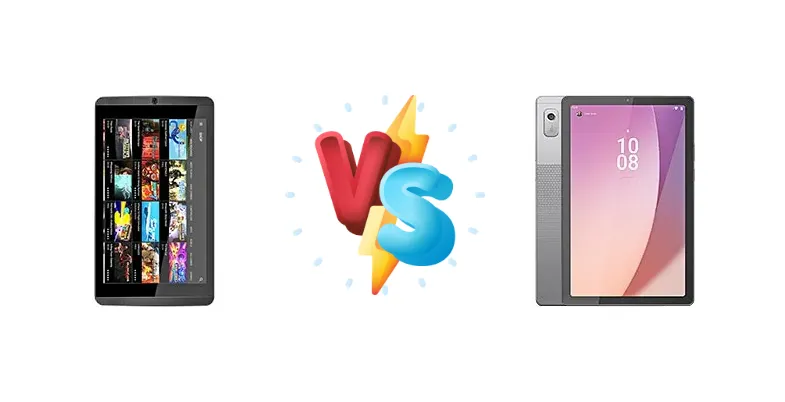
The Nvidia Shield K1, released in 2015, was a landmark device for Android gaming. Now, years later, it faces a new contender: the Lenovo Tab M9, a modern budget tablet. This comparison examines whether the K1’s specialized hardware still holds up against the more broadly capable, and significantly newer, Helio G80-powered Tab M9, focusing on performance, usability, and value.
🏆 Quick Verdict
For the average user, the Lenovo Tab M9 is the better choice. While the Nvidia Shield K1 boasts a powerful (for its time) Tegra K1, the Tab M9’s more efficient Helio G80, coupled with a modern software experience and wider app compatibility, provides a smoother, more versatile experience. The K1’s age and limited software support are significant drawbacks.
| Network |
|---|
| 2G bands | N/A | GSM 850 / 900 / 1800 / 1900 |
| 3G bands | - | HSDPA 850 / 900 / 1700(AWS) / 1900 / 2100 |
| 4G bands | - | 1, 2, 3, 4, 5, 7, 8, 18, 19, 20, 26, 28, 38, 40, 41, 66 |
| EDGE | No | - |
| GPRS | No | - |
| Speed | - | HSPA, LTE - cellular model only |
| Technology | No cellular connectivity | GSM / HSPA / LTE |
| Launch |
|---|
| Announced | 2015, November. Released 2015, November | 2022, December 20 |
| Status | Discontinued | Available. Released 2023, March 14 |
| Body |
|---|
| Dimensions | 221 x 126 x 9.2 mm (8.70 x 4.96 x 0.36 in) | 215.4 x 136.8 x 8 mm (8.48 x 5.39 x 0.31 in) |
| SIM | No | Nano-SIM (cellular model only) |
| Weight | 356 g (12.56 oz) | 344 g (12.13 oz) |
| | Stylus | - |
| Display |
|---|
| Resolution | 1920 x 1200 pixels, 16:10 ratio (~283 ppi density) | 800 x 1340 pixels, 5:3 ratio (~173 ppi density) |
| Size | 8.0 inches, 185.6 cm2 (~66.6% screen-to-body ratio) | 9.0 inches, 230.0 cm2 (~78.1% screen-to-body ratio) |
| Type | IPS LCD | IPS LCD, 400 nits (typ) |
| Platform |
|---|
| CPU | Quad-core 2.2 GHz Cortex-A15 | Octa-core (2x2.0 GHz Cortex-A75 & 6x1.8 GHz Cortex-A55) |
| Chipset | Nvidia Tegra K1 | Mediatek MT6769V/CU Helio G80 (12 nm) |
| GPU | ULP GeForce Kepler (192 cores) | Mali-G52 MC2 |
| OS | Android 5.0 (Lollipop), upgradable to 7.0 (Nougat) | Android 12 |
| Memory |
|---|
| Card slot | microSDXC (dedicated slot) | microSDXC (dedicated slot) |
| Internal | 16GB 2GB RAM | 32GB 3GB RAM, 64GB 4GB RAM, 128GB 4GB RAM |
| | - | eMMC 5.1 |
| Main Camera |
|---|
| Features | HDR | - |
| Single | 5 MP, AF | 8 MP, AF |
| Video | Yes | 1080p |
| Selfie camera |
|---|
| Features | HDR | - |
| Single | 5 MP | 2 MP |
| Video | - | 720p |
| Sound |
|---|
| 3.5mm jack | Yes | Yes |
| 35mm jack | Yes | Yes |
| Loudspeaker | Yes, with stereo speakers | Yes, with dual speakers |
| | Dual bass reflex port | - |
| Comms |
|---|
| Bluetooth | 4.0, A2DP, LE | 5.1, A2DP, LE |
| NFC | No | No |
| Positioning | GPS, GLONASS | GPS, GLONASS, GALILEO - cellular model only |
| Radio | No | Unspecified |
| USB | microUSB 2.0 | USB Type-C 2.0 |
| WLAN | Wi-Fi 802.11 a/b/g/n, dual-band | Wi-Fi 802.11 a/b/g/n/ac, dual-band, Wi-Fi Direct |
| Features |
|---|
| Sensors | Accelerometer, gyro, compass | Accelerometer, proximity |
| | HDMI port | - |
| Battery |
|---|
| Charging | - | 10W wired |
| Type | Li-Ion 5200 mAh, non-removable (19.75 Wh) | Li-Po 5100 mAh |
| Misc |
|---|
| Colors | Black | Arctic Grey, Frost Blue |
| Models | - | TB310FU |
| Price | About 200 EUR | About 180 EUR |
Nvidia Shield K1
- Powerful GPU for its time (Tegra K1)
- Potential for GeForce Now streaming
- High-resolution display (based on historical data)
- Outdated software and limited updates
- Potential battery degradation
- Older CPU architecture
Lenovo Tab M9
- Modern Android experience
- More efficient processor (Helio G80)
- Wider app compatibility
- Lower peak performance compared to K1's GPU in specific scenarios
- Basic camera system
- Slow charging speed (10W)
Display Comparison
Display specifications for the Shield K1 are not provided, but it featured a high-resolution display for its time. The Lenovo Tab M9 lacks detailed display specs beyond its size, but its LCD panel is likely to have lower peak brightness and color accuracy compared to the K1’s original panel. The K1’s age means potential screen burn-in is a concern, while the Tab M9 benefits from a newer panel with potentially better viewing angles. The Tab M9’s 10W charging suggests a focus on efficiency rather than rapid charging, impacting overall usability.
Camera Comparison
Camera details for the Shield K1 are unavailable, but it was not a primary focus of the device. The Lenovo Tab M9’s camera specifications are also limited, suggesting a basic camera experience. Neither tablet is expected to excel in photography, and image quality will likely be adequate for casual snapshots. The focus here is clearly not on camera performance.
Performance
The Nvidia Shield K1’s Tegra K1, with its quad-core 2.2 GHz Cortex-A15 CPU, was a powerhouse in 2015, featuring a powerful GPU designed for gaming. However, the Lenovo Tab M9’s MediaTek Helio G80, an octa-core processor (2x2.0 GHz Cortex-A75 & 6x1.8 GHz Cortex-A55), benefits from newer CPU architecture and a more efficient 12nm process. While the K1’s GPU might still outperform the G80 in specific, older titles optimized for Nvidia hardware, the G80’s multi-core CPU provides superior multitasking and responsiveness in modern applications. The K1’s older architecture also lacks the power efficiency of the G80, leading to potentially shorter battery life and more heat generation.
Battery Life
Battery capacity for both devices is unspecified. However, the Lenovo Tab M9’s 10W wired charging indicates a slower charging speed, prioritizing efficiency over quick top-ups. The Nvidia Shield K1, being an older device, likely suffers from battery degradation, potentially offering significantly less usable battery life than a new Tab M9. The Helio G80’s 12nm process contributes to better power efficiency, potentially offsetting the Tab M9’s lower charging wattage with longer runtimes.
Buying Guide
Buy the Nvidia Shield K1 if you specifically need a device for emulating older games or streaming from a GeForce Now server, and are comfortable with potential software limitations and a dated user experience. Buy the Lenovo Tab M9 if you prioritize a modern Android experience, everyday usability, media consumption, and a broader range of app compatibility, all at a lower price point.
Frequently Asked Questions
❓ Will the Nvidia Shield K1 still run modern Android games smoothly?
While the Tegra K1 was powerful for its time, many modern Android games are optimized for newer architectures and may experience performance issues or be incompatible with the K1’s older software. The Lenovo Tab M9’s Helio G80 is better suited for running current titles, though it won’t match flagship-level performance.
❓ Is the Nvidia Shield K1 still a good option for streaming games via GeForce Now?
Yes, the Nvidia Shield K1 remains a viable option for GeForce Now streaming due to its Nvidia hardware. However, the Tab M9 can also stream games, and its more modern connectivity (likely Wi-Fi 5 or 6 vs the K1’s older standard) may provide a more stable streaming experience.
❓ How does the Helio G80 in the Lenovo Tab M9 handle multitasking?
The Helio G80’s octa-core CPU, with its combination of Cortex-A75 and Cortex-A55 cores, provides excellent multitasking capabilities. It can handle multiple apps running simultaneously without significant slowdown, a task where the K1’s older quad-core processor may struggle.