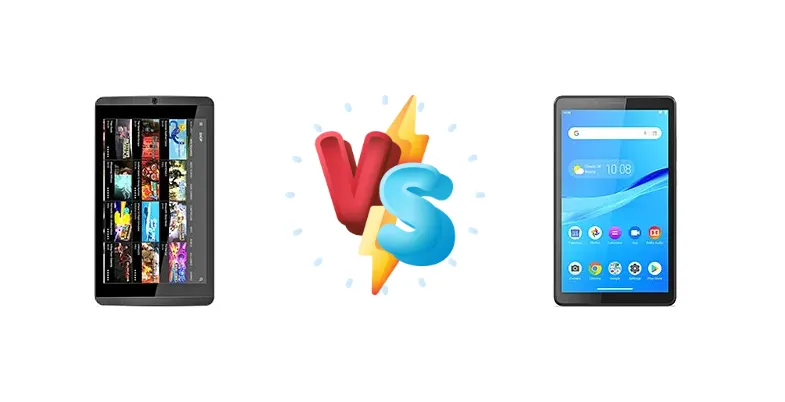
The Nvidia Shield K1, released in 2014, represented a high-water mark for Android gaming tablets. Now, years later, it faces a new contender: the Lenovo Tab M7, a budget-friendly option aimed at everyday use. This comparison examines whether the K1’s aging but powerful hardware can still compete with a modern, cost-optimized tablet.
🏆 Quick Verdict
For dedicated gamers and those prioritizing streaming, the Nvidia Shield K1 remains the superior choice due to its significantly more powerful Tegra K1 chipset. However, the Lenovo Tab M7 offers a more modern Android experience and better value for casual users seeking a basic tablet for media consumption and light tasks.
| Network |
|---|
| 2G bands | N/A | GSM 850 / 900 / 1800 / 1900 |
| 3G bands | - | HSDPA 850 / 900 / 1900 / 2100 |
| 4G bands | - | 1, 3, 4, 7, 8, 20 |
| EDGE | No | - |
| GPRS | No | - |
| Speed | - | HSPA, LTE - cellular model only |
| Technology | No cellular connectivity | GSM / HSPA / LTE |
| Launch |
|---|
| Announced | 2015, November. Released 2015, November | 2019, September. Released 2019, October |
| Status | Discontinued | Discontinued |
| Body |
|---|
| Build | - | Glass front, aluminum back, aluminum frame |
| Dimensions | 221 x 126 x 9.2 mm (8.70 x 4.96 x 0.36 in) | 176.3 x 102.9 x 8.3 mm (6.94 x 4.05 x 0.33 in) |
| SIM | No | Nano-SIM (cellular model only) |
| Weight | 356 g (12.56 oz) | 236 g (8.32 oz) |
| | Stylus | - |
| Display |
|---|
| Resolution | 1920 x 1200 pixels, 16:10 ratio (~283 ppi density) | 600 x 1024 pixels, 16:9 ratio (~170 ppi density) |
| Size | 8.0 inches, 185.6 cm2 (~66.6% screen-to-body ratio) | 7.0 inches, 137.9 cm2 (~76.0% screen-to-body ratio) |
| Type | IPS LCD | IPS LCD |
| Platform |
|---|
| CPU | Quad-core 2.2 GHz Cortex-A15 | Quad-core 1.3 GHz |
| Chipset | Nvidia Tegra K1 | Mediatek MT8321 (28 nm) - Wi-FiMediatek MT8765B - Wi-Fi/LTE |
| GPU | ULP GeForce Kepler (192 cores) | Mali-400 |
| OS | Android 5.0 (Lollipop), upgradable to 7.0 (Nougat) | Android 9.0 (Pie) - 2GB RAM, Android 9.0 Pie (Go edition) - 1GB RAM |
| Memory |
|---|
| Card slot | microSDXC (dedicated slot) | microSDXC (dedicated slot) |
| Internal | 16GB 2GB RAM | 8GB 1GB RAM, 16GB 1GB RAM, 32GB 2GB RAM |
| Main Camera |
|---|
| Features | HDR | - |
| Single | 5 MP, AF | 2 MP |
| Video | Yes | 720p |
| Selfie camera |
|---|
| Features | HDR | - |
| Single | 5 MP | 2 MP |
| Video | - | 720p |
| Sound |
|---|
| 3.5mm jack | Yes | Yes |
| 35mm jack | Yes | Yes |
| Loudspeaker | Yes, with stereo speakers | Yes |
| | Dual bass reflex port | - |
| Comms |
|---|
| Bluetooth | 4.0, A2DP, LE | 4.2, A2DP, LE |
| NFC | No | No |
| Positioning | GPS, GLONASS | GPS, GLONASS - cellular model only |
| Radio | No | FM radio |
| USB | microUSB 2.0 | microUSB 2.0 |
| WLAN | Wi-Fi 802.11 a/b/g/n, dual-band | Wi-Fi 802.11 b/g/n, Wi-Fi Direct |
| Features |
|---|
| Sensors | Accelerometer, gyro, compass | Accelerometer |
| | HDMI port | - |
| Battery |
|---|
| Type | Li-Ion 5200 mAh, non-removable (19.75 Wh) | Li-Po 3590 mAh, non-removable |
| Misc |
|---|
| Colors | Black | Iron Grey, Platinum Grey, Onyx Black |
| Models | - | TB-7305F, TB-7305X, TB-7305I |
| Price | About 200 EUR | About 100 EUR |
Nvidia Shield K1
- Significantly more powerful processor for gaming and streaming.
- Larger screen size for a more immersive experience.
- Potential for custom ROMs and advanced features.
- Aging hardware and software support.
- Likely shorter battery life.
- Potentially limited availability and higher price due to age.
Lenovo Tab M7
- More affordable price point.
- Modern Android operating system with potential for updates.
- Better battery life due to efficient chipset.
- Significantly weaker performance for gaming and demanding tasks.
- Lower screen resolution and potentially inferior display quality.
- Basic camera capabilities.
Display Comparison
Display specifications are not provided for either device. However, given the Shield K1’s release date, it likely features an LCD panel with a resolution around 1920x1200. The Lenovo Tab M7, being a budget device, likely utilizes a lower-resolution LCD as well. The K1’s larger screen size (8 inches vs. the Tab M7’s 7 inches) will offer a more immersive viewing experience, but the Tab M7’s smaller form factor enhances portability. Color accuracy and brightness are likely to be inferior on both devices compared to modern tablets.
Camera Comparison
Camera details are absent for both devices. Given their respective market segments, camera quality is unlikely to be a strong point for either. The Shield K1 was never marketed for its photography capabilities, and the Tab M7 likely features basic sensors suitable for video calls and occasional snapshots. Expect limited detail and poor low-light performance from both.
Performance
The core difference lies in the chipsets. The Nvidia Shield K1’s Tegra K1, with its quad-core 2.2 GHz Cortex-A15 CPU, was a flagship processor in its time, boasting a powerful GPU. This translates to significantly better graphics performance than the Lenovo Tab M7’s MediaTek MT8321, which features a quad-core 1.3 GHz CPU. The MT8321, built on a 28nm process, is designed for efficiency, not raw power. The K1’s architecture, while older, is optimized for gaming, while the Tab M7 struggles with even moderately demanding titles. The K1 likely has more RAM, further aiding performance, though the exact amount isn't specified. The Tab M7’s MT8765B Wi-Fi/LTE modem provides modern connectivity, something the original K1 may lack depending on the model.
Battery Life
Battery capacity is not specified for either device. However, the Tegra K1’s higher power consumption will likely result in shorter battery life on the Shield K1 compared to the Lenovo Tab M7, despite the Tab M7’s less powerful processor. The Tab M7’s efficiency-focused chipset and smaller screen size contribute to better battery endurance. Charging wattage is also unknown, but the Tab M7 likely supports faster charging due to its more modern design.
Buying Guide
Buy the Nvidia Shield K1 if you need a tablet capable of emulating older consoles, streaming games via GeForce Now, or enjoying demanding Android titles. Its Tegra K1 processor provides a level of graphical performance the Tab M7 simply cannot match. Buy the Lenovo Tab M7 if you prefer a lightweight, portable tablet for reading, browsing, and basic video playback. Its lower price point and more recent software support make it ideal for users prioritizing affordability and simplicity.
Frequently Asked Questions
❓ Can the Nvidia Shield K1 still play modern Android games?
While the Tegra K1 is powerful for its age, many modern Android games require newer hardware and software features. The K1 can handle some titles with reduced settings, but demanding games may experience performance issues or be incompatible. Emulation of older consoles is where the K1 truly shines.
❓ Is the Lenovo Tab M7 suitable for streaming video services like Netflix and YouTube?
Yes, the Lenovo Tab M7 is perfectly adequate for streaming video content. Its screen size and resolution are sufficient for comfortable viewing, and its Wi-Fi connectivity ensures smooth playback. However, it may struggle with high-resolution or HDR content.
❓ Does the Nvidia Shield K1 receive software updates anymore?
Official software updates from Nvidia have ceased for the Shield K1. However, the active Android developer community has created custom ROMs that can breathe new life into the device and provide access to newer Android versions, albeit with potential stability trade-offs.
❓ What kind of storage options are available on the Lenovo Tab M7?
The Lenovo Tab M7 typically comes with 16GB or 32GB of internal storage, expandable via a microSD card. This is crucial, as the operating system and pre-installed apps consume a significant portion of the internal storage.