
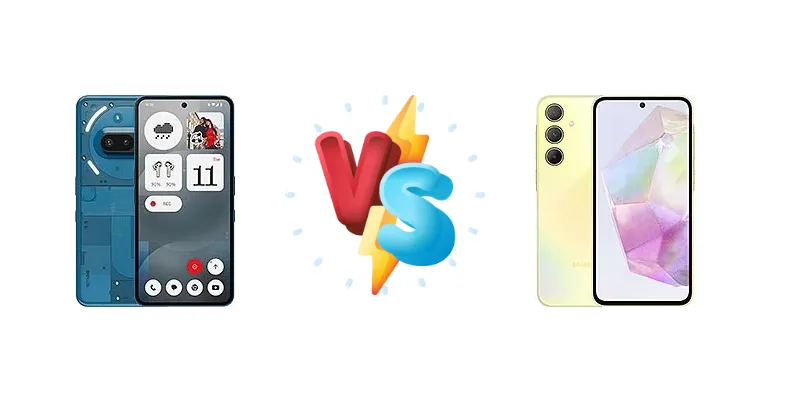
Nothing Phone (3a) vs Samsung Galaxy A35: A Deep Dive into Mid-Range Champions
| Phones Images | |||||
|---|---|---|---|---|---|
|
🏆 Quick Verdict
For most users, the Nothing Phone (3a) emerges as the stronger choice. Its more efficient Snapdragon 7s Gen 3 chipset, coupled with a brighter display and faster charging, provides a smoother and more responsive experience. While the Galaxy A35 offers a familiar Samsung interface, it falls behind in raw performance and display quality.
| PHONES | ||
|---|---|---|
| Phone Names | Nothing Phone (3a) | Samsung Galaxy A35 |
| Network | ||
|---|---|---|
| 2G bands | GSM 850 / 900 / 1800 / 1900 | GSM 850 / 900 / 1800 / 1900 |
| 3G bands | HSDPA 800 / 850 / 900 / 1700(AWS) / 1900 / 2100 | HSDPA 850 / 900 / 1700(AWS) / 1900 / 2100 |
| 4G bands | 1, 2, 3, 4, 5, 7, 8, 12, 17, 18, 19, 20, 26, 28, 38, 40, 41, 42, 48, 66 | 1, 2, 3, 4, 5, 7, 8, 12, 13, 17, 20, 25, 26, 28, 32, 38, 40, 41, 66 |
| 5G bands | 1, 2, 3, 5, 7, 8, 12, 20, 28, 38, 40, 41, 48, 66, 77, 78 SA/NSA | 1, 3, 5, 7, 8, 26, 28, 40, 41, 66, 77, 78 SA/NSA/Sub6 |
| Speed | HSPA, LTE, 5G | HSPA, LTE, 5G |
| Technology | GSM / HSPA / LTE / 5G | GSM / HSPA / LTE / 5G |
| Launch | ||
|---|---|---|
| Announced | 2025, March 04 | 2024, March 11 |
| Status | Available. Released 2025, March 11 | Available. Released 2024, March 15 |
| Body | ||
|---|---|---|
| Build | Glass front (Panda Glass), plastic frame, glass back | Glass front (Gorilla Glass Victus+), plastic frame, glass back |
| Dimensions | 163.5 x 77.5 x 8.4 mm (6.44 x 3.05 x 0.33 in) | 161.7 x 78 x 8.2 mm (6.37 x 3.07 x 0.32 in) |
| SIM | Nano-SIM + Nano-SIM | · Nano-SIM + eSIM· Nano-SIM + Nano-SIM |
| Weight | 201 g (7.09 oz) | 209 g (7.37 oz) |
| Display | ||
|---|---|---|
| Protection | Panda Glass, Mohs level 5 | Corning Gorilla Glass Victus+ |
| Resolution | 1080 x 2392 pixels (~387 ppi density) | 1080 x 2340 pixels, 19.5:9 ratio (~390 ppi density) |
| Size | 6.77 inches, 111.5 cm2 (~88.0% screen-to-body ratio) | 6.6 inches, 106.9 cm2 (~84.8% screen-to-body ratio) |
| Type | AMOLED, 1B colors, 120Hz, 2160Hz PWM, HDR10+, 800 nits (typ), 1300 nits (HBM), 3000 nits (peak) | Super AMOLED, 120Hz, 1000 nits (HBM) |
| Platform | ||
|---|---|---|
| CPU | Octa-core (1x2.5 GHz Cortex-A720 & 3x2.4 GHz Cortex-A720 & 4x1.8 GHz Cortex-A520) | Octa-core (4x2.4 GHz Cortex-A78 & 4x2.0 GHz Cortex-A55) |
| Chipset | Qualcomm SM7635 Snapdragon 7s Gen 3 (4 nm) | Exynos 1380 (5 nm) |
| GPU | Adreno 810 | Mali-G68 MP5 |
| OS | Android 15, up to 3 major Android upgrades, Nothing OS 3.1 | Android 14, up to 4 major Android upgrades, One UI 7 |
| Memory | ||
|---|---|---|
| Card slot | No | microSDXC (uses shared SIM slot) |
| Internal | 128GB 8GB RAM, 256GB 8GB RAM, 256GB 12GB RAM | 128GB 4GB RAM, 128GB 6GB RAM, 128GB 8GB RAM, 256GB 6GB RAM, 256GB 8GB RAM, 256GB 12GB RAM |
| Main Camera | ||
|---|---|---|
| Features | LED flash, panorama, HDR | LED flash, panorama, HDR |
| Triple | 50 MP, f/1.9, 24mm (wide), 1/1.57", 1.0µm, dual pixel PDAF, OIS 50 MP, f/2.0, 50mm (telephoto), 1/2.74", 0.64µm, PDAF (25cm - ∞), 2x optical zoom 8 MP, f/2.2, 15mm, 120˚ (ultrawide), 1/4.0", 1.12µm | 50 MP, f/1.8, (wide), 1/1.96", PDAF, OIS 8 MP, f/2.2, 123˚, (ultrawide), 1/4.0", 1.12µm 5 MP (macro) |
| Video | 4K@30fps, 1080p@30/60/120fps, gyro-EIS, OIS | 4K@30fps, 1080p@30/60fps, gyro-EIS |
| Selfie camera | ||
|---|---|---|
| Single | 32 MP, f/2.2, 22mm (wide), 1/3.44" | 13 MP, f/2.2, (wide), 1/3.06", 1.12µm |
| Video | 1080p@30fps | 4K@30fps, 1080p@30fps |
| Sound | ||
|---|---|---|
| 35mm jack | No | No |
| Loudspeaker | Yes, with stereo speakers | Yes, with stereo speakers |
| Comms | ||
|---|---|---|
| Bluetooth | 5.4, A2DP, LE | 5.3, A2DP, LE |
| NFC | Yes | Yes (market/region dependent) |
| Positioning | GPS, GALILEO, GLONASS, BDS, QZSS | GPS, GALILEO, GLONASS, BDS, QZSS |
| Radio | No | No |
| USB | USB Type-C 2.0, OTG | USB Type-C 2.0, OTG |
| WLAN | Wi-Fi 802.11 a/b/g/n/ac/6, dual-band, Wi-Fi Direct | Wi-Fi 802.11 a/b/g/n/ac/6, dual-band, Wi-Fi Direct |
| Features | ||
|---|---|---|
| Sensors | Fingerprint (under display, optical), accelerometer, gyro, proximity, compass | Fingerprint (under display, optical), accelerometer, gyro, compass |
| Battery | ||
|---|---|---|
| Charging | 50W wired, 50% in 19 min, 100% in 56 min | 25W wired |
| Type | 5000 mAh | Li-Ion 5000 mAh |
| Misc | ||
|---|---|---|
| Colors | Black, White, Blue | Iceblue, Lilac, Navy, Lemon |
| Models | A059 | SM-A356E, SM-A356E/DS, SM-A356B, SM-A356B/DS, SM-A356U, SM-A356U1 |
| Price | $ 340.00 / € 249.00 | $ 138.00 / C$ 419.99 / £ 205.99 / € 259.99 / ₹ 18,299 |
| SAR | - | 0.81 W/kg (head) |
| SAR EU | - | 0.44 W/kg (head) 0.92 W/kg (body) |
| EU LABEL | ||
|---|---|---|
| Battery | 43:56h endurance, 1400 cycles | - |
| Energy | Class C | - |
| Free fall | Class C (90 falls) | - |
| Repairability | Class C | - |
Nothing Phone (3a)
- Brighter display for better outdoor visibility
- More powerful and efficient Snapdragon 7s Gen 3 chipset
- Faster 50W charging
- Potentially better image processing
- Less established brand recognition
- Software updates may not be as frequent as Samsung
Samsung Galaxy A35
- Familiar Samsung One UI experience
- Strong brand reputation and customer support
- Potentially longer software support lifecycle
- Wider availability
- Less powerful Exynos 1380 chipset
- Slower 25W charging
- Dimmer display
- Less efficient battery performance
Display Comparison
The Nothing Phone (3a) boasts a significantly brighter display, reaching a measured 1273 nits compared to the Galaxy A35’s 1024 nits. This translates to better visibility outdoors under direct sunlight. While both likely utilize OLED panels (though not explicitly stated), the higher peak brightness of the Nothing Phone (3a) is a clear advantage. The lack of information regarding refresh rates or panel technology (LTPO) on either device leaves a gap in the comparison, but the brightness difference is a tangible benefit for the Nothing Phone (3a).
Camera Comparison
Without detailed camera specs, a direct comparison is difficult. However, focusing on the chipsets, the Snapdragon 7s Gen 3 generally offers superior image signal processing (ISP) capabilities compared to the Exynos 1380. This translates to better dynamic range, noise reduction, and overall image quality. The absence of information regarding sensor sizes and optical image stabilization (OIS) on either device makes a definitive judgment impossible, but the chipset advantage leans towards the Nothing Phone (3a). We can safely assume both phones will include standard wide, ultrawide, and potentially macro lenses, but the quality will likely vary significantly.
Performance
Under the hood, the Nothing Phone (3a) features the Qualcomm SM7635 Snapdragon 7s Gen 3 (4nm), while the Galaxy A35 is powered by the Exynos 1380 (5nm). Despite the Exynos’s 5nm process, the Snapdragon 7s Gen 3’s newer architecture – specifically the Cortex-A720 cores – provides a performance edge. The Snapdragon’s CPU configuration (1x2.5 GHz Cortex-A720, 3x2.4 GHz Cortex-A720, 4x1.8 GHz Cortex-A520) is more modern than the A35’s (4x2.4 GHz Cortex-A78 & 4x2.0 GHz Cortex-A55). This architectural advantage will be most noticeable in demanding applications and gaming. The 4nm node of the Snapdragon also contributes to better thermal efficiency, potentially reducing throttling during sustained workloads.
Battery Life
The Nothing Phone (3a) delivers a remarkable 43:56h endurance and an active use score of 13:38h, while the Samsung Galaxy A35 achieves 12:26h of active use. This suggests the Nothing Phone (3a) offers superior battery life, likely due to the more efficient Snapdragon chipset. Furthermore, the Nothing Phone (3a) supports 50W wired charging, reaching 50% charge in just 19 minutes and 100% in 56 minutes, significantly faster than the Galaxy A35’s 25W charging. The Nothing Phone (3a)'s combination of longer battery life and faster charging is a compelling advantage.
Buying Guide
Buy the Nothing Phone (3a) if you prioritize performance, a vibrant display, and fast charging, and appreciate a minimalist software experience. You'll benefit from a phone that feels snappier in everyday tasks and offers a more modern aesthetic. Buy the Samsung Galaxy A35 if you prefer Samsung’s One UI, value long-term software support, and are less concerned with achieving peak performance. Its established ecosystem and brand recognition are key advantages.