
Nothing Phone (3a) vs Nothing Phone (2): Which Glyph-Enabled Phone Reigns Supreme?
| Phones Images | |||||
|---|---|---|---|---|---|
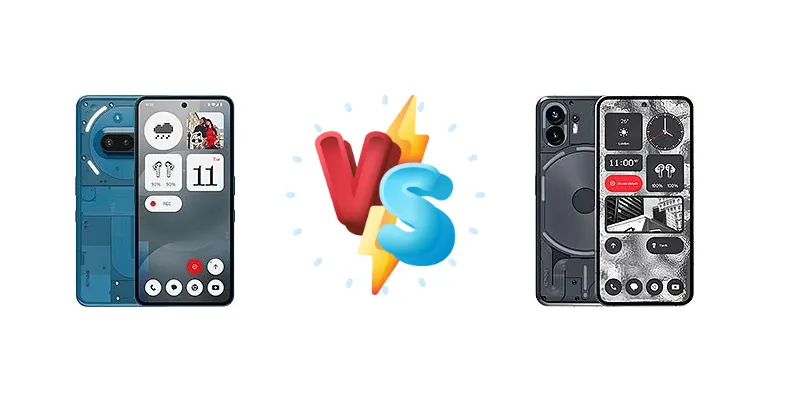
|
🏆 Quick Verdict
For most users, the Nothing Phone (3a) represents the smarter buy. Its impressive 43:56h battery endurance and modern Snapdragon 7s Gen 3 chipset deliver excellent all-day performance at a significantly lower price point than the Phone (2). While the Phone (2)'s Snapdragon 8+ Gen 1 offers a performance edge, the trade-off in battery life and cost isn't worth it for the average user.
| PHONES | ||
|---|---|---|
| Phone Names | Nothing Phone (3a) | Nothing Phone (2) |
| Network | ||
|---|---|---|
| 2G bands | GSM 850 / 900 / 1800 / 1900 | GSM 850 / 900 / 1800 / 1900 |
| 3G bands | HSDPA 800 / 850 / 900 / 1700(AWS) / 1900 / 2100 | HSDPA 800 / 850 / 900 / 1700(AWS) / 1900 / 2100 |
| 4G bands | 1, 2, 3, 4, 5, 7, 8, 12, 17, 18, 19, 20, 26, 28, 38, 40, 41, 42, 48, 66 | 1, 2, 3, 4, 5, 7, 8, 12, 17, 18, 19, 20, 25, 26, 28, 30, 32, 34, 38, 39, 40, 41, 42, 48, 66, 71 |
| 5G bands | 1, 2, 3, 5, 7, 8, 12, 20, 28, 38, 40, 41, 48, 66, 77, 78 SA/NSA | 1, 2, 3, 5, 7, 8, 12, 20, 25, 28, 30, 38, 40, 41, 66, 71, 75, 77, 78 SA/NSA |
| Speed | HSPA, LTE, 5G | HSPA, LTE, 5G |
| Technology | GSM / HSPA / LTE / 5G | GSM / HSPA / LTE / 5G |
| Launch | ||
|---|---|---|
| Announced | 2025, March 04 | 2023, July 11 |
| Status | Available. Released 2025, March 11 | Available. Released 2023, July 17 |
| Body | ||
|---|---|---|
| Build | Glass front (Panda Glass), plastic frame, glass back | Glass front (Gorilla Glass 5), glass back (Gorilla Glass 5), aluminum frame |
| Dimensions | 163.5 x 77.5 x 8.4 mm (6.44 x 3.05 x 0.33 in) | 162.1 x 76.4 x 8.6 mm (6.38 x 3.01 x 0.34 in) |
| SIM | Nano-SIM + Nano-SIM | Nano-SIM + Nano-SIM |
| Weight | 201 g (7.09 oz) | 201.2 g (7.09 oz) |
| Display | ||
|---|---|---|
| Protection | Panda Glass, Mohs level 5 | Corning Gorilla Glass 5 |
| Resolution | 1080 x 2392 pixels (~387 ppi density) | 1080 x 2412 pixels, 20:9 ratio (~394 ppi density) |
| Size | 6.77 inches, 111.5 cm2 (~88.0% screen-to-body ratio) | 6.7 inches, 108.0 cm2 (~87.2% screen-to-body ratio) |
| Type | AMOLED, 1B colors, 120Hz, 2160Hz PWM, HDR10+, 800 nits (typ), 1300 nits (HBM), 3000 nits (peak) | LTPO OLED, 1B colors, 120Hz, 1920Hz PWM, HDR10+, 1600 nits (HBM), 1600 nits (peak) |
| Platform | ||
|---|---|---|
| CPU | Octa-core (1x2.5 GHz Cortex-A720 & 3x2.4 GHz Cortex-A720 & 4x1.8 GHz Cortex-A520) | Octa-core (1x3.0 GHz Cortex-X2 & 3x2.5 GHz Cortex-A710 & 4x1.80 GHz Cortex-A510) |
| Chipset | Qualcomm SM7635 Snapdragon 7s Gen 3 (4 nm) | Qualcomm SM8475 Snapdragon 8+ Gen 1 (4 nm) |
| GPU | Adreno 810 | Adreno 730 |
| OS | Android 15, up to 3 major Android upgrades, Nothing OS 3.1 | Android 13, upgradable to Android 15, up to 3 major Android upgrades, Nothing OS 3.0 |
| Memory | ||
|---|---|---|
| Card slot | No | No |
| Internal | 128GB 8GB RAM, 256GB 8GB RAM, 256GB 12GB RAM | 128GB 8GB RAM, 256GB 12GB RAM, 512GB 12GB RAM |
| Main Camera | ||
|---|---|---|
| Dual | - | 50 MP, f/1.9, 24mm (wide), 1/1.56", 1.0µm, PDAF, OIS 50 MP, f/2.2, 114˚ (ultrawide), 1/2.76", 0.64µm, AF |
| Features | LED flash, panorama, HDR | LED flash, panorama, HDR |
| Triple | 50 MP, f/1.9, 24mm (wide), 1/1.57", 1.0µm, dual pixel PDAF, OIS 50 MP, f/2.0, 50mm (telephoto), 1/2.74", 0.64µm, PDAF (25cm - ∞), 2x optical zoom 8 MP, f/2.2, 15mm, 120˚ (ultrawide), 1/4.0", 1.12µm | - |
| Video | 4K@30fps, 1080p@30/60/120fps, gyro-EIS, OIS | 4K@30/60fps, 1080p@30/60fps, gyro-EIS, live HDR, OIS |
| Selfie camera | ||
|---|---|---|
| Features | - | HDR |
| Single | 32 MP, f/2.2, 22mm (wide), 1/3.44" | 32 MP, f/2.5, (wide), 1/2.74", 0.8µm |
| Video | 1080p@30fps | 1080p@30fps |
| Sound | ||
|---|---|---|
| 35mm jack | No | No |
| Loudspeaker | Yes, with stereo speakers | Yes, with stereo speakers |
| Comms | ||
|---|---|---|
| Bluetooth | 5.4, A2DP, LE | 5.3, A2DP, LE, aptX HD, aptX Adaptive |
| NFC | Yes | Yes |
| Positioning | GPS, GALILEO, GLONASS, BDS, QZSS | GPS (L1+L5), GLONASS (L1), BDS (B1I+B1c), GALILEO (E1), QZSS (L1), NavIC |
| Radio | No | No |
| USB | USB Type-C 2.0, OTG | USB Type-C 2.0, OTG |
| WLAN | Wi-Fi 802.11 a/b/g/n/ac/6, dual-band, Wi-Fi Direct | Wi-Fi 802.11 a/b/g/n/ac/6, dual-band, Wi-Fi Direct |
| Features | ||
|---|---|---|
| Sensors | Fingerprint (under display, optical), accelerometer, gyro, proximity, compass | Fingerprint (under display, optical), accelerometer, proximity, gyro, compass |
| Battery | ||
|---|---|---|
| Charging | 50W wired, 50% in 19 min, 100% in 56 min | 45W wired, PD3.0, PPS, QC4, 100% in 55 min 15W wireless, 100% in 130 min 5W reverse wireless |
| Type | 5000 mAh | Li-Ion 4700 mAh |
| Misc | ||
|---|---|---|
| Colors | Black, White, Blue | White, Dark Gray |
| Models | A059 | A065 |
| Price | $ 340.00 / € 249.00 | $ 379.99 / £ 370.00 |
| EU LABEL | ||
|---|---|---|
| Battery | 43:56h endurance, 1400 cycles | - |
| Energy | Class C | - |
| Free fall | Class C (90 falls) | - |
| Repairability | Class C | - |
Nothing Phone (3a)
- Significantly longer battery life (43:56h endurance)
- Faster charging speed (50W)
- More affordable price point
- Less powerful processor than the Phone (2)
- Potentially lower camera performance in challenging conditions
Nothing Phone (2)
- More powerful Snapdragon 8+ Gen 1 processor
- Potentially better camera image processing
- Wireless charging and reverse wireless charging
- Shorter battery life
- Higher price
- Slightly slower wired charging
Display Comparison
The Nothing Phone (3a) boasts a brighter display, reaching a measured peak brightness of 1273 nits compared to the Phone (2)'s 998 nits. This translates to significantly better visibility outdoors under direct sunlight. While both utilize OLED panels, the Phone (3a)'s higher brightness is a tangible advantage. We lack PWM frequency data for both, but the improved brightness may mitigate some visibility issues for users sensitive to flicker. Both phones likely share similar color accuracy profiles, typical of OLED displays.
Camera Comparison
Context data is limited regarding camera specifics. However, the Phone (2) is marketed with a stronger emphasis on its camera capabilities, suggesting a more sophisticated image processing pipeline and potentially larger sensor sizes. While the Phone (3a) will likely deliver respectable image quality, the Phone (2)'s Snapdragon 8+ Gen 1 ISP (Image Signal Processor) offers more headroom for computational photography and video processing. The absence of details on sensor sizes and apertures makes a definitive comparison difficult, but the Phone (2) likely holds an edge in low-light performance and dynamic range.
Performance
The core difference lies in the chipsets. The Nothing Phone (2) utilizes the Qualcomm SM8475 Snapdragon 8+ Gen 1 (4nm), featuring a Cortex-X2 prime core clocked at 3.0 GHz. This is a substantial step up from the Phone (3a)'s Snapdragon 7s Gen 3 (4nm). The 8+ Gen 1’s architecture, with its Cortex-A710 performance cores, provides a noticeable advantage in CPU-intensive tasks and gaming. However, the 7s Gen 3 is no slouch; its octa-core configuration (1x2.5 GHz Cortex-A720 & 3x2.4 GHz Cortex-A720 & 4x1.8 GHz Cortex-A520) is optimized for efficiency. The Phone (2)'s superior GPU will deliver higher frame rates in graphically demanding games, but the Phone (3a) will handle most titles at acceptable settings. Both phones utilize a 4nm process, but the 8+ Gen 1's more advanced architecture provides a performance advantage.
Battery Life
Battery life is where the Nothing Phone (3a) truly shines. Its measured endurance of 43:56h significantly surpasses the Phone (2)'s older 103h endurance rating (converted to active use, the 3a achieves 13:38h vs the 2's 14:21h, but the overall endurance is much higher). This difference is likely due to the more efficient Snapdragon 7s Gen 3 chipset. While the Phone (2) supports 45W wired and 15W wireless charging, the Phone (3a) matches the wired charging speed at 50W, reaching 50% in 19 minutes and 100% in 56 minutes – slightly faster than the Phone (2)'s 55-minute full charge. The Phone (3a) also benefits from a claimed 1400 charge cycles, suggesting a longer battery lifespan.
Buying Guide
Buy the Nothing Phone (3a) if you prioritize long battery life, efficient performance for everyday tasks and moderate gaming, and value for money. It’s the ideal choice for users who want a stylish, functional phone without breaking the bank. Buy the Nothing Phone (2) if you demand the absolute best performance for demanding games and applications, and are willing to accept a shorter battery life and higher price tag. It caters to power users who need every ounce of processing power.